Q&A: Friederike Otto assesses the role of climate change in extreme weather events

Heat waves. Wildfires. Floods. Friederike Otto studies such extreme weather events to untangle what is natural and what is due to climate change. She and Geert Jan van Oldenborgh founded World Weather Attribution more than a decade ago. Today the initiative—powered by a handful of postdocs and a thousand-strong network of volunteers around the world—releases its attribution results within a couple of weeks of extreme weather events. (For more on extreme-weather-event attribution, see PT’s 2023 article “Connecting extreme weather events to climate change ,” by Michael Wehner.)

Friederike Otto
(Photo by Peter Himsel.)
World Weather Attribution studies typically have multiple parts: What happened and what were the impacts? What was the role of climate change? And finally, looking forward, what adaptation actions would reduce the hazard for a future such event? The initiative, says Otto, has become much more professional over the past five years. “We have a team and some funding from the European Union and mostly from philanthropies.”
Otto earned her first degree, in physics, at the University of Potsdam in 2007 and a PhD in philosophy at the Free University of Berlin in 2011. She joined the faculty at Imperial College London in 2021 and became a professor in the university’s Centre for Environmental Policy last October. She also contributes to the Intergovernmental Panel on Climate Change (IPCC). She is motivated, she says, by wanting to show that “climate change is here and now and not something that happens somewhere else and sometime in the future.”
Why did you study physics?
I would have loved to do history, but my grades from high school were not high enough. In Germany, the more popular a course is, the higher your grades have to be to get in. My options were engineering and physics. Physics turned out to be a good choice.
Was there something that hooked you on physics?
I really enjoyed quantum mechanics, which is also why I ended up doing a PhD in philosophy.
How did you get into climate studies?
I chose climate physics as one of the subjects for which I would do an exam for my diploma. I learned a lot about climate models and ended up focusing on them for my PhD.
Where did your path take you after the PhD?
I applied to lots of postdocs in Germany, and I never even got short-listed. I applied to one postdoc outside Germany, at Oxford University. I ended up there, and I started studying extreme weather events.
How did you get into studying extreme weather?
Pretty much at the same time I started my postdoc, in 2011, two papers were published about the Russian heat wave of 2010. One of them concluded that climate change made the event five times more likely, and the other said it was mainly a natural event. My postdoc adviser, Myles Allen, who had pioneered one of the methods based on climate models to attribute extreme events, introduced me to Geert Jan van Oldenborgh, who had pioneered a different approach based on observations.
Geert Jan and I combined the two methods. We wrote a paper that basically reconciled the two papers. It showed that they were both right but were asking different questions. With that work, we started to establish the methodology that—with lots of variations and improvements—we are still using in World Weather Attribution.
Tell me how you started World Weather Attribution and how it works.
At the time, very few people were studying extreme weather. Usually, when an extreme event happened, scientists would not say anything in public about the role of climate change. When I was at the American Geophysical Union meeting in 2014, someone who worked for Climate Central, a US-based nonprofit, said to me, “Can you do this faster?” Geert Jan and I tried, and we decided yes, we could do it faster.
When you say faster, what time scales are you comparing?
We had worked on the normal peer-review time scale. A study may take six months, but by the time the results are published, a year and half or so later, people have long forgotten the particular event. Faster means within a week or two.
What makes it possible to be faster?
We have a large network of collaborators around the world who can quickly help us define an event. And we have a clear breakdown of the steps. First, you need to figure out what happened and how to define the event. For a heat wave, for example, what’s the region? What variables should we look at? Over what time frame? And so on. That takes time and expertise. The next step is to look at the observational data and look for trends. Are the number or intensity of these events changing over time?

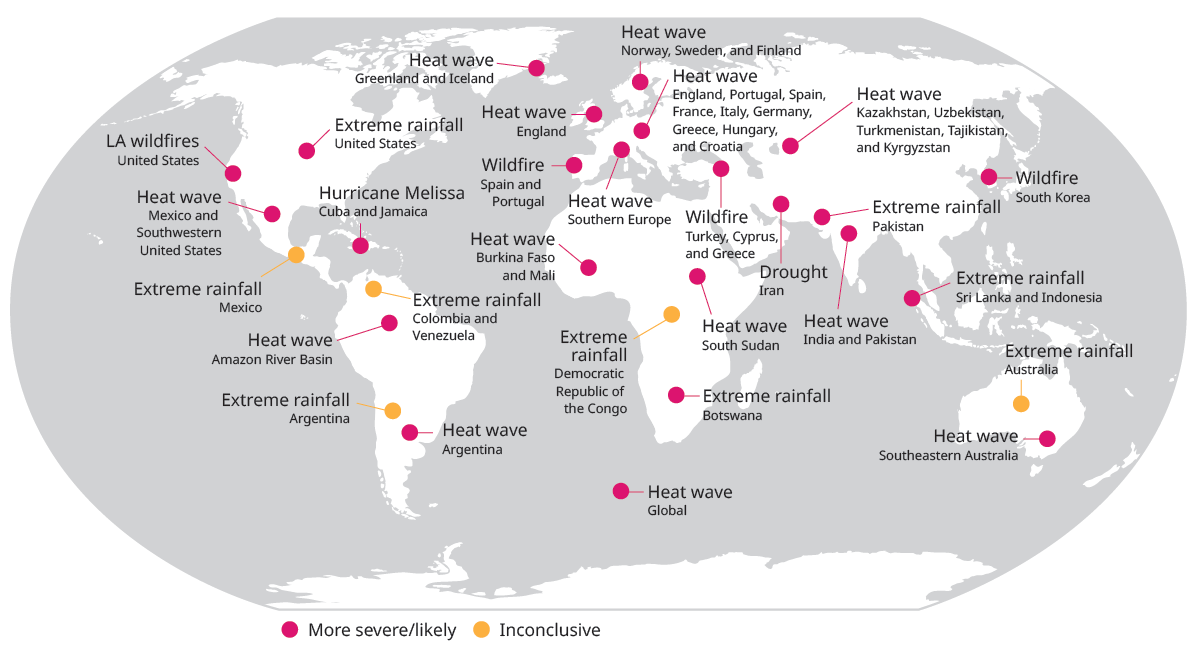
World Weather Attribution researchers found that climate change increased the severity and/or likelihood of most of the 28 extreme weather events it analyzed last year.
(Image adapted from World Weather Attribution using a map by iStock.com/katykin.)

Then you do an attribution analysis. For that, you use climate models or statistical modeling to compare the events for the climate we live in today with an assumption of the same events in a world that is, now, 1.4 degrees Celsius cooler. Would the occurrence frequency or intensity have changed? You might find that in today’s climate, it’s a 1 in 10-year event, but that in a world without climate change, it’s a 1 in 100-year event. Because the only difference in the models is global warming or the increase in greenhouse gases, you can then say that the event has become 10 times more likely because of climate change.
How many events do you analyze a year, and how do you select them?
We have developed a trigger methodology, together with the Red Cross, that is based on humanitarian impact. For each type of hazard, we have different criteria. For flooding, for example, if more than 100 people lost their lives or more than a million people were affected, or a state of emergency was declared, then we consider the event.
With that method, 3 to 12 events trigger per week, and every Friday, the team discusses them and makes a decision. Do we have the people power available? If an event is in a region that has not been studied much, or if it’s a type of hazard for which we don’t have much evidence, we give it priority.
We aim to do 20 events a year. For most of them, climate change is a significant factor: In 2024, it was in 25 out of 30 events, and in 2025, it was 23 out of 28.
Have you had pushback?
Surprisingly little. Our results have been reported accurately by a broad spectrum of the media. There was some resistance in the scientific community when we started. People said we can’t bypass peer review.
After announcing our findings quickly, we subsequently write papers that are peer reviewed so they will stand the test of time. And when we do something new method-wise, we write a paper and put it to peer review so that our methods have credibility.
Do you see impact?
Together with the Red Cross, we look at drivers of vulnerability and hazard and ask what those drivers mean for adaptation. For a recent wildfire study in Patagonia, for example, we said that to prevent wildfires, invasive pine trees need to be reduced. We try to be detailed, but it depends how fast we do things and how many local collaborators we have on the team.
Another good example of adaptation is the heat-wave action plans that Germany introduced in 2023. Our studies were used in a debate in parliament. But it’s always hard to know what is because of our input versus other factors.
We always hold a press briefing so that the media can ask questions and we can explain the results. For some studies, we do policy briefings.
How do you juggle that work with your professor duties?
I probably teach less than some professors because my work on World Weather Attribution buys out some of my teaching time. I also work with legal scholars on how to translate scientific evidence into legal evidence and, with an expert in Kenya, I cosupervise a graduate student on heat and health. I have another graduate student who looks at climate change from an economics point of view.
What is your involvement in the IPCC?
For the sixth assessment, published in 2021, I was a lead author on the chapter on extreme events and I worked on the synthesis report. It’s quite empowering to be able to bring your expertise to policymakers. And you get to know a lot of people from around the world. Now I’m coordinating lead author on regional climate change and extreme weather for the seventh assessment.
I would like to see people act on the evidence of global climate change. Working on the IPCC is one way to try to make that happen. World Weather Attribution is another.