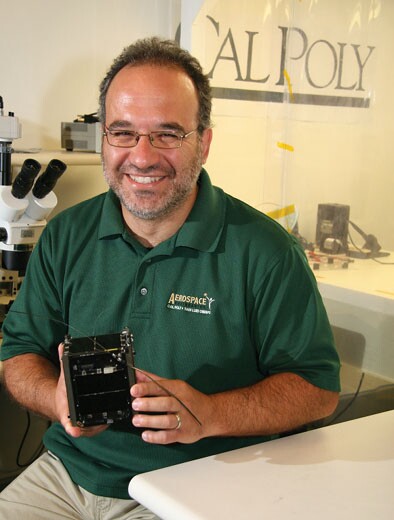
How can students participate in satellites, from building to launching to communicating with their orbiting experiments? That challenge brought Bob Twiggs and Jordi Puig-Suari together in 1998. At the time, Twiggs was running a satellite program for graduate students in Stanford University’s aeronautics and astronautics department and Puig-Suari was getting a similar program, mainly for undergraduates, started at California Polytechnic State University.
They developed the CubeSat, a 10 × 10 × 10 cm3 box in which a user can send nearly anything into space. The boxes are stackable. Most CubeSats consist of one unit, but some are two or more units long.
Jordi Puig-Suari CREDIT: Cal Poly
Twiggs and Puig-Suari also designed the Poly-Picosatellite Orbital Deployer, or P-POD, to make it easy to fly piggyback on large rockets. Their efforts became the unofficial standard for nanosatellites. “Once we had that first launch in the US, everything exploded,” says Puig-Suari. In other words, more and more people, companies, and countries are deploying CubeSats. (See Physics Today, November 2014, page 27.)
Now that CubeSats have really taken off, Puig-Suari is trying to straddle academia and industry. He remains at Cal Poly, but is also heavily involved in Tyvak, a spin-off company he cofounded that builds advanced CubeSats and interfaces between CubeSat builders and rocket launchers.
Bob Twiggs. CREDIT: Kentucky Space
Twiggs retired from Stanford in 2008 but, he says, “I got tired of being retired.” He is now at Morehead State University in Kentucky, where he is developing an even smaller satellite and getting involved in microgravity experiments that students can fly on their tiny satellites.
Physics Today crossed orbits with the CubeSat developers this fall.
PT: How did you get into the satellite game?
TWIGGS: When I got out of high school, I didn’t really have any idea of what I wanted to do. Four years in the Air Force as an electronics technician gave me a background in electronics, which I liked, so then I majored in electrical engineering at the University of Idaho.
I accepted a job at a company in Silicon Valley that made microwave amplifiers, and got a master’s at Stanford while I was there. Later, I moved to Ogden, Utah, where I wrote software for TRW and started teaching at Weber State University. While I was there, a guy from Morton Thiokol wanted a meeting with faculty to talk about a project. He said, we’ve got this idea, and we have a guy from the FAA [Federal Aviation Administration] that wants to build a satellite.
So industry guys along with faculty and students ended up building a satellite that went on the Challenger in 1985. We built it in two years, with a bunch of guys who didn’t know how to build satellites, and it worked. It was built to look for signals from FAA radars. It turned out that because of some interface problems, it didn’t do that. But the one thing it did do is it kind of restarted the idea of a small satellite program. In the beginning, satellites were small. But as rockets got bigger, satellites got bigger and more expensive and took longer to build.
PUIG-SUARI: I was always interested in rockets and airplanes and things that go fast. In school I got more interested in the space side of things. I grew up in Barcelona, Spain, at a time when they were not doing anything related to aerospace. I ended up at Purdue University. I did my bachelor’s, master’s, and PhD there. That was never in the plan. The plan was always to go work at a company after getting my bachelor’s, but we were doing interesting things and it was fun, so I kept going.
That led me to my first job as a professor, at Arizona State University [ASU]. After four years I moved to Cal Poly to start a space program. The university’s motto is “learn by doing.” We were trying to figure out how we could follow that philosophy in space. I was skeptical, because my experience at ASU said this is something that takes a long time—students would graduate before they would see the spacecraft.
Through one of our students, I made a connection with Bob. We realized that we had the same problem, that building student satellites was an issue, that the timelines didn’t work, and finding a launch was very difficult. So we got the idea of let’s make them smaller, let’s make them simpler, let’s figure out how to protect the primary so they will give us launches.
PT: What does “protect the primary” mean?
PUIG-SUARI: Nobody wanted to launch student satellites, because they are high risk. If the student satellite breaks, it could break the main payload or the launch vehicle.
So that’s where the idea of “let’s encapsulate the satellites in some way to protect the primary” came from. That’s where the P-POD came from.
PT: By encapsulate, you are referring to what became the CubeSat box? And the P-POD can be attached to any rocket; it carries and ejects the CubeSats, correct?
PUIG-SUARI: Yes. The P-POD is just a jack-in-the-box. A spring pushes the satellites out.
Our other idea was to make them truly small. The key to teaching students was not necessarily a fancy mission. We were trying to teach them processes. How do you build space-quality hardware? How do you test it? How do you integrate it into a vehicle for launch? Our mission was education. All we cared about was teaching.
TWIGGS: Most of the students I worked with were master’s degree students. They were there for one year, and then they graduated. New ones would come in and change this and add that. I kind of came to the conclusion that two things were impeding the program: Size and size. If I could make it small, maybe they wouldn’t put so much in, and if it were small, then perhaps we could afford to get launches.
I worked with Jordi to build a launcher that would hold three CubeSats. It came out around 1999, and we finally got it all together and the first ones were launched in 2003.
PT: You started CubeSats with students in mind.
PUIG-SUARI: Initially, it was an interesting separation of environments. Academia had reason to do it, and we were getting a lot of flak from industry, JPL [NASA’s Jet Propulsion Laboratory], and NASA. They said we were creating something which is way too small. But for educational purposes, we just wanted to build a Sputnik. We are talking about a very simple thing. A radio that beeps, that’s it. So a small satellite was all we needed to teach students. Universities were flocking to the idea.
The dimensions—that is, building a small satellite—were interesting. But the revolution was the standardization, the idea that you can launch easily and cheaply, and use commercial, off-the-shelf electronics.
PT: Was the idea from the start to create a standard?
PUIG-SUARI: Yes. It was difficult convincing people there was a value in standardizing things. Outside of the size, the standard is not rigid—you can do whatever you want. But now everybody understands what a standard does for you, and why it’s beneficial.
PT: How did CubeSats go from being purely for students to attracting interest from space agencies and companies around the world?
PUIG-SUARI: We created this standard, we had designed the P-POD, and we thought we had something that would work. And then we started looking for launches. In the US, nobody wanted to touch it.
It’s something you stick on the side of the rocket. It adds risk. People were cautious.
So we decided to try Russia. Cal Poly decided it was okay to try, and they had to register with the State Department as an arms dealer. We called the State Department and told them we wanted to launch 14 satellites from Russia in a year and a half. They said, “You’re crazy.” But when we told them these are university satellites, and the package is about 20 kilos, they said, “This is interesting, tell us more.” The process was much easier than we thought it would be. The first launch was in 2003. The second was in 2006. All of the sudden, NASA called us and said, “We want to use the deployer you guys demonstrated in Russia.” It was a complete sea change.
For example, now NASA has the ELANA [Educational Launch of Nanosatellites] initiative, which launches university payloads. And when NSF put out their first call for proposals in 2008, they told me they expected to get a few proposals, with a couple that were really interesting. But what happened was, they got over 25 proposals, and there were a couple that were not interesting.
PT: The CubeSat and the P-POD are now in wide use. Did you patent them?
PUIG-SUARI: No. It’s completely open source, and I think that’s one of the reasons it’s successful. If we had tried to make a profit out of the standard, we would have failed.
We spent a lot of effort qualifying the box. We published the standard and said, “This is what the box will fit. Go build satellites.” It was a total grassroots effort. The vision was always that it didn’t matter what launch vehicle you use, so long as it fits the box, and for the launch vehicle, it doesn’t matter what the satellites are; as long as they are inside the box, they won’t bother you.
TWIGGS: We are going the same route with the PocketQube—no patent. If you want to promote them, you really can’t patent them, that really slows things down.
PT: What’s the PocketQube?
TWIGGS: A lot of people complained that there was not enough room in a CubeSat, so I thought, why don’t we take it a step down, and maybe they’ll leave us alone.
PT: So your motivation for making an even smaller satellite was for students to be able to build and launch them without having NASA breathing down your neck?
TWIGGS: That’s true. We are hoping that if you paid $120 000 for a 1U CubeSat, and you have eight PocketQubes, you are down to one-eighth of $120 000, a reasonable number that maybe a university or even a high school can afford. If we cut it right, then we can make eight PocketQubes out of a CubeSat.
The other thing is what we put in the PocketQube. We use electronics that you would never think would work. The total cost of the electronics in a PocketQube is less than $250 and with solar panels it’s still less than $500 total. So we are paying $500 compared to $50 000–$100 000 for a CubeSat.
PT: What are you each focusing on now?
PUIG-SUARI: I have entered this new venture with Tyvak. We want to focus on commercial capability and creating infrastructure to really push the envelope on what you can do with a CubeSat. One of the things we are trying to do is to follow the mindset of the commercial electronics industry, and become more customized, more integrated, more multifunctional, so you can do almost all the functions of the spacecraft on a single board. If you want to increase the performance of CubeSats, you need to make room for the payload.
Next year I will be on leave from Cal Poly working at Tyvak. As an academic, as a teacher, I am spending some time on that side of the fence, because if we want to train these professionals of the future, they need to be ready for these kinds of space companies, as well as for the traditional industry. For the next year I am doing that, and then I will see. I think there is a huge benefit to balancing those two worlds.
TWIGGS: I have been around satellites—CubeSats, PocketQubes—for so long. They are still a thrill, but I really want to push microgravity research. Processes in microgravity are different than here on Earth with gravity. For example, they’ve shown that stem cells grow 8 to 10 times as fast in microgravity as they do on Earth. There is a real need to produce large quantities of stem cells for medical purposes. And a big question is, what happens to cancer cells in space? If they grow faster, then we could do experiments at a faster rate. If they grow slower, maybe what you want to do is send people to space to retard the cancer growth while you have an opportunity to try and cure them.
We could put microgravity experiments in satellites, and we could actually eject capsules so they reenter and you catch them. We’re talking to FedEx, because FedEx has got all those small airplanes. We’re saying, “Come on guys, you can catch stuff in space with those!” It’s really exciting stuff, going back to old technology, but for a whole different purpose. Let’s say we were producing stem cells, and I want to harvest them every two weeks. Maybe I can do it with this capsule system.
PT: Were you surprised by the success of CubeSats?
PUIG-SUARI: If you had asked me 10 years ago, I would have told you my wildest hope is that we would have a few universities launching a couple of CubeSats every year. I had no idea what was coming. And my guess is that we have no idea what is coming in the next years.