Tiny oscillating circuit exhibits new quantization of electrical conductance
DOI: 10.1063/1.2364227
If quantum computers , molecular memories, and other futuristic devices for handling quantum information are to work, physicists and engineers will need rules for building the underlying circuits. And because quantum coherence is so fragile and fleeting, those rules should hold at high frequencies.
A team from École Normale Supérieure in Paris has just reported experimental evidence that supports one such rule. 1 Conceived 13 years ago by Markus Büttiker, Anna Prêtre, and Harry Thomas, the theoretical rule gives the impedance of an RC circuit when the circuit is small and cold enough for the electrons to act coherently and clean enough for the electrons to travel ballistically. 2
Jean-Marc Berroir, Christian Glattli, and Bernard Plaçais led the Paris team. Their experiment confirms one of the theory’s most striking predictions: When a resistor and capacitor are coupled, the conductance is quantized in units of 2e 2/h. An outwardly similar quantization was discovered in DC circuits in 1988. 3 However, Glattli and Büttiker believe the quantized AC conductance is fundamentally different from its DC counterpart and from the quantized conductance in the quantum Hall effect. As such, it’s a new and distinct quantization in mesoscopic electronics.
Out of the theory
The theoretical origin of quantized AC conductance lies in a paradigm-setting 1957 paper by Rolf Landauer. 4 Landauer realized that scattering theory provides a natural and effective way to understand how electrons move in small, cold, clean circuits. According to Landauer, conductance is the manifestation of the probability that electrons—more precisely, their wavepackets—bounce off or pass through constrictions on their way around a DC circuit.
Landauer’s paper languished after publication. But by the 1980s, experimenters were making devices in which electrons traveled coherently and ballistically. Theorists became interested, too. Then, in 1988, two independent groups—a British group at the University of Cambridge and a Dutch collaboration from Philips Research Laboratories in Eindhoven and Delft University of Technology—made a startling discovery: The conductance of a coherent DC circuit is quantized in units of e 2/h. (The online version of this story links to the original Physics Today report from November 1988, page 21 .)
In their respective experiments, the British and Dutch groups used the then-new quantum point contact. A QPC consists of two closely spaced electrodes deposited on top of a semiconductor heterojunction. At the junction itself, the band structures of the two semiconductors bend to meet each other in such a way that the bottom of the conduction band falls below the Fermi energy. The result is a thin layer that conducts electrons in the plane of the junction like a metal: a two-dimensional electron gas (2DEG).
The electrodes are sharp and point toward each other. Putting a strong negative voltage on both of them clears electrons away from the region between the electrodes and pinches the 2DEG in two. Easing the voltage lets the two parts of the 2DEG reconnect through a narrow channel. When the electron wavelength and channel width are comparable, electrons can’t squeeze through the QPC without meeting Landauer-style resistance. Because its width is the only source of resistance, a QPC is the simplest resistor of all.
Experimenters and theorists saw in the QPC a vessel for exploring the physics of electron transport on scales and at temperatures for which the size of the electron’s wavepacket matters. One of the first lines of QPC research to be developed concerns charge noise—fluctuations in current caused by the discreteness of the charge carriers. (See Henk van Houten and Carlo Beenakker’s article “Quantum Point Contacts,” Physics Today, July 1996, page 22 .)
Büttiker wondered how charge noise behaves in the AC regime, but he realized he couldn’t analyze the problem without first understanding the current itself. In the early 1990s, with Prêtre and Thomas, he analyzed a simple coherent circuit: a QPC coupled with a single capacitor.
The theorists followed Landauer’s scattering-theory approach, but also required that the electrons satisfy Poisson’s equation, which relates electric potential to charge distribution. To handle the impedance, they split the capacitor into two components: a constant classical capacitor, whose capacitance arises from its geometry, and a phase-dependent quantum capacitor, which is coupled coherently with a QPC.
Landauer’s successors had shown that for each spin orientation, the conductance through a QPC-like channel is a sum of terms proportional to e 2/h. The terms correspond to waveguide modes; the wider the channel, the more modes are transmitted and the higher the conductance.
Büttiker, Prêtre, and Thomas found a different result. In the AC regime, the main effect of widening the QPC is not to transmit more modes, but to let more electrons enter the capacitor, where they linger before exiting with a phase-dependent probability. The QPC’s conductance is the product of a new conductance quantum 2e 2/h and the squared mean dwell time divided by the mean squared dwell time 〈τ〉2/〈τ 2〉, where τ is the mode-dependent time an electron spends in the capacitor.
Into the lab
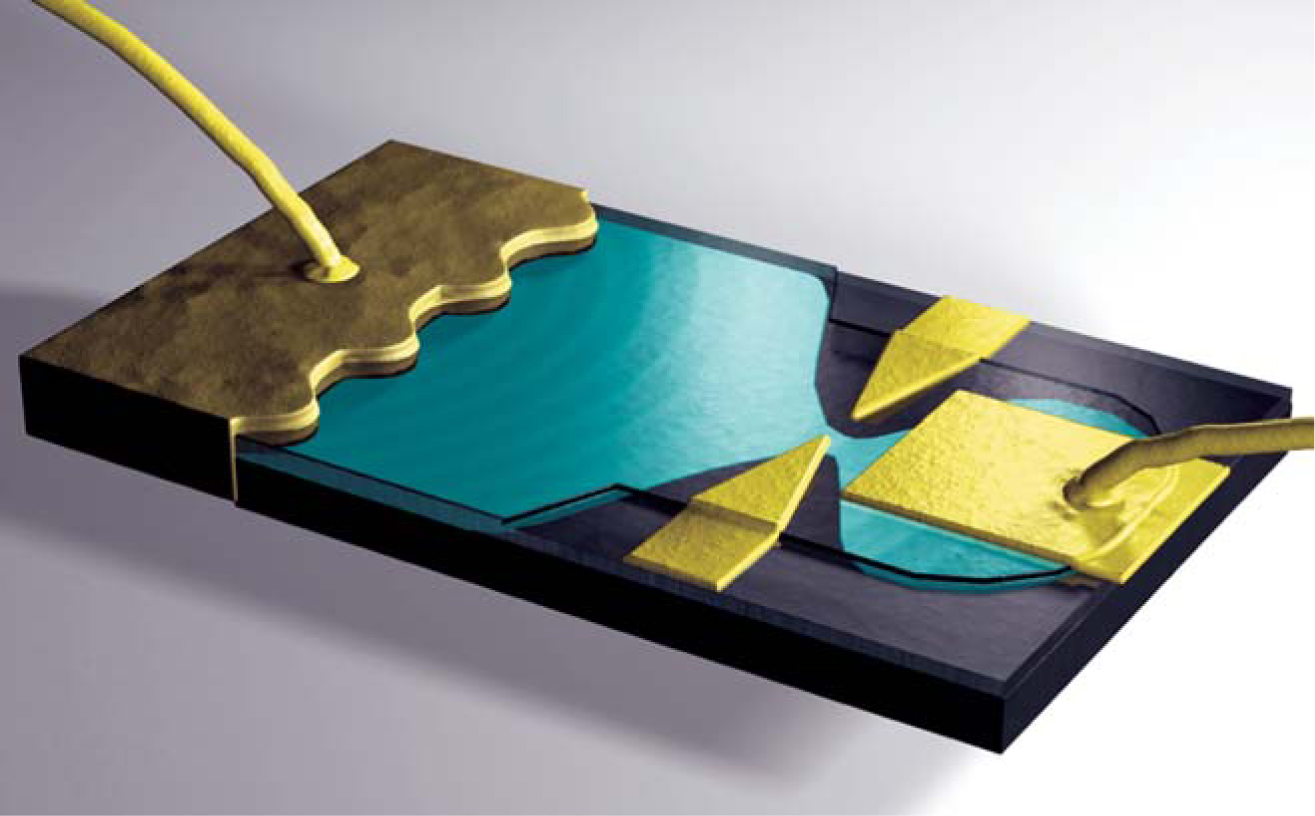
To probe the quantum state of mesoscopic devices, experimenters are increasingly turning to high frequencies. (See Physics Today, March 2006, page 16 .) With the aim of characterizing AC transport on the mesoscale, Julien Gabelli and other members of the Paris team designed, built, and ran the device shown schematically in figure 1.

Figure 1. The coherent RC circuit used in the Paris group’s experiments is based on a two-dimensional electron gas (blue) that occupies the interface between a layer of gallium arsenide (black) and the layer of aluminum gallium arsenide above it (gray). A pair of pointed, negatively charged surface electrodes pinch the 2DEG to form a quantum point contact. To the right of the QPC is the capacitor, whose plates consist of a quantum dot and a surface electrode. To the left of the QPC is an electrode (brown) that makes ohmic contact with the 2DEG. The wires that sprout from the capacitor’s electrode and the ohmic contact connect to the gigahertz power supply and the measuring equipment.
(Adapted from ref. 1.)

Like the circuit analyzed by Büttiker, Prêtre, and Thomas, the Paris device consists of a QPC coupled in series with a capacitor. At one end of the device, a quantum dot corrals part of the 2DEG and acts as one plate of the capacitor. A surface electrode above the dot acts as the other plate. At the other end of the device, an electrode makes ohmic contact with the rest of the 2DEG. Applying an AC voltage between the capacitor’s electrode and the ohmic contact completes the circuit.
The Paris researchers made three devices. In their paper, they present measurements from two of them, named E1 and E3, which differ in the size of the QPC. The heterojunctions measure 1.5 × 1.0 × 0.3 µm3 and the experiments ran at frequencies around 1 GHz and a temperature of 30 mK.
For the simplest and most direct comparison with theory, the Paris group applied a 1.3-T magnetic field. The field not only lifts the spin degeneracy of the electrons, but also pushes the electrons to the edges of the quantum dot, making the transport effectively 1-dimensional and single-mode.
The experiment measures admittance (the inverse of impedance and the AC analog of conductance). Extracting the QPC’s conductance from the admittance involved two main steps. First, the Paris group adapted Büttiker, Prêtre, and Thomas’s general theory to model a QPC coupled with a quantum dot. Doing so resolved the contributions to the impedance of the QPC and the coherent component of the capacitance. Second, to complete the connection from theory to measurement, the group calibrated the device’s total capacitance.
In the model, the quantum dot has equally spaced energy levels; electrons that enter the capacitor obey Fermi–Dirac statistics; and transmission through the QPC occurs in one mode. Although the model omits electron–electron interactions, it can reproduce the measured admittance fairly well.
To calibrate the total capacitance, the experimenters took advantage of a technique called Coulomb blockade spectroscopy. At low temperatures and voltages, an electron can tunnel across a capacitor. Once across, it repels other electrons that might join it. Raising the voltage overcomes the so-called Coulomb blockade, which, in a plot of differential conductance versus voltage, appears as a sequence of peaks.
The peaks flatten with rising temperature, whereas their spacing remains inversely proportional to the capacitance. Plotting the peak width for a range of temperatures yields the total capacitance and makes it possible to derive the QPC resistance R q from the measured admittance.
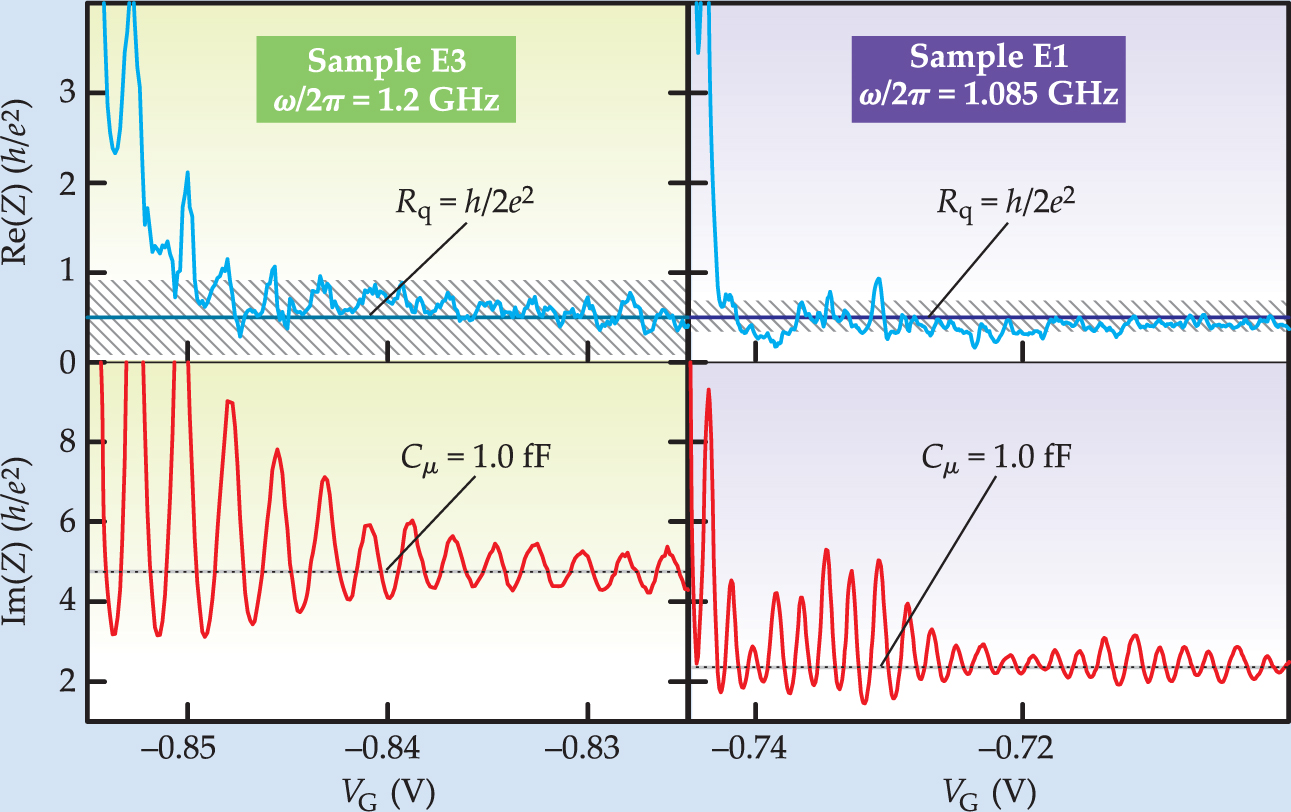
The results for samples E1 and E3 appear in figure 2. Because only one mode is present, 〈τ 2〉/〈τ〉2 = 1 and R q should be constant and equal to h/2e 2 for both samples, despite the size difference. Within experimental uncertainties, that prediction appears true. And R q is clearly not equal to Landauer’s DC value, which is twice as big.

Figure 2. Experimentally derived impedance for two different samples, E1 and E3, is plotted here in units of the Landauer resistance quantum h/e 2. Upper panels: When V G, the voltage across the QPC, is strongly negative, the QPC barely transmits electrons; its resistance, which corresponds to the real part of the impedance Z, is high. But at less negative voltages, the QPC opens and Re(Z) adopts a best-fitting value of h/2e 2 for both samples. The hatched region indicates the range of uncertainty in the data. Lower panels: Im(Z) arises from the total capacitance C µ , whose value is derived from Coulomb blockade spectroscopy and indicated by the dashed lines.
(Adapted from ref. 1.)

Kirchhoff’s laws
The Paris team titled their paper “Violation of Kirchhoff’s Laws for a Coherent RC Circuit.” Physicists accustomed to quantum weirdness don’t expect Gustav Kirchhoff’s venerable laws to apply when electrons behave like waves. But the laws’ coherent counterparts could prove as useful.
The Paris group’s micron-sized heterojunctions run coherently at millikelvin temperatures. But on the nanometer scale of individual molecules and carbon nanotubes, electron conduction is coherent at the relatively accessible 77 K of liquid nitrogen. If the era of molecular electronics arrives, physics and engineering students may have to learn another set of laws for combining resistors, capacitors, and other circuit elements.
References
1. J. Gabelli, G. Fève, J.-M. Berroir, B. Plaçais, A. Cavanna, B. Etienne, Y. Jin, D. C. Glattli, Science 313, 499 (2006) https://doi.org/10.1126/science.1126940 .
2. M. Büttiker, A. Prětre, H. Thomas, Phys. Rev. Lett. 70, 4114 (1993);
A. Prětre, H. Thomas, M. Büttiker, Phys. Rev. B 54, 8130 (1996).3. B. J. van Wees et al., Phys. Rev. Lett. 60, 848 (1988); https://doi.org/10.1103/PhysRevLett.60.848
D. A. Wharam et al., J. Phys. C 21, L209 (1988) https://doi.org/10.1088/0022-3719/21/8/002 .4. R. Landauer, IBM J. Res. Dev. 1, 233 (1957) https://doi.org/10.1147/rd.13.0223 .