Stretchable Conductors Help Clear the Path to Skinlike Large-Area Devices
DOI: 10.1063/1.1603068
“Sensitive skin” is the delicate name for a visionary technology: thin flexible large-area sensor arrays. With sensitive skin, one could endow robots with the information-gathering tools they need to work in unstructured environments; one could clothe heart patients with shirts that monitor arrhythmia; one could equip food handlers with gloves that detect spoiled meat. The applications of sensitive skin are many, varied, and—unfortunately—out of reach.
The applications remain visions, but not because scientists and engineers can’t make suitable sensors or flexible substrates on which to put them. Stretchable fabrics and materials have been around for years. And sensors, like the sequins on an ice skater’s costume, can be made small enough that they’re unaffected when a substrate bends, twists, or stretches.
But sequins, unlike the sensors on sensitive skin, don’t need conducting interconnects to function. Pulling on a glove, for example, involves deforming the material by 10% or more, but metal wires and thin films rupture at strains of a few percent. Conducting polymers, such as polyacetylene, can’t do the job because they don’t conduct electricity well enough.
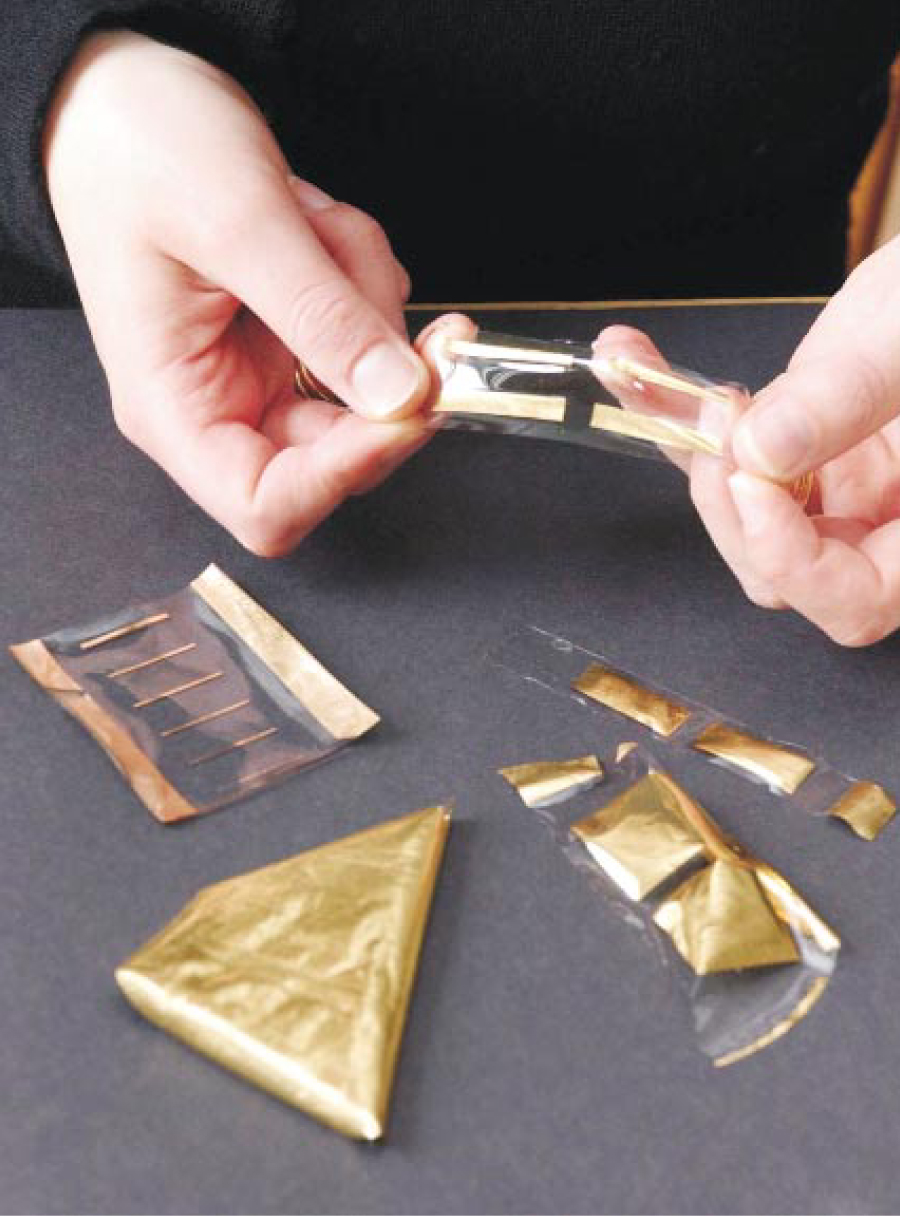
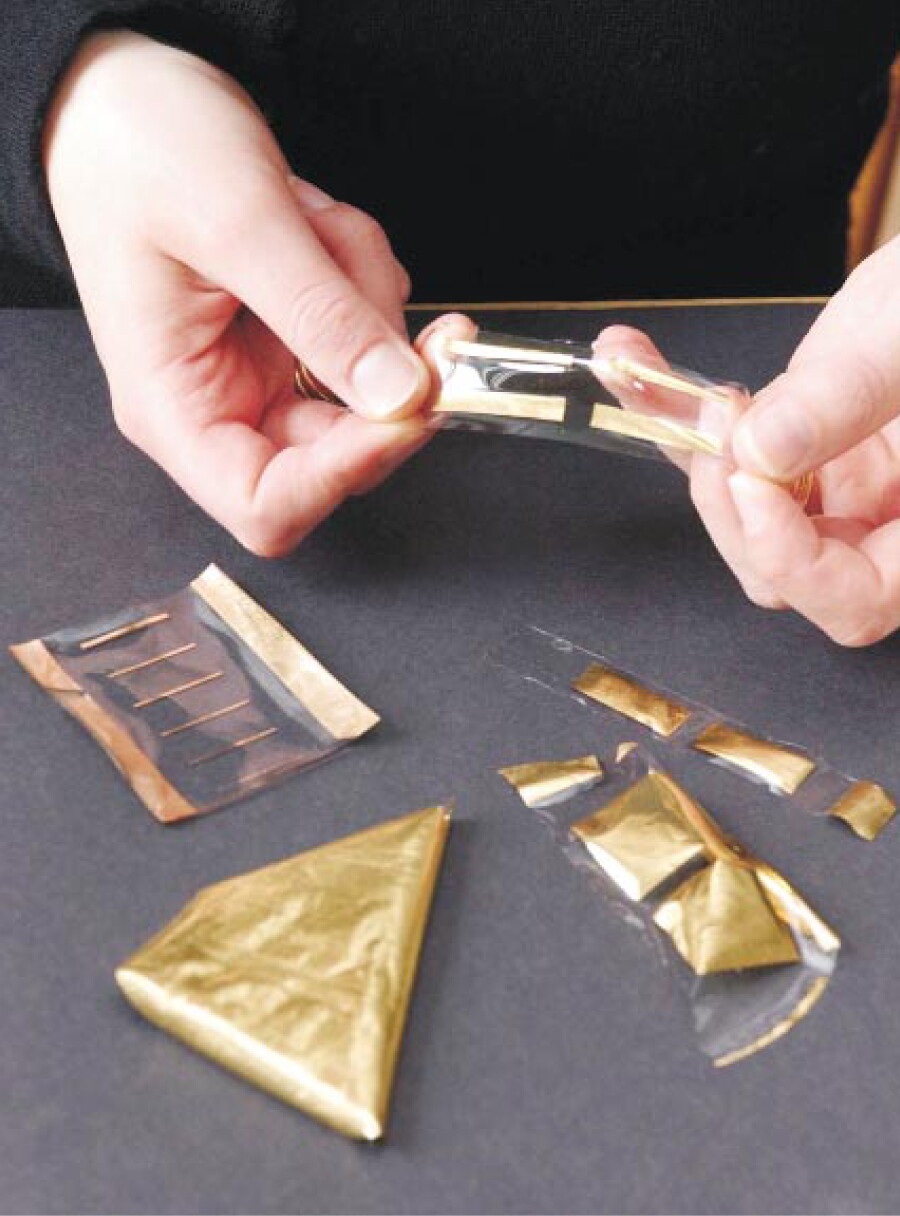
Now, a team of four engineers from Princeton University has found a way to deposit stretchable interconnects on a flexible substrate. 1 Shown in figure 1, the metal films developed by Sigurd Wagner, his postdoc Stéphanie Périchon Lacour, and their colleagues Zhigang Suo and Zhenyu Huang, continue to conduct even when subjected to tensile strains of 40%.

Figure 1. Stéphanie Lacour demonstrates the flexibility of the stretchable conductor she developed with Princeton University’s Sigurd Wagner, Zhenyu Huang, and Zhigang Suo.
(Courtesy of Lacour.)
Necking
To appreciate why it’s so difficult to make flexible metal interconnects, consider what happens when tensile stress is applied to a metal wire. Unlike a rubber band, which responds to stress by stretching evenly, a metal wire develops a local deformation—a neck—that bears almost all the stress. As the stress increases, the neck thins, lengthens by a factor of two or more, then breaks when the strain of the whole wire reaches a few percent. Thin metal films rupture in the same way.
When Wagner began his quest for stretchable interconnects three years ago, his main working idea was to add slack. He tried various schemes, including stripes that zigzag over the substrate rather than run straight. They didn’t work, but in the course of his investigations, he noticed that gold, when deposited in a thin layer on silicone rubber, develops a surface pattern like the ridges and fissures of a human brain.
Puzzled by the patterns, Wagner consulted his collaborator Suo, who pointed to a 1998 paper by Harvard University’s Ned Bowden and others. 2 Bowden, who’s now at the University of Iowa, had discovered that gold forms similar patterns on an elastomeric silicone called polydimethyl-siloxane (PDMS). To make the patterns, Bowden heated the PDMS surface before and during the deposition process. When it cools, the PDMS, thanks to its larger coefficient of thermal expansion, compresses the gold layer, causing both the substrate and the layer to wrinkle together. Here, Wagner realized, was a simple method for adding slack—in the form of built-in compressive strain—to a thin metal layer.
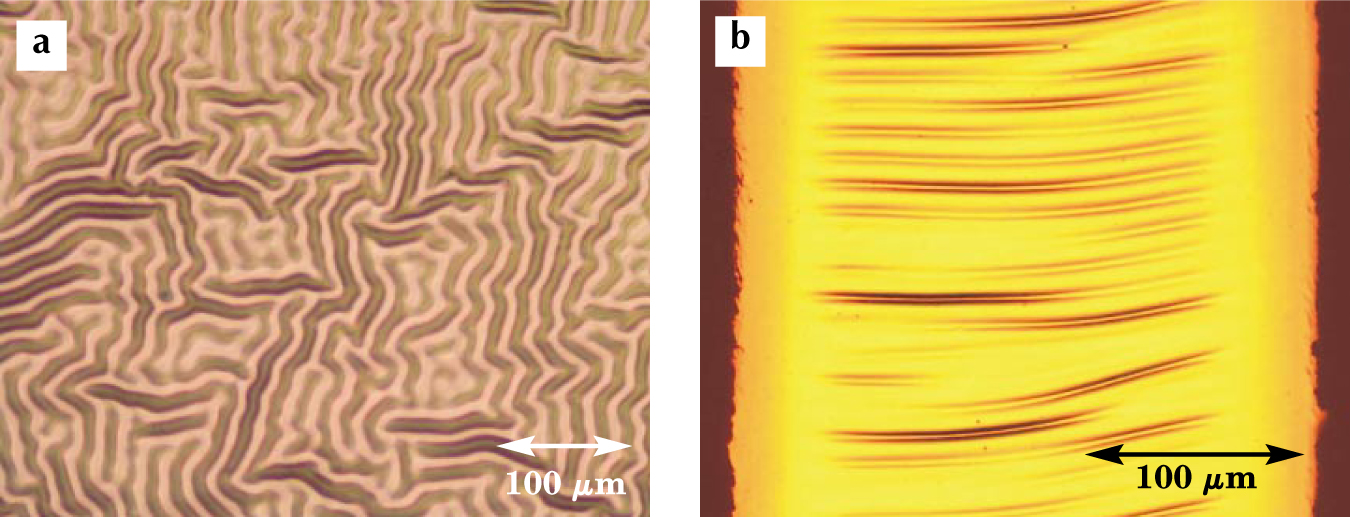
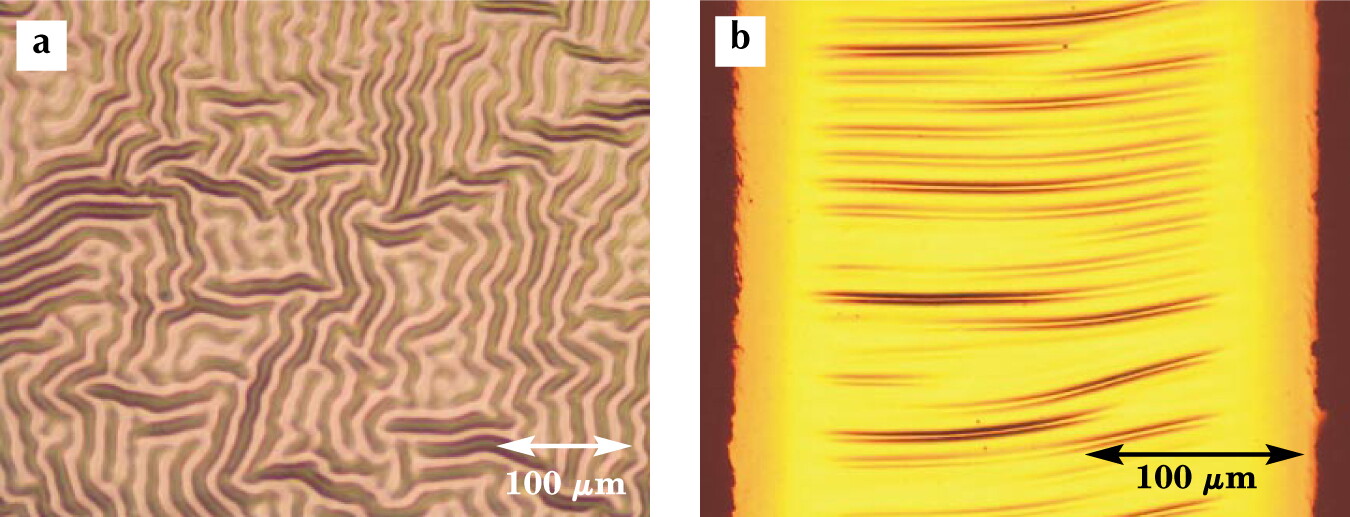
The project to exploit the wrinkling took off when Lacour joined Wagner’s lab in 2001. She found she could modify the gold layer’s waviness by depositing the gold in thin stripes through a mask. Obligingly, as figure 2 shows, the wrinkles line up across the stripe—just the arrangement for acting as a source of built-in compressive strain along the length of the stripe.

Figure 2. Gold deposited on silicone develops a wavy, wrinkled pattern because the silicone has a greater coefficient of thermal expansion than does gold. (a) On large areas, the wrinkles run in all directions. (b) But in stripes, the wrinkles line up perpendicular to the direction of the stripe.
(Adapted from ref. 1.)
To investigate the stripes’ performance, Lacour made samples like the one shown in figure 1. The samples consisted of roughly 1-mm-thick strips of PDMS topped with gold stripes 100 nm thick and 250 µm wide. A 5-nm underlayer of chromium helped the gold stick to the PDMS. Her experimental setup consists of a homemade microtensile tester for stretching the samples, meters for measuring resistance and elongation, and a video camera attached to a microscope for observing the samples.
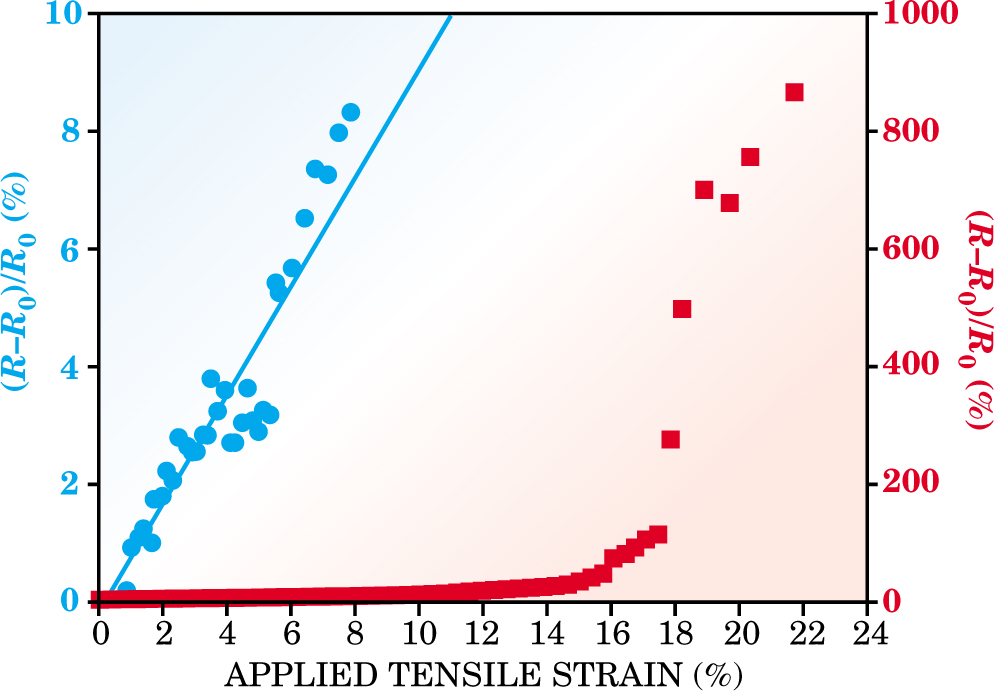
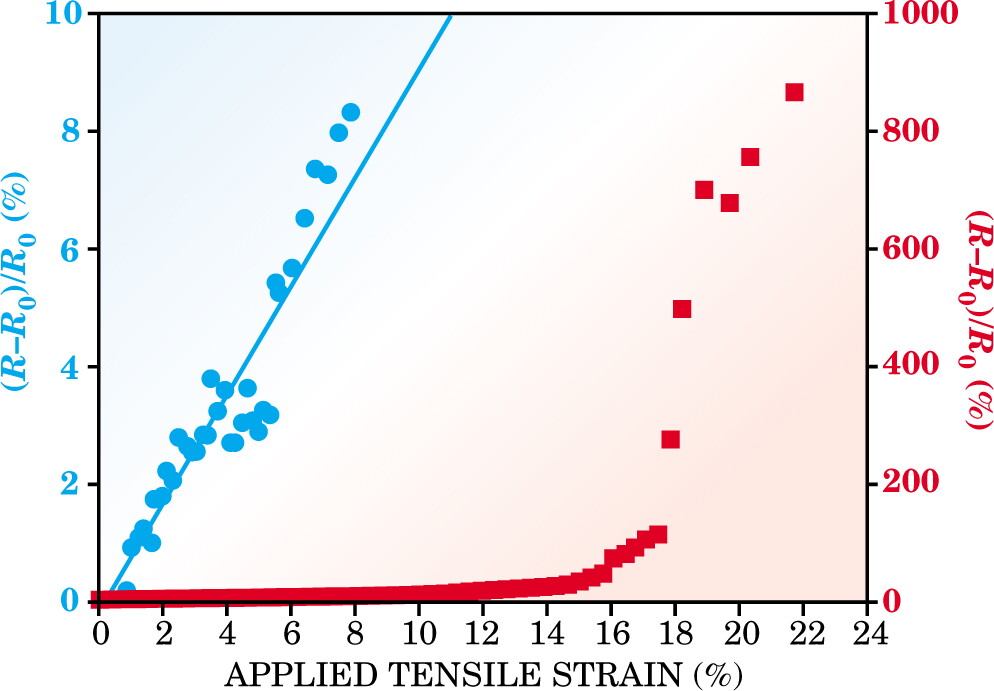
According to calculations by Suo and his post-doc Huang, the gold stripes should have a built-in compressive strain of about 0.4%. Lacour, therefore, expected to see the breaking strain increase by 0.4 percentage points to about 1.5%. As she ratcheted up the strain, the stripe’s resistance increased linearly. To her surprise, the resistance stayed in the linear regime up to a strain of about 8%. The stripe didn’t break. Higher strains brought another surprise. As figure 3 shows, the resistance rose more sharply above 8% strain, but it didn’t become infinite—even at 22% strain.

Figure 3. Resistance increases with applied strain in two regimes. Below a strain of about 8%, the increase is linear (blue points and left-hand scale). Above 8%, the increase accelerates (red points and right-hand scale), but even at a strain of 22%, the resistance remains finite.
(Adapted from ref. 1.)
The video showed what was happening. As the strain increased from zero, small cracks opened along the edges of the stripe. The cracks steadily widened and lengthened, causing the linear rise in resistance. At around 16% strain, the cracks extended all the way across the stripe, but the resistance, though high, remained finite. Lacour and Wagner don’t know why the severed stripe conducts, but they suspect the small-scale roughness of the PDMS surface might play a role. Some of the gold, along with chromium from the adhesive underlayer, could remain in troughs on the surface and provide electrical connection across the gap.
Why doesn’t the stripe break at the predicted strain of 1.5%? Suo says that the flexible substrate suppresses necking. A neck, he points out, needs free space to form and lengthen. If the film is stuck to the substrate, that room for expansion is off limits.
To function as a sensitive skin component, an interconnect has to repeatedly endure strains of 10% or more. With that goal in mind, Lacour, assisted by graduate student Joyelle Jones and undergraduate Catriona Chambers, performed two additional experiments, which they reported at the Materials Research Society’s spring meeting in San Francisco.
In the first experiment, they stretched samples up to 12 times between zero and 10% strain. The resistance behaved the same way, regardless of the cycle. In the second experiment, Lacour, Jones, and Chambers aimed to boost the stripe’s built-in compressive stress by depositing gold on strained PDMS. The trick worked. Prestraining the substrate by 10–15% raised the stripe’s breaking strain from 16% to 40%.
Despite these successes, much remains to be done, including figuring out how to make interconnects that cross each other. Still, Wagner hopes one day to realize one of his visions: to make a circuit that he can fold up and put in his pocket like a handkerchief.
References
1. S. P. Lacour, S. Wagner, Z. H. Huang, Z. Suo, Appl. Phys. Lett. 82, 2404 (2003) https://doi.org/10.1063/1.1565683 .
2. N. Bowden et al., Nature 393, 146 (1998) https://doi.org/10.1038/30193 .