South Dakota begins to reap benefits of underground lab
DOI: 10.1063/PT.3.2745

A decade ago South Dakota was “53 out of 53 in terms of NSF dollars” among US states and territories, says Mike Rounds, the former governor who in January was sworn in to the US Senate (R-SD). “If you are not a leader in research and technology, you have missed the boat,” he says. That conviction is what drove the state’s dogged support for turning the defunct Homestake Gold Mine in Lead into an underground laboratory. Now come the payoffs, including the lab itself, the state’s 23 new PhD programs in science and engineering, and a $5 million visitors’ center slated to open in June.
Thanks to $120 million in state and private money, plus $15 million a year in operations funding from the US Department of Energy, the Sanford Underground Research Facility (SURF) is shaping into an attractive site for experiments that require shielding from cosmic rays (see Physics Today, February 2013, page 19 ). So far it is host to the LUX dark-matter observatory, which is in the midst of a 300-day run, and the Majorana Demonstrator, which is looking for neutrinoless double-beta decay. CASPAR, a 1-MV, 3-m-long accelerator for studying stellar nuclear reactions, will move in this fall. And Black Hills State University (BHSU)—about 30 km northwest of SURF—is setting up a user facility that will offer both background counters to test components for underground experiments and microscopes for biology and geology studies.
Big time
These days the area is abuzz with the prospect of the Long-Baseline Neutrino Facility (LBNF) coming to the underground lab. A time-projection chamber, 1480 m deep and filled with 40 kilotons of liquid argon, would look for oscillations in neutrinos originating 1300 km away at Fermilab in Illinois. The project was strongly endorsed last year by the US high-energy physics community (see Physics Today, July 2014, page 18 ). Since then, the collaboration has grown to more than 140 institutes in 23 countries and has “agreed that the first phase—with 10 kt—would start up in 2021,” says Fermilab director Nigel Lockyer. “If you work backwards, we’d better start digging the hole in 2017. It’s a very aggressive schedule.”
The billion-dollar project doesn’t yet have a green light but President Obama’s fiscal year 2016 budget request includes $20 million for it (see the story on page 25). “It is a small but good start and is symbolically important,” says Lockyer. “And DOE has agreed to go through the decisions quickly.” For its part, SURF management is rehabilitating a second mine shaft. Fixing the shaft is for safety and accessibility, says Rounds. And as for the LBNF’s not yet having been approved, he says, “Which comes first, the chicken or the egg? If we have a facility that is ready, it will make approval of the LBNF a higher probability.”
The LBNF detector will generate an estimated $300 million in construction spending in the state, says Constance Walter, the lab’s communications director. The local economic impact of SURF up through 2014 totaled $135 million, she says. And the lab has led to the creation of 163 jobs in the state.
Besides the immediate economic benefits, the LBNF would bring more visibility to science. “Young people would get to rub shoulders with top scientists,” says Rounds. “They would see that they don’t necessarily have to leave our state permanently to have a career in science.”
“A major catalyst”
Among the aboveground shoulder-rubbing and science growth that SURF has already spurred are expanded college and university physics departments and outreach programs for K–12 schoolchildren. For example, in the past two years the nearby South Dakota School of Mines has doubled its physics faculty with the hiring of six new physicists; several of them recently won a three-year, $1.1 million grant from DOE for neutrino and dark-matter research. Together with the University of South Dakota, the School of Mines launched the state’s first physics PhD program in the fall of 2013. Richard Schnee, who moved to the School of Mines last August from Syracuse University, says he’s had “more inquiries from prospective graduate students about joining my group than I had received in total over the previous five years.” So far, 19 students are enrolled in South Dakota’s physics PhD program; the plan is to grow to 48.
From 2010 to 2014, the number of bachelor’s recipients in the state across all science, technology, engineering, and math (STEM) fields grew from 1376 to 1693 (in physics those numbers went from 7 to 25); total college enrollment hovered around 36 450. “It would be hard to refute that SURF has served as a major catalyst for our advancements in STEM in recent years,” says Nathan Lukkes, assistant vice president for research and economic development at the state’s Board of Regents.
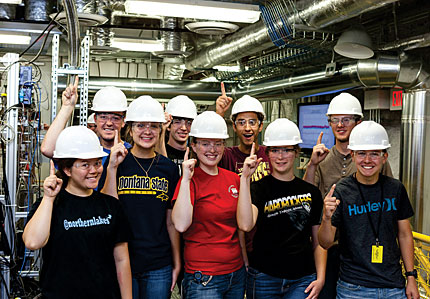
Each summer, with a combination of state, federal, and private money, SURF hosts more than a dozen fresh high school graduates and college students who are from or study in South Dakota. The facility’s internships and Davis–Bahcall scholarships (see photo on previous page) are oversubscribed by a factor of 5 to 10 and application numbers are increasing every year, says Walter.

Summer students with Davis–Bahcall scholarships spend five weeks studying accelerator and underground physics. Here the 2013 cohort is at the Sanford Underground Research Facility; they also visited Fermilab and Argonne National Laboratory in Illinois and Gran Sasso National Laboratory in Italy.
LAURA HOWARD, SANFORD UNDERGROUND RESEARCH FACILITY

Cabot-Ann Christofferson, a chemistry instructor at the School of Mines, is the DOE liaison for the Majorana Demonstrator and oversees the clean-room infrastructure at SURF for preparing extremely pure copper. But when she finished her graduate studies in materials science and engineering at the School of Mines, she “struggled with how to stay in the state. For science and engineering, there was not a lot of support. The lab is a new avenue,” she says.
“SURF has changed the research culture in the state. It provides opportunities for students, and it will increase the job opportunities in our state,” says Dongming Mei of the University of South Dakota. A couple of spin-off companies in areas relevant to underground research are “close to being launched,” he says. Brianna Mount, a researcher at Black Hills State University and the principal investigator for the university’s facility in the underground lab, notes that because of SURF, “people in places like Rapid City and Spearfish know the words ‘neutrino’ and ‘dark matter.’ ”
More about the authors
Toni Feder, tfeder@aip.org