Small Programs Survive by Pooling Students
DOI: 10.1063/1.2117813

Daniel Suson sees only some of his students. They attend his classes from several campuses, but at any given time, only one remote site is displayed on a monitor. Suson and other professors and students agree that the setup is not ideal, but it’s better than the alternative—axing undergraduate physics programs.
Suson, of Texas A&M University–Kingsville, is chair of the Texas Electronic Coalition for Physics, a “distributed department” that offers upper-level physics classes to students at five Texas A&M campuses. The TECP was formed in 2001, although the departments involved began sharing courses in 1993. The collaboration was a way around state rules that withhold funding when enrollment in college classes dips below 10. The shared classes are large enough to receive state money, which goes to the campus where the professor is located.
Distributed departments
“Numbers are the critical factor,” says Lionel Hewett, a TECP professor at Kingsville. All five participating campuses, he adds, “had too few graduates and too few students attending classes. Programs were going to be killed.” In addition to Kingsville, the TECP campuses are Tarleton State University, West Texas A&M University, Texas A&M International, and Texas A&M University–Corpus Christi; in physics, the last two offer only a minor.
The TECP schools’ physics departments may be smaller than their campuses and the state board of higher education would like, but they’re in good company. According to the statistics division of the American Institute of Physics, 3.9 was the median number of physics bachelor’s degrees awarded in 2003 by institutions that offered no higher physics degree; taken together, those institutions produced 44% of physics bachelors that year.
Given those numbers, enrollment requirements, and tight budgets, it’s no surprise that campuses have begun pooling students. A trio of universities in South Dakota, for example, have been sharing upper-level classes in physics for nearly a decade, and a different subset of that state’s universities offers joint classes in modern languages. Low enrollments played a role in a partnership that got started last year between the Birmingham and Tuscaloosa campuses of the University of Alabama. In that case, however, being able to offer more electives was also key. “We’ve found that students want to learn astrophysics,” says UA–Birmingham’s Tom Nordlund. “We don’t have anyone here that does that. But they [Tuscaloosa] do. Like-wise, they don’t have faculty who know much biophysics, so I teach that.”
The number of such shared programs around the US is unknown. In 2001, when the Department of Education awarded $395 000 to the TECP to generalize its program for larger teams and other disciplines, “we were not aware of any other project doing what they proposed. That’s why we funded it,” says a staff member for the department’s Fund for the Improvement of Postsecondary Education.
Collaborations like the TECP differ from what is perhaps the best-known distributed physics department, at the City University of New York. There, graduate students from many branch schools travel to a central location in Manhattan for their classes. With its hybrid of interactive television and the internet, the TECP model also differs from typical distance-learning classes. The coalition launched a laboratory course last year and hopes to eventually offer a master’s degree. Says Suson, “I truly believe that distributed departments represent one of the best ways, if not the only way, that small programs will survive in the future.”
Video barriers
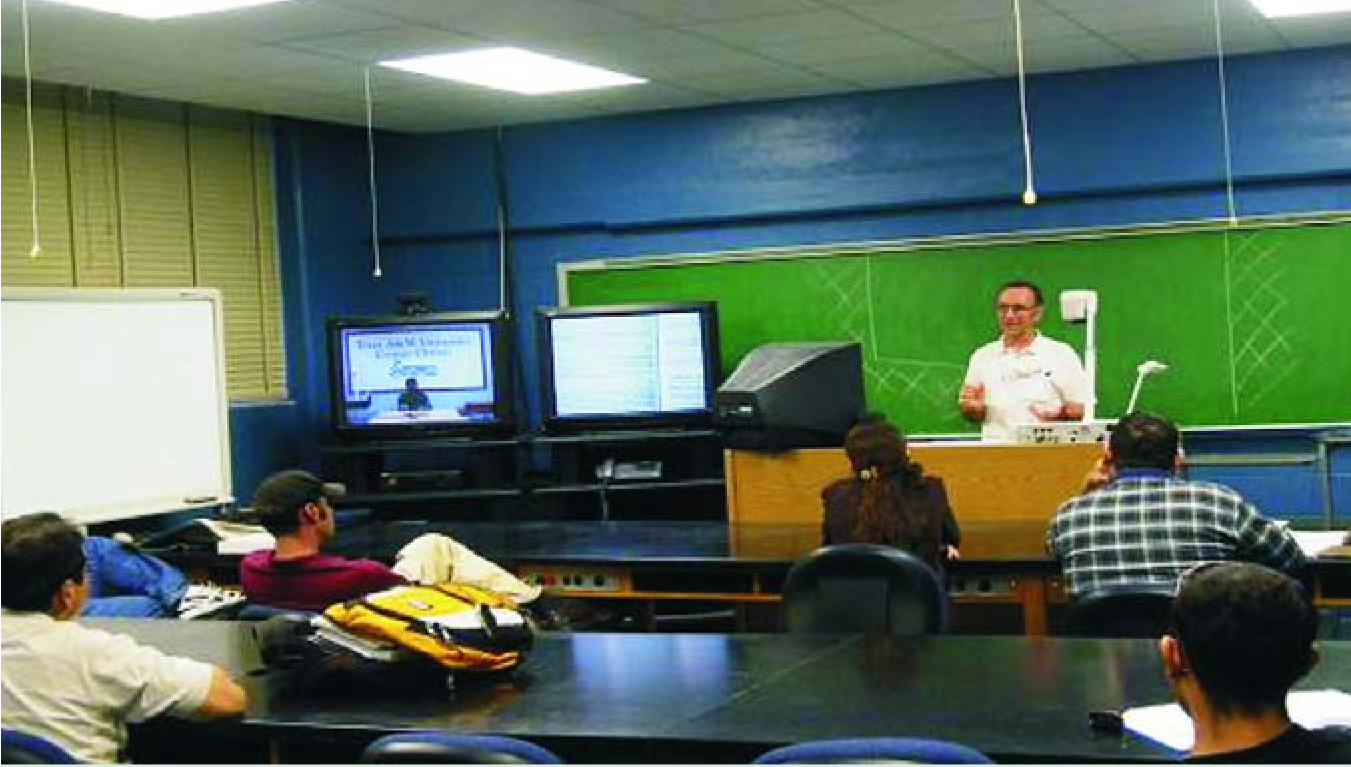
Each TECP department has a room equipped with cameras and two monitors. One monitor shows the professor or his lecture—“simulations, video tapes, projected notes, PowerPoint slides, anything that can be projected or put on a computer,” says Suson. The other shows the students in whichever classroom someone last spoke.
Generally, each campus has an on-site mentor, a faculty member who collects homework solutions, administers exams, and is available to help students.
The format and technology of remote classrooms slow things down. Not only are equipment glitches common, says Hewett, but “the content has to go on the Web. Putting out content over a little bitty TV screen, they couldn’t see the full equations.” Distance teaching takes more preparation than a normal class, he adds. “It provides students with anonymity, and they turn off,” agrees Corpus Christi TECP professor M. K. Balasubramanya. “When I teach I call on each campus to respond, and that slows the pace.”
“You can never truly replace face-to-face between faculty members and students,” says James Espinosa, who spent three years on the faculty of West Texas A&M before moving to the University of West Georgia. “To develop a relationship, I had to go out of my way to interact with students. It forced me to become a more person-able professor.” For example, says Espinosa, “you have to get [the students] relaxed. They were nervous about hitting their microphone or asking questions. There’s a barrier with the video system, and you as a professor have to cross the barrier.” Adds Suson, “If you get someone who does not realize the difference in medium, and is not prepared, it can be a fiasco.”
Oren Quist of South Dakota State University says his remote-teaching collaboration is “more and more convinced it’s not as good as having a local teacher. A lot of little things detract from the educational experience.” And, he says, “I think if we didn’t have it, we’d have more physics majors. It’s a smoke-and-mirrors method to get around the rules.”
Strength in numbers
Whatever its drawbacks, the distributed department “has strengths versus being a tiny department,” Espinosa says. “The West Texas A&M physics department was on its deathbed when I arrived [in 2000].” The number of graduating seniors “went from zero to two or three a year [in three years]. Without the coalition, I wouldn’t have been able to do that.” What’s more, he says, “the students have more competition and more interactions, and they see the teaching styles of different professors.” Remote learning, adds Balasubramanya, “requires more student engagement. They have to be more self-driven.”
And if it weren’t for the coalition, TECP professors would be stuck either teaching only service courses or teaching the upper-level courses without pay. “Historically, each of us had to teach a course gratis,” says Hewett. Professors did that, he says, because “it’s the students that stimulate you and keep you excited about the field.”
For their part, students see remote classes as a compromise. “When I first started off,” says Trent Brunson, who graduated from West Texas A&M this year, “it was an absolute nightmare. My professor had the personality of a tree stump—it was really hard to connect with the professors at first.” Brunson, who was the only physics major in his class, says things got better when he started studying with students at another TECP campus.
The regular course offerings afforded by the TECP “allow students to take classes and graduate, instead of switching majors,” says Karl Matlage, a recent Kingsville graduate who is starting a PhD in theoretical physical chemistry at the University of Texas at Austin. “The professors were willing to do whatever was necessary to make this work,” he adds. “If it was up to me, I’d prefer an on-site class. But for anyone that doesn’t have the resources to go to a large university, this is the best bet.”

Teleteaching: Students in Lionel Hewett’s modern physics class see course material on the right-hand screen and a remote participating classroom on the left.
LIONEL HEWETT

More about the authors
Toni Feder, American Center for Physics, One Physics Ellipse, College Park, Maryland 20740-3842, US . tfeder@aip.org