Shanghai builds topflight light source
DOI: 10.1063/1.2349721

After several years of the Chinese government’s wavering over whether to fund a major upgrade of an electron–positron collider or a new state-of-the-art synchrotron light source, China’s scientists are getting both facilities.
In going ahead with both the collider in Beijing (see the story on page 22) and the Shanghai Synchrotron Radiation Facility, the government was helped by China’s scientists having convincingly argued that the country has enough scientists to build and use both facilities, says Zhao Zhentang, head of accelerator construction for the SSRF. But perhaps most important is that the local Shanghai government is donating land plus ponying up about a third of the $150 million tab for the SSRF; the Chinese Academy of Sciences and the central government are splitting the balance. The price of the SSRF is “relatively cheap,” says Zhao, “because we can build the linac, magnets, vacuum chambers, and power supplies here in China.” Other components, such as superconducting RF cavities, klystrons, and some software, are imported.
The SSRF will be a 3.5-GeV machine that, with the help of undulators, will provide x rays spanning 0.1 to 40 keV. Its above-ground storage ring is 432 meters in circumference, and at first will have seven public beamlines plus a few dedicated to universities and industry; eventually it will have as many as 60 beamlines. Expected research areas include biological crystallography, materials science, environmental science, physics, chemistry, and medical imaging. “It’s the first third-generation light source in mainland China,” says Zhao. “It will play a very important role in the nation’s cutting-edge research of fundamental and applied sciences. It is comparable with Diamond [in the UK] and Soleil [in France].”
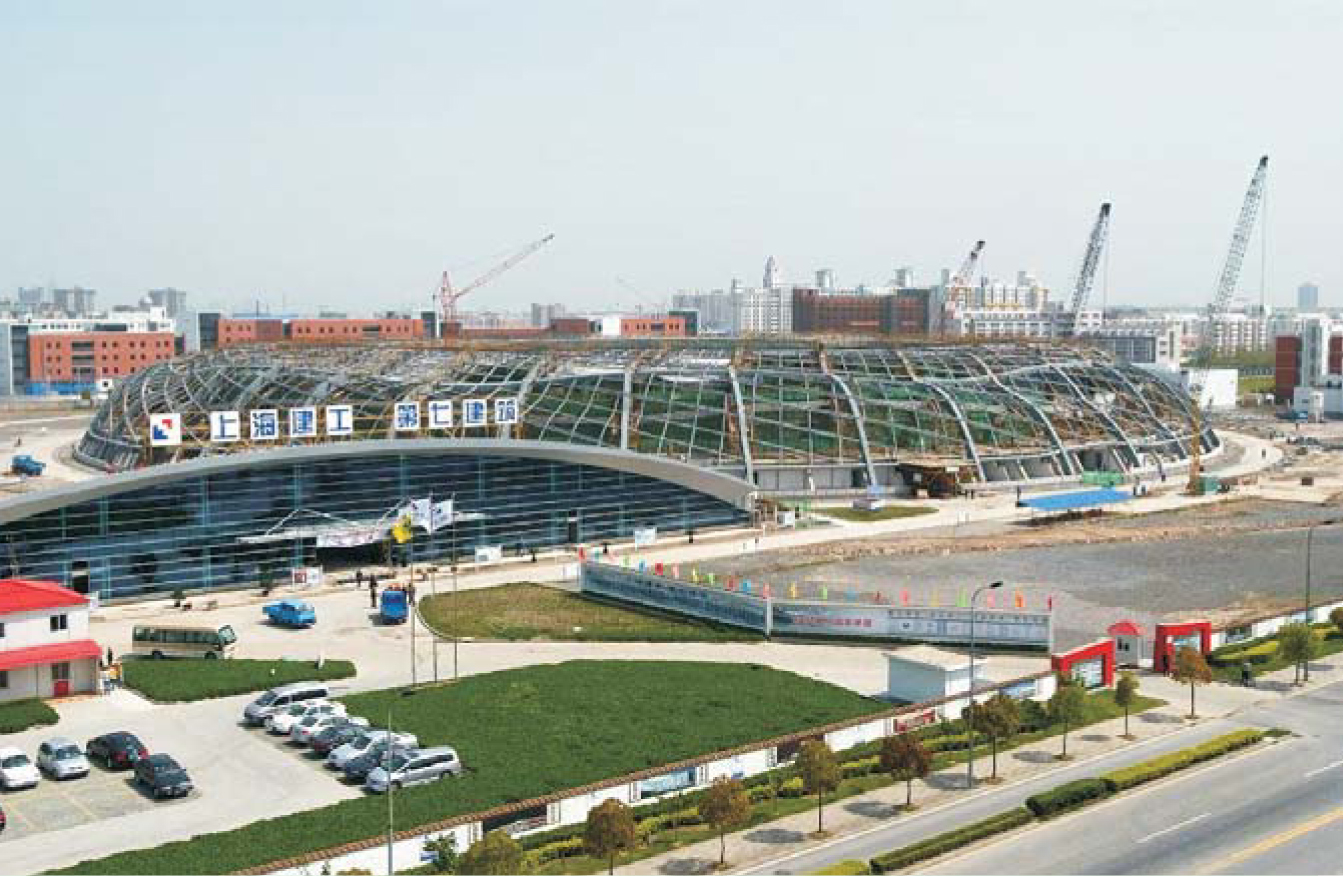
The building housing the synchrotron “looks like a nautilus shell,” says Stanford University’s Bob Hettel, an adviser to the SSRF project. “From what I understand, the Shanghai municipal government wants the building to have artistic merit, to be the technical jewel in the crown of the Shanghai region.” Located on the east side of Shanghai in Pudong, a technical corridor that only a few years ago consisted of villages, vegetable gardens, and rice paddies, the SSRF will be easily accessible from the airport by magnetically levitated train, and the hope is to attract international users.
The SSRF is scheduled to go on line in spring 2009.

An architect’s conception of the completed facility is shown.
SHANGHAI INSTITUTE OF ARCHITECTURAL DESIGN


The synchrotron light source under construction in Shanghai will be housed in a spiral-shaped building.
WEICHENG HU, SHANGHAI INSTITUTE OF APPLIED PHYSICS

More about the authors
Toni Feder, tfeder@aip.org