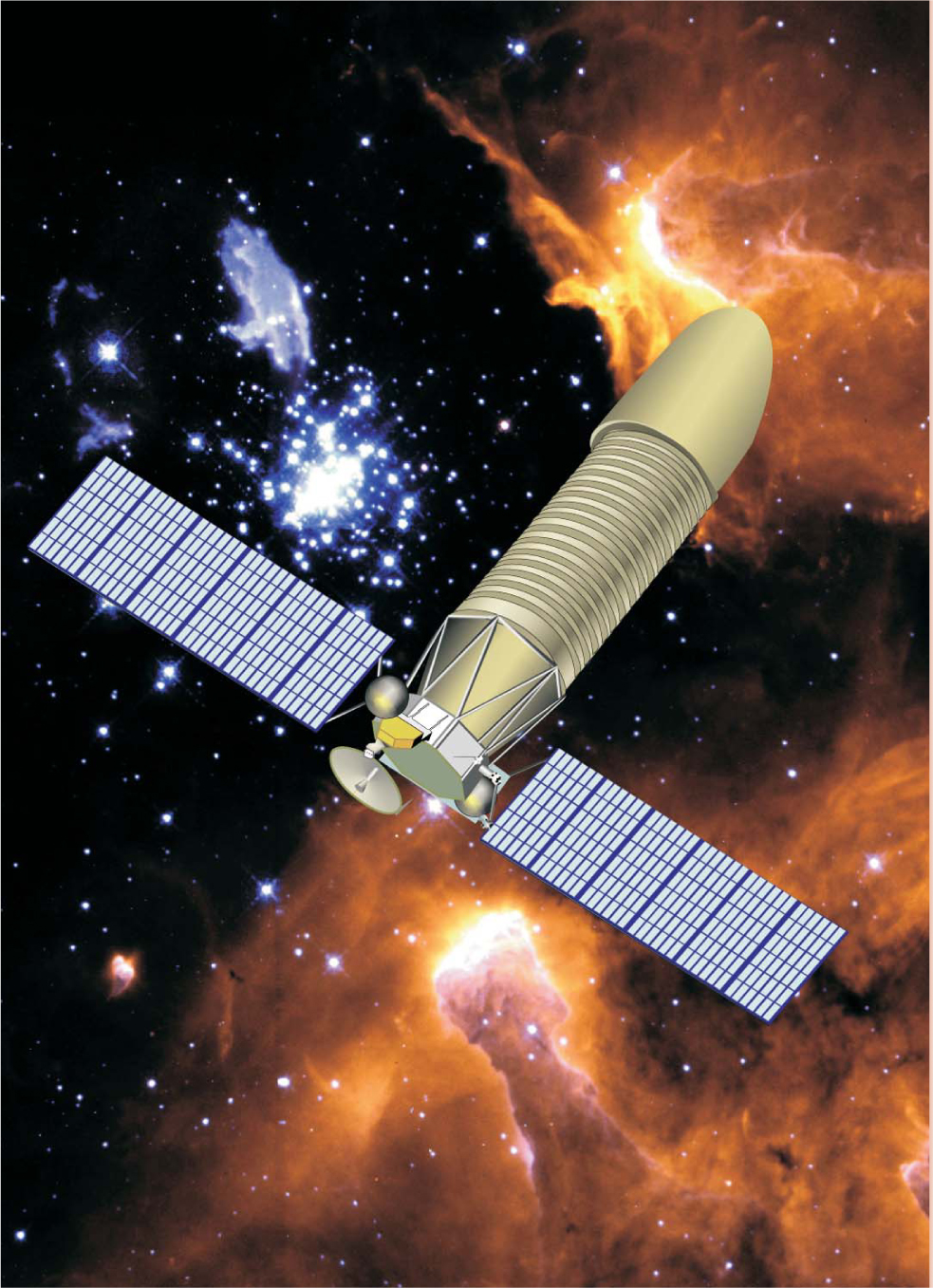
Russia leads international team on revived UV space telescope
DOI: 10.1063/1.2761794

A UV space telescope originally planned in the Soviet Union has regained traction as the Russian-led World Space Observatory and is set for launch in the first part of the next decade.
“It will be a multipurpose observatory,” says WSO principal investigator Boris Shustov, director of the Russian Academy of Sciences’ Institute of Astronomy in Moscow. Topics of study will include a search for missing baryonic matter in the intergalactic medium, the composition of atmospheres of exoplanets, and accretion physics in star formation and galaxy evolution. The WSO, he adds, “is the only large-scale facility planned in the UV in the next 15 years.”
“The WSO is a follow-on to the Hubble [Space Telescope ],” says the University of Leicester’s Martin Barstow. “Whereas the JWST [James Webb Space Telescope , NASA’s successor to the HST ] doesn’t deal with the optical and UV part of what the Hubble does, so the WSO observes in the UV, and doesn’t do IR.” Among the WSO’s strengths, adds Michel Dennefeld of Paris’s Institute of Astrophysics, “are that its instruments will be entirely dedicated to UV observations and, with its high orbit, it will allow long observations of faint objects.”
Global participation
Russia will cover the largest chunk of the WSO’s estimated €300 million ($400 million) tab, supplying the satellite bus, launch facilities, ground equipment, and a telescope with a 1.7-meter primary mirror. The rest will be provided in roughly equal parts by Russia’s four main partners.
Germany has designed a high-resolution spectrograph, sensitive in the 103–310 nm range. Scientists in China are working on a long slit spectrograph (LSS) for observing extended and faint objects. Italy is developing an imaging camera with three channels that together cover the wavelength range from 115 nm in the UV through 700 nm in the visible. In addition, says Isabella Pagano of Italy’s National Institute for Astrophysics, who is overseeing her country’s participation in the WSO, “The Italian Space Agency is discussing using the Italian station in Kenya for this project. It would be nice because it’s close to the equator and [with other ground stations] would give us control of the satellite 24 hours a day.”
Spain—so far the only country besides Russia to have made a formal commitment to the project—is developing a space flight control and scientific operations center. Norbert Kappelmann of the University of Tübingen says the German team is waiting for the others to catch up with their R&D before applying for further WSO funding. China and Italy are both expected to sign interagency agreements with Russia later this year.
Many other countries have been involved in planning the WSO, and some may participate in smaller ways. “The UK financial situation is quite tight at the moment, so we are trying to participate in the LSS along with the Chinese,” says Barstow. “But whatever happens in terms of hardware, we will participate as much as we can in the science program.” Argentina, France, Israel, Mexico, the Netherlands, and others are similarly strapped for cash but intellectually engaged in the project. Ukraine and Kazakhstan are both involved, and South Africa hopes to host a science operations center.
Notably, the US is not on board. “The US scientific community told us it’s not a high priority,” says NASA press officer Grey Hautaluoma. US astronomers may fear that lobbying for an international project could jeopardize funding for a much larger UV telescope, which is currently stalled, or for the Cosmic Origins Spectrograph, a UV instrument slated to be installed on the HST next year. Moreover, some WSO scientists suggest it’s better for the US not to be involved because US concerns about potentially sensitive information could cause delays.
In any case, the WSO will be open to the entire international astronomy community. “One of the things that is different about this compared to other Russian missions,” says Barstow, “is that, after a lot of sweat and tears and negotiations, we have a scheme for how data will be handled that is much like what you might loosely call the western approach. There will be guaranteed time for the instrument people and a guest observer program for everyone else.”
Dreams converge
“Before the Russian space agency approved the WSO about a year and a half ago,” says Pagano, “it seemed like a dream.” The project’s genesis goes back to a plan from the late 1980s that languished after the Soviet Union collapsed, plus efforts begun in 1997 for a successor to the European Space Agency-NASA-UK International Ultraviolet Explorer. The convergence of the two was spearheaded by the late Willem Wamsteker, who was based at the European IUE station in Spain. That’s why, says that country’s WSO liaison, Ana Ines Gomez de Castro of the Universidad Complutense of Madrid, “Spain is so firmly committed to [the WSO].”
Meanwhile in Russia, says Shustov, “for more than 10 years, from the beginning of the 1990s, it was the dark ages for space science. If you compare the late 80s to the mid-90s, the official drop in funding was a factor of 20. That meant no real project could be realized.” Beginning in 2004, he adds, “money rose. There is not as much money as [there was] in the Soviet Union, but now the federal space program looks more realistic.”

The World Space Observatory .
(Artist’s conception courtesy of the

More about the authors
Toni Feder, American Center for Physics, One Physics Ellipse, College Park, Maryland 20740-3842, US . tfeder@aip.org