Q&A: Graduate student Ari Jain strives to better the world through research and leadership
DOI: 10.1063/pt.jlmf.jfaw


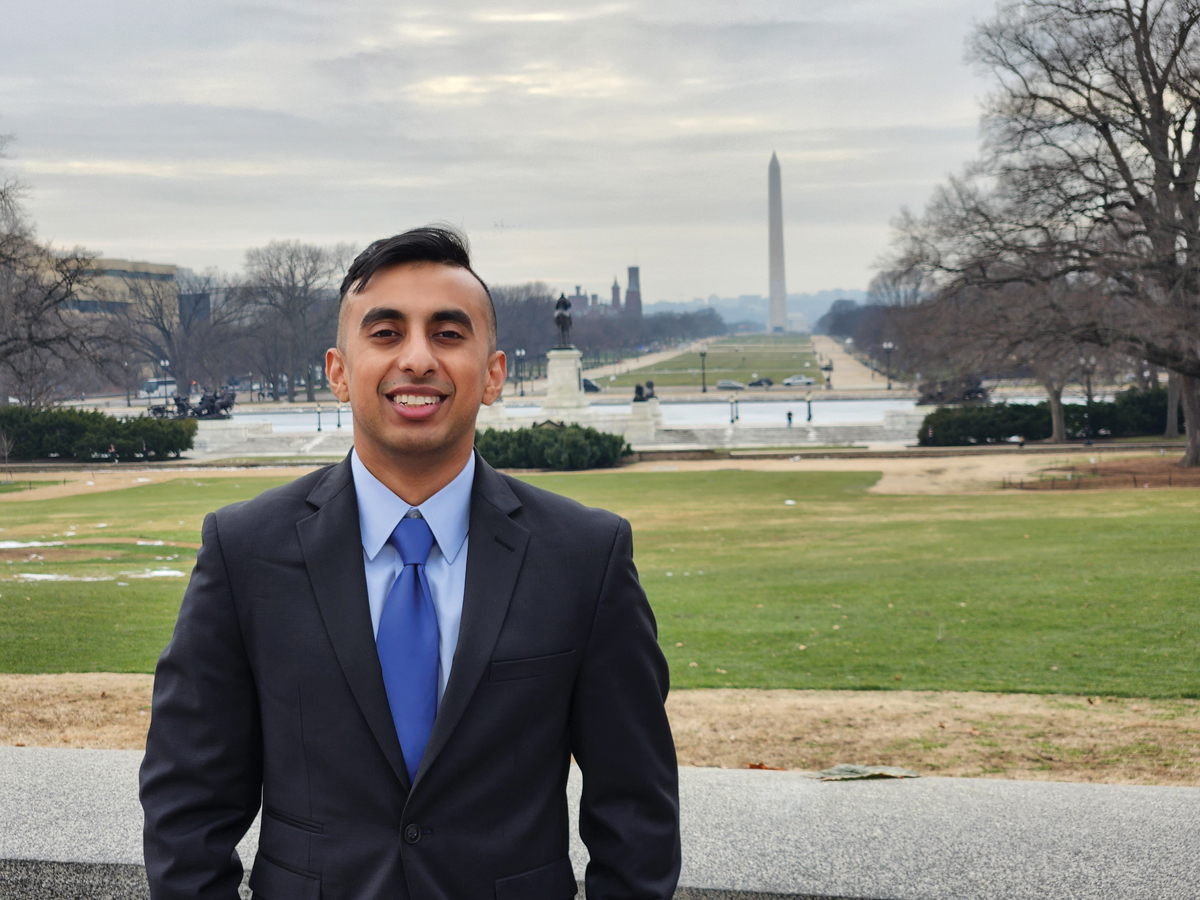
Ari Jain went to Washington, DC, to lobby for the RESEARCHER Act and other policy issues through the American Physical Society’s Congressional Visits Day this past January. (Photo courtesy of Adhiraj Bhagat.)

“You can’t be a pilot—it’s dangerous.” That’s what Ari Jain’s mom told him when he was a small child and wanted to become one. So, instead of flying planes, he decided in middle school he would design them. Says Jain, “The passion never went away.”
Jain earned his bachelor’s and master’s degrees in aerospace engineering. Now he’s working on his doctorate at Georgia Tech and expects to graduate in December 2026. Alongside his experimental research on combustion engines, Jain is active in three professional societies: He is the past chair of the American Physical Society (APS) Forum on Graduate Student Affairs (FGSA), the deputy director for young professionals for the American Institute of Aeronautics and Astronautics Region II (which covers the southeast US), and the vice president for the Georgia Tech Aerospace Engineering Graduate Student Association.
His participation in governance, he says, has helped him grow as a leader and develop his network. It also builds confidence: “I see that I can make an impact, and I shouldn’t feel I have anything less to offer than someone who is later in their career.”
PT: Describe your research.
JAIN: I work on combustion for commercial gas-turbine engines—the type you see on the planes that you fly on. I work on advancing the technologies that lower pollutants—nitrous oxides and nonvolatile particulate-matter emissions.
Part of my research is on the combustion side of things, the actual physics. The other side is the diagnostics and how we measure and analyze flows of combustion products.
PT: How do you decrease pollutants?
JAIN: In gas-turbine emissions broadly, carbon dioxide makes up about 80% of emissions, and non-CO2 emissions are the other roughly 20%. To decrease CO2 emissions, there are sustainable aviation fuels made from alternative feedstocks. The current jet fuel in the US is called Jet A. You are allowed to mix Jet A in a 50-50 ratio with sustainable aviation fuels and deploy that on an aircraft. The goal is to get to 100% sustainable fuel.
For non-CO2 emissions, like nitrous oxides and nonvolatile particulate matter, one of the mitigation strategies is to burn fuel lean—that is, increase the air-to-fuel ratio. However, burning fuel lean inherently has more risks. We need to continue understanding how the sustainable fuels and lean burning affect engine performance and operability.
PT: What type of risks?
JAIN: The risk is that combustion is not sustained and the engine goes out. That’s not a good thing at 40 000 feet.
PT: Tell me about your governance activities.
JAIN: I think of the roles I have as being on two different levels. There is the local campus level and the society level. Being a part of both gives me an opportunity to be clued in to what’s happening in both arenas and to be able to make an impact. As an undergraduate, I served on the executive committee for the American Institute of Aeronautics and Astronautics student branch at my campus, the University of Illinois Urbana-Champaign. Once I got to grad school, I could apply my leadership skills at a broader level.

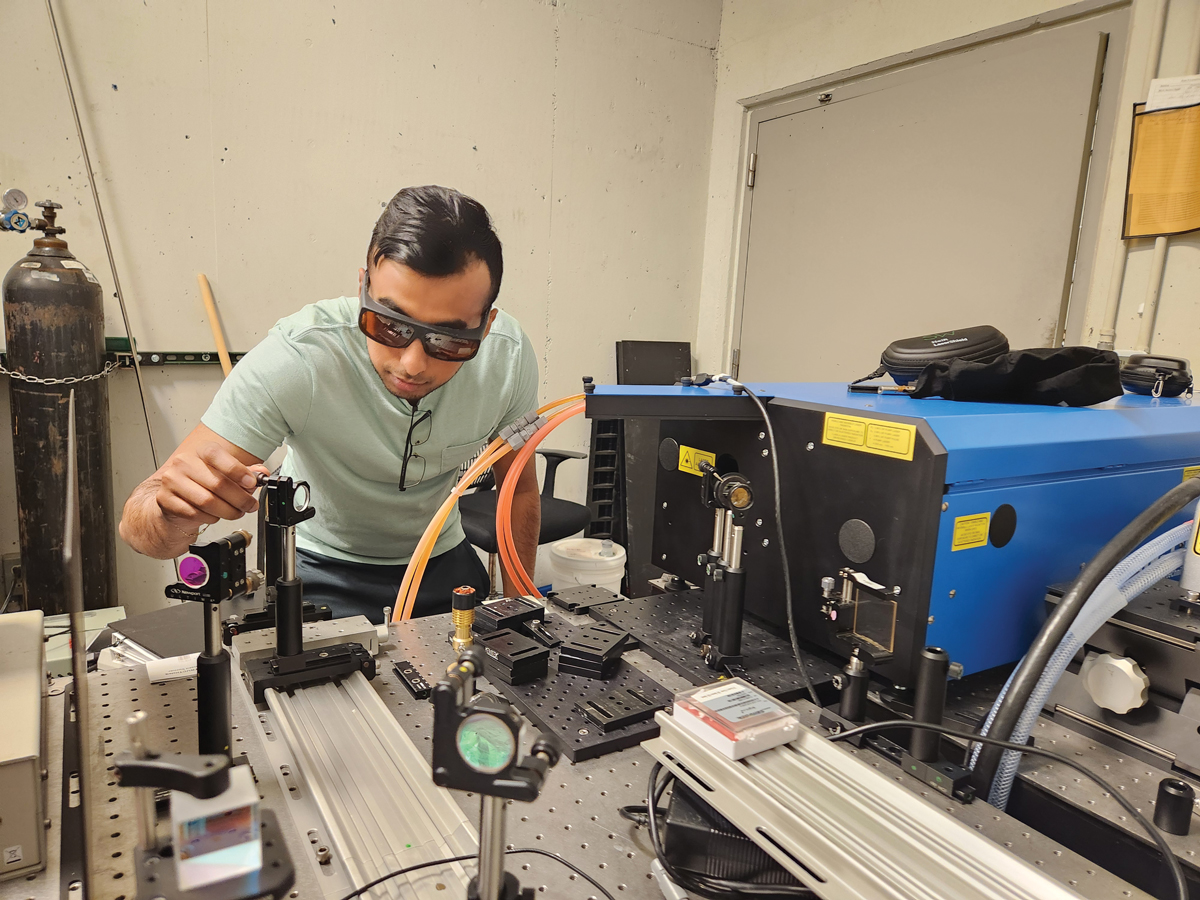
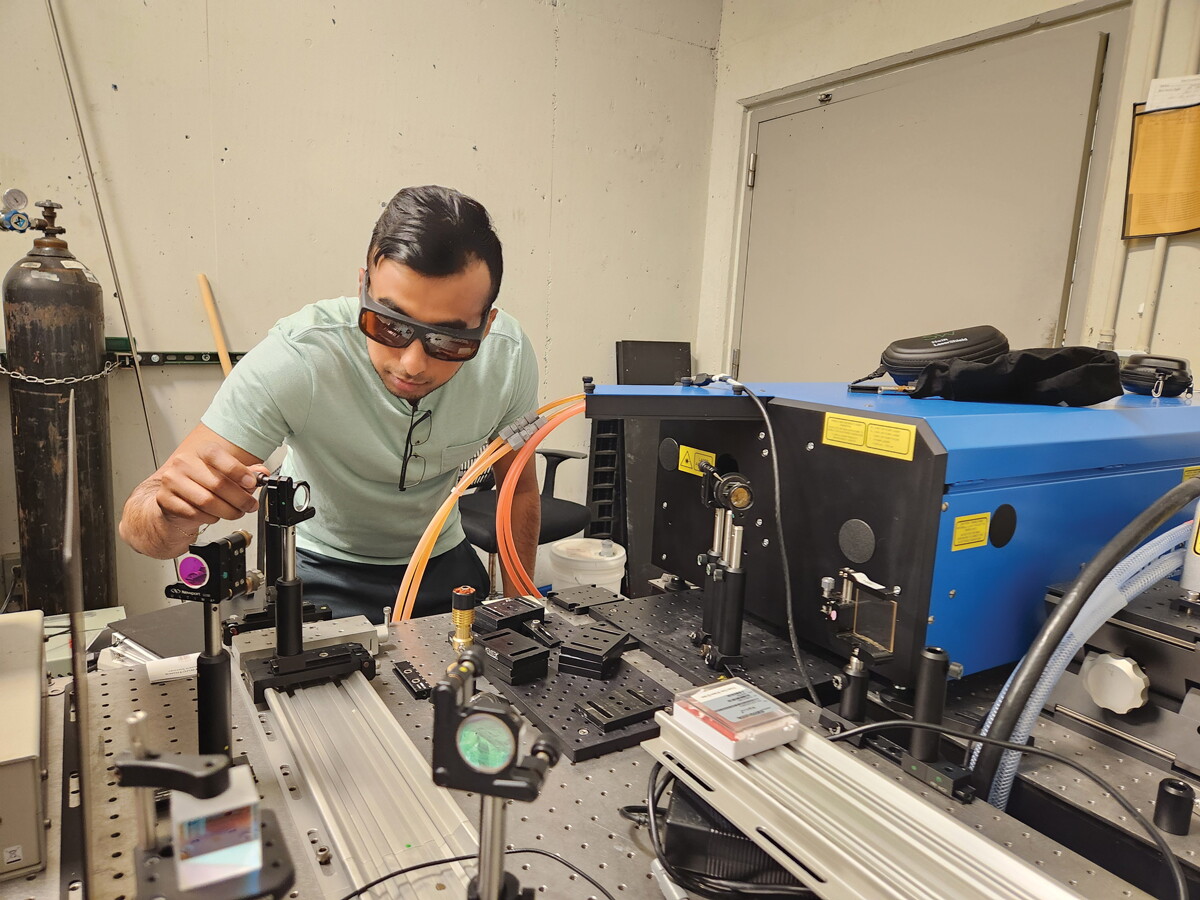
Reducing pollution from airplane combustion engines is the focus of Ari Jain’s doctoral studies at Georgia Tech. He uses lasers to monitor where flames and combustion chemicals are. (Photo courtesy of Adhiraj Bhagat.)
PT: What are examples of what you do in your current roles?
JAIN: Some are little things. Georgia Tech’s qualifying exams for the PhD program in aerospace engineering are notoriously tough. The aerospace graduate student association provides exam takers with resources to ease the anxiety of taking that big exam: We connect them with people who can give them mock exams, and there is a massive study bank for them to look at notes from previous years. When I was studying for my exam, that bank helped me a lot, so I know it’s important to maintain it.
For APS, the FGSA administers travel awards to students who need support to get to conferences. I am one of the people who goes through the applications. This year, we funded 19 students—a handful of which were international students—to go to the Global Physics Summit in March. Being able to give those students a chance to present their work and take advantage of networking is very rewarding.
The APS FGSA also organizes sessions for the Global Physics Summits. We curate the topics, invite speakers, and make it happen. It’s an annual thing. This year, the topics were ethics and publishing, graduate students as changemakers, and a career panel that we cosponsored with a couple other APS units. And, because it’s the International Year of Quantum Science and Technology, we had a quantum-focused session.
PT: How did you, as an engineering student, become involved in APS?
JAIN: My master’s degree was more in the pure fluid-dynamics space, so I joined APS for their division of fluid dynamics. My work is very physics adjacent: I am applying fluid-dynamics concepts in a combustion setting. That’s why, although I am not a physicist per se, I stay involved with APS.
PT: How did you get into APS governance?
JAIN: Of all the units that the APS has, the Forum on Graduate Student Affairs is the most important and relevant to me. When they put out a call for serving on their executive committee, I threw my hat in the ring. I was elected.
PT: What appeals to you about serving in the leadership of professional societies?
JAIN: I know that we are impacting individual students in a big way.
Last year, there was a bill in Congress called the RESEARCHER Act, which directs the White House Office of Science and Technology Policy to gather data on graduate student and postdoc stipends and develop new, more robust guidelines for how federal agencies should suggest grant allocations toward such stipends when they put out calls for proposals.
Through APS, we launched a nationwide grassroots campaign. Eight hundred letters were sent to senators and House of Representatives officials. We were able to arrange trainings for constituents for how to talk to lawmakers. And we arranged six meetings. Based on those meetings, two additional congressmen signed on to cosponsor the bill.
With the end of that session of Congress, the bill died. It will have to go through the process again. The last I heard is that it’s close to being reintroduced.
The thought that “Hey, I can help other graduate students and postdocs get fair compensation, get more money,” is probably the most rewarding thing I’ve done in my governance positions.
PT: How much time do you invest in your society activities?
JAIN: Like 10 hours a week. I don’t know how I make time for them, but I do. And I would encourage other graduate students to get involved. You will get as much out of it as you put into it.
PT: What are your plans for after you finish your PhD?
JAIN: I’m currently in two frames of mind. I may like to work at an R&D center in industry. And, because of my activities with the RESEARCHER Act, I want to explore aerospace policy, or science policy in general, as a possible career path.
This article was originally published online on 1 May 2025.
More about the authors
Toni Feder, tfeder@aip.org