Professional societies introduce AI for organizational tasks


Attendance can be in the many thousands at some meetings, like this one by the American Geophysical Union in 2024. AGU and other professional societies are working to improve their members’ experience with AI tools to optimize schedules and meet people.
(Photo by Beth Bagley/AGU.)

Which sessions at a ginormous conference should I participate in? Who should I connect with professionally? Where can I apply for research money? Those are some of the questions that professional societies are starting to delegate to AI.
“AI is redefining what’s possible for professionals,” says Michael Jones, vice president of mobile technologies at Results Direct, a company that works with trade associations. The associations have a wealth of data, he says, and AI makes the data more accessible.
Blazing the trail is the American Geophysical Union (AGU), which began testing AI-based programs for its members and conference attendees in summer 2025 and implementing them in the fall. Other professional societies are also experimenting with AI.
A wealth of data
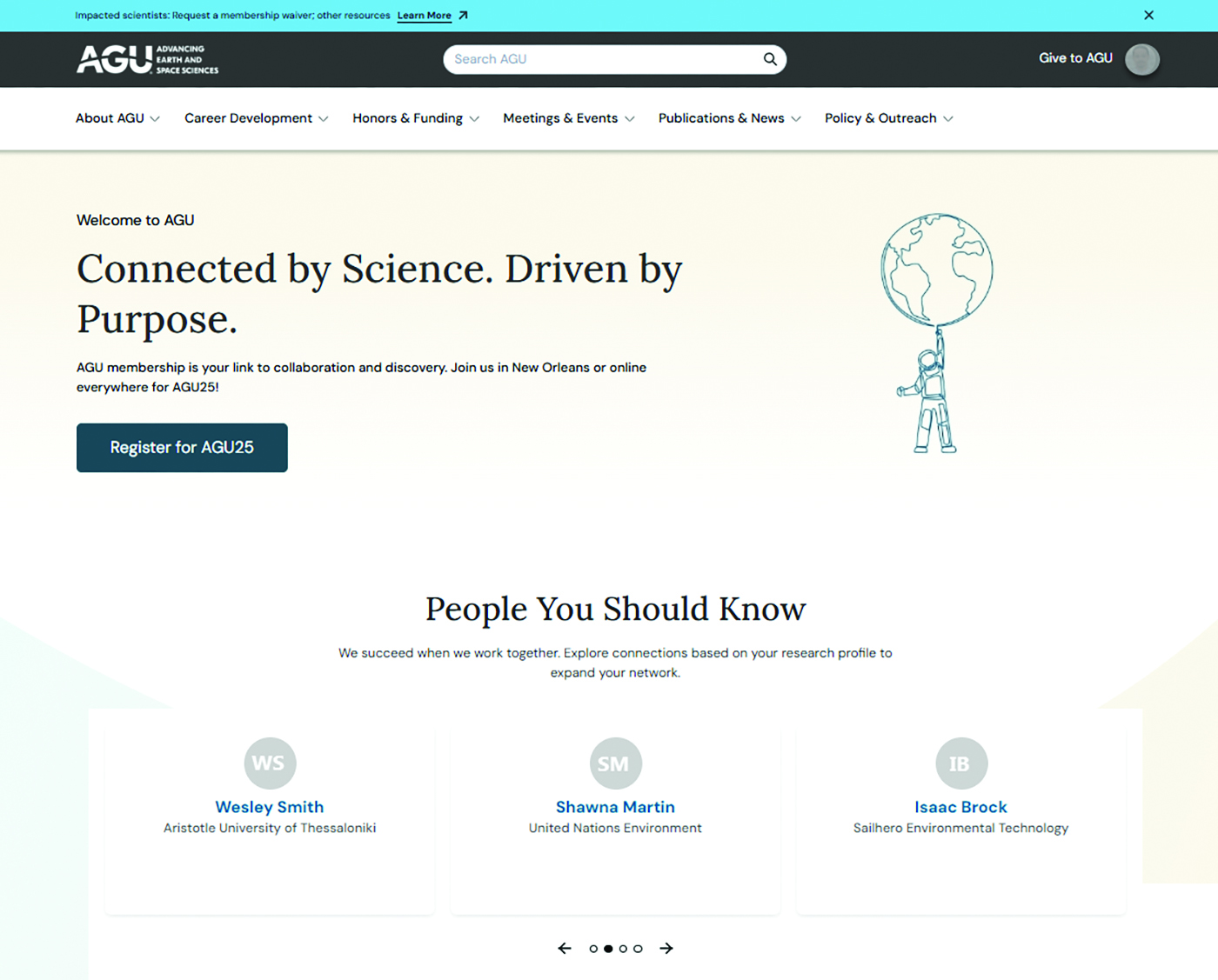
When a member logs onto their AGU account, they see suggestions for professional contacts. “People you should know” is one of several new AI tools that AGU has developed to exploit its database.
Natalie Raia is a researcher at the University of Arizona who works at the intersection of Earth sciences and information science, and as a member of AGU’s Digital User Group, she is testing the society’s AI tools. She has made four new connections through the suggestions that popped up on her AGU home page, she says. “The suggestions can be based on career stage or on work.” It’s up to the individual whether they want to follow up, she says, “but it could be really good for someone seeking collaborators or a postdoctoral adviser.”
AGU doesn’t collect data on how often suggestions are pursued, says Thad Lurie, the society’s senior vice president of digital and technology. “It’s too invasive. We are sensitive to privacy.”
AGU’s AI tools plumb member profiles, which include publications, abstracts, and institutions. If members have linked to their ORCID identifiers, their profiles will have that information too. The tools also use data from nonmembers’ publications in AGU journals and their contributions to its conferences. The data are all publicly available, but the AGU’s AI tools and recommendations are accessible only to members.
Another new AGU tool called Grant Finder generates customized suggestions for applying for research funds; it works both from the society’s database on members’ publishing history and from keyword searches. For example, a researcher could input “air quality,” “metamorphic geology,” or “groundwater aquifer modeling.” In testing the pilot, Raia says the tool saved her time by bringing together options from federal, state, and local agencies and philanthropies. “I was able to sift through opportunities that I probably otherwise would not have discovered.” Those include, she says, grants through NSF that she may not have found “because of the bins and structures of the NSF website.”

When an AGU member logs onto their account, they are now met with AI-generated suggestions for professional connections.
(Screenshot with fictionalized data courtesy of Heather Lent/AGU.)

The goal of another tool, Session Finder, is to help conference participants figure out which sessions to submit their abstracts to and which ones to prioritize attending. AGU annual meetings are large, with roughly 25 000 attendees, more than 50 concurrent sessions, and a couple thousand talks. With Session Finder, the whole abstract is digested by AI, which then suggests relevant sessions.
For choosing which sessions to attend, the approaches until now were keyword based. “You would try to find session descriptions that matched, but things were easily missed,” says Heather Lent, AGU’s digital product director. For example, she says, a search for “plume” could miss relevant talks that instead mention “ash.” The AI tool solves that problem by connecting the concepts.
With the Session Finder, says Raia, “I tell the program, ‘Here is my research. Tell me what is of interest.’” The tool finds related research in seemingly unconnected disciplines, she says. “It will challenge people to look at new topics. I think that’s exciting and will lead to more mixing of people.” The Session Finder, she says, will also help newcomers and students “cut through what could be a large, overwhelming program and find their spaces faster.”
Diversifying peer review
AGU is also using AI to help its journal editors identify peer reviewers. “I handle hundreds of papers each year,” says Sarah Feakins, an AGU editor and Earth sciences professor at the University of Southern California. Traditionally, she says, she and other editors have found peer reviewers through their own networks, author recommendations, and online searches. To get two or three reviewers, she says, she would have to make about eight requests. “Finding reviewers is a challenge.”
To find reviewers with the AGU AI program, the editor pastes in a paper’s abstract and specifies how many suggestions they want. The program spits out names with scores that rate the match. A postdoc or student who has published only on that specific topic will have a high matching score, says Feakins, “whereas someone who has published in a wide range of areas will have a diluted score.” She and other editors say that they vet suggested reviewers. Still, says Feakins, “the potential of AI to speed up workflow is vast.”
Anna Wåhlin has been an editor for the Journal of Geophysical Research: Oceans for four years. “We always struggle to find good reviewers,” says Wåhlin, a professor of physical oceanography at the University of Gothenburg in Sweden. “And we tend to focus on male, senior scientists that are well known.” Using the full AGU database, she says, the AI tool “does a better job than I would do” at finding candidate reviewers. In particular, she says, the pool is more diverse in terms of reviewers’ gender, age, and geography. “This has brought in more reviewers from Asia that I may not have thought of before,” she says.
Wåhlin has also found that she’s getting a higher positive response rate from potential reviewers. “Maybe it’s because these are people who haven’t been asked as often,” she says.
So far, the AGU peer-review tool is limited to the AGU database. That’s not a big concern, says Feakins, because the database includes not just society members but anyone who has published in an AGU journal or presented at an AGU conference. That’s most of the field. And partnerships with other geophysical societies in Europe and Asia may be forged in the future, says Wåhlin.
Privacy, note Feakins, Wåhlin, and others, is key to the process, which is why the AGU program is self-contained and the editors are not using ChatGPT or other widely available AI platforms. “Finding peer reviewers is an excellent use of large language models,” says Wåhlin. “It helps our work as editors. And authors should be happy, too, because it speeds up the review time by about two weeks.”
Enhancing value for members
Other professional societies are dipping their toes into AI along the same lines as AGU. In preparation for its January 2026 meeting, the American Astronomical Society (AAS) built a tool to sort session abstracts. “We were able to sort abstracts reliably and efficiently,” says AAS CEO Kevin Marvel. “And the AI system suggests accurate session titles and organizes the sessions following our timing rules.”

This app uses AI to help conference goers find talks, meet people, and plan their schedules. A pilot version debuted at the INFORMS annual fall meeting.
(Photo by Warren Hearnes.)

Overall, says Marvel, the aim is to “amplify the work of volunteers and staff.” They will be freed from busywork that AI can do and be able to use their time for creative things that enhance the value for members, he says.
Warren Hearnes, the former chief data scientist at Best Buy, is vice president of technology strategy for the Institute for Operations Research and the Management Sciences (INFORMS), a professional society for decision and data sciences. He created a prototype app that debuted at the society’s annual conference in October. The app is meant to help conference goers navigate the nearly 5000 talks that take place over three and a half days. It does not dive into member data but rather accesses abstracts and other conference information and uses generative AI to address queries, says Hearnes. “It tries to mimic how people think and ask questions. It helps people discover talks without having to explicitly list every keyword or topic.”
The types of questions people posed to the app included things like who from industry would be talking about supply chain optimization and who the international speakers were. Those got helpful responses. But common questions like where an ATM or the bathroom was went unanswered. The program, says Hearnes, does not use location information.
“The app elevated my conference experience,” says INFORMS vice president for practice Robin Lougee, who tested the prototype. “I was interested in agentic AI in industry and asked what was going on in that area on Tuesday,” she says. “The app served up suggestions.” It was convenient and fast, she says. “But more than fast, I found things I probably wouldn’t have without it.”
“We are taking baby steps,” says Hearnes. “We are testing the use of large language models to get more engagement and connection at our conference and potentially on message boards. As a society, if people get value out of their society membership, we will have less churn, better conferences, and the field will be better off.”