Private Money Launches Institute Melding Particle Physics and Cosmology at Stanford
DOI: 10.1063/1.1387587

When Jonathan Dorfan, director of SLAC, decided to create an institute for nurturing the overlap of particle physics, astrophysics, and cosmology at Stanford University, he didn’t have to look far for funding: This spring, Silicon Valley entrepreneur Pehong Chen and his wife Adele pledged $15 million to launch the Pehong and Adele Chen Particle Astrophysics and Cosmology Institute.
“It’s clear to everyone that the agendas of particle physics and cosmology and astrophysics have become very intertwined,” says Dorfan. For example, at SLAC’s B Factory, which smashes together electrons and positrons of unequal energies, “we are reaching further back in time, answering questions of how the universe was born.” The new institute, Dorfan adds, “is a way to combine the disparate efforts at SLAC and on [Stanford’s main] campus—a focal point for faculty and young people that will be a mixing pot for ideas and cross-fertilization.”
The Chens’ gift will endow the directorship of the institute—the only new job—and pay for a building to house some 90 people, including 10 faculty members drawn from both theoretical and experimental physics, postdocs, students, and support staff. Dorfan is raising additional money for running costs and for prestigious, highly paid postdoctoral positions. As with the Chen donation, he’s seeking private money “for expediency.”
For his part, Chen, president and CEO of the Redwood City, California-based software company BroadVision, is funding the new institute because “we in the high-tech industry are the direct beneficiaries of fundamental research. It’s a good investment, and more recently, it seems to be ignored.”
Fraternal appreciation also contributed to the Chens’ largesse: Chen’s older brother, Pisin Chen, happens to be a physicist at SLAC. “He was very inspirational when I was growing up,” Pehong Chen says. After Pisin came to study in the US in the 1970s, for example, he used to send physics problems to Pehong, who was still in their native Taiwan. “Although [my brother] didn’t succeed in luring me into studying physics, I have always had great admiration for physicists whose discoveries have provided the basis of most modern technologies, and also have revolutionized our concepts about space, time, matter, and the universe,” says Chen. “An interesting set of twists and turns has given me the opportunity to help.”

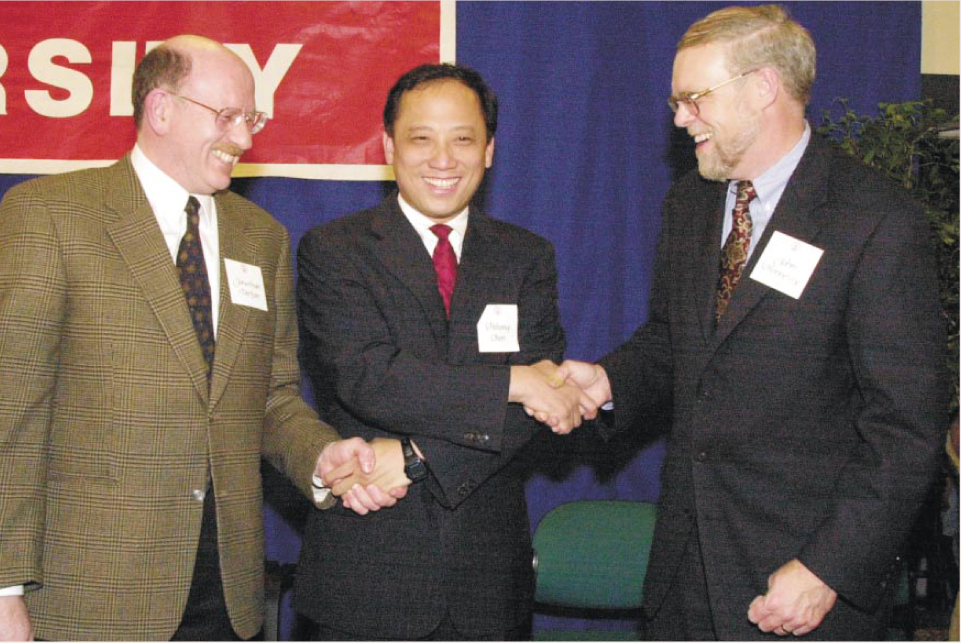
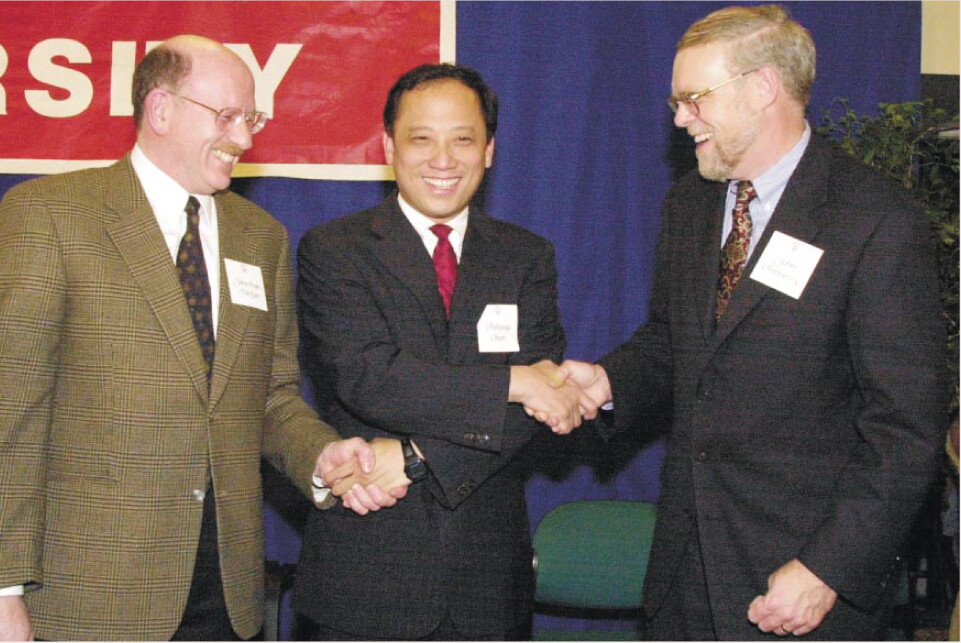
Pehong Chen (center), Jonathan Dorfan (left), and Stanford University president John Hennessy celebrate the announcement of the Pehong and Adele Chen Particle Astrophysics and Cosmology Institute.
LINDA CICERO, STANFORD U. NEWS SERVICE
More about the authors
Toni Feder, tfeder@aip.org