Prisoner of conscience to get retrial in Iran
DOI: 10.1063/PT.3.2618

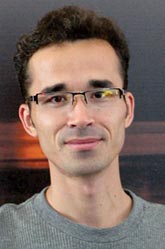
Omid Kokabee’s most recent physics paper, published on the arXiv eprint server last March, lists his address as “Ward 350 of Evin Prison, Tehran, Iran.” The University of Texas at Austin graduate student was detained in January 2011 on a trip home to visit his family. This past October Iran’s Supreme Court said it will retry Kokabee.

Omid Kokabee

Kokabee’s field is nuclear physics, with a focus on laser optics and photonics. In a letter to a friend in early 2013, Kokabee wrote that his imprisonment is a punishment for refusing to work in Iran’s security and military system. He had been approached several times; even after his incarceration, he was told he could secure his release if he agreed to work in a military lab. He refused.
Earlier this year Kokabee shared the American Physical Society’s Andrei Sakharov Prize for “his courage in refusing to use his physics knowledge to work on projects that he deemed harmful to humanity, in the face of extreme physical and psychological pressure.” And in October the American Association for the Advancement of Science recognized him with its Award for Scientific Freedom and Responsibility.
In late October, the United Nations Human Rights Council conducted a review of Iran’s human rights record. Timed for visibility in light of that review, a letter signed by 31 Nobel laureates and a petition signed by thousands of people were delivered on 28 October to the Iran UN mission in New York City by representatives of Amnesty International, the Committee of Concerned Scientists, and the International Campaign for Human Rights in Iran (ICHRI). Both documents call for Kokabee to be freed.
Hadi Ghaemi, ICHRI executive director, notes that Kokabee’s trial lasted “only a few minutes,” and neither he nor his lawyer was allowed to speak or defend against the charges of a “relationship with the hostile state of USA.” A “relationship” is understood to mean that Kokabee is accused of spying. It’s not true, says Ghaemi: The US is not hostile, and Kokabee didn’t have a “relationship.” (See the interview with Ghaemi at http://www.physicstoday.org in the Daily Edition’s Singularities department.)
Kokabee’s health has deteriorated in prison. He has heart, digestion, kidney, and dental problems. The 32-year-old has lost four teeth. “We are extremely worried,” says Ghaemi. “He needs immediate medical care.”
Family, friends, colleagues, and human rights advocates hope the news of a retrial for Kokabee signifies his imminent release. Kokabee plans to return to Austin to complete his PhD.
According to Ghaemi, some 10 000 Iranians are studying in the US, and about 800 political prisoners are currently held in Iran.
More about the authors
Toni Feder, tfeder@aip.org