Polish cosmologist wins religion prize
DOI: 10.1063/1.2930730

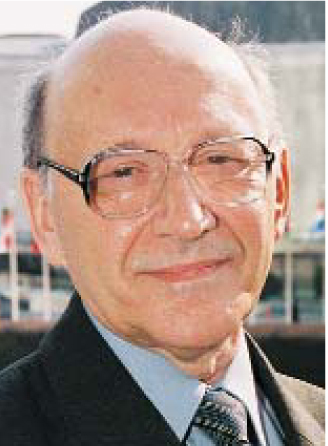
Catholic priest and cosmologist Michael Heller is this year’s winner of the Templeton Prize. According to the Templeton Foundation, which bestows it, the prize is intended to “serve as a philanthropic catalyst for discovery in areas engaging life’s biggest questions, ranging from explorations into the laws of nature and the universe to questions on love, gratitude, forgiveness, and creativity.” The Templeton Prize is the largest annual award to an individual and was designed to have a bigger purse than the Nobel Prize. This year it is worth about $1.6 million.
Heller, a member of the philosophy faculty at the Pontifical Academy of Theology in Krakow, Poland, first became a priest and then studied physics. Although he served in a parish at one time, he now pursues both interests as a scholar. He began his scientific career looking at dissipative processes in cosmic evolution. Today his focus is on using noncommutative geometry to construct a theoretical model to unify gravity and quantum mechanics. On the religious side, he says, “My idea is not so much philosophy of science, but philosophy in science.” Time, space, causality, and determinism, he says, were traditionally in the realm of philosophy and are now a part of physics. “It is my passion to investigate these problems as they are present in physical theories.” For Heller, science and religion inhabit “two nonintersecting planes. They are methodically different, they require conceptually different equipment. But they interact with each other—they did that in history very often.”
Under communism, the Polish authorities were officially antipathetic to both religion and intellectualism. But, Heller says, “to be in such a system is in a sense enriching because you can better know human nature and human stupidity.” Both professions, he adds, “require an entire human life. But it was easy, for me at least: I just followed my passions.”
Heller says his Templeton money will go toward founding the Copernicus Center “to further research and education in science and theology as an academic discipline.” The center traces back to an interdisciplinary discussion group originally formed in the 1960s by Karol Wojtyła, the future Pope John Paul II.

Heller
KAREN MARSHALL
More about the authors
Toni Feder, tfeder@aip.org