Physics Papers Sold at Auction
DOI: 10.1063/1.1535001

Modern physics drew nearly $1.8 million at an auction on 4 October. “It was a groundbreaking sale,” says Francis Wahlgren, head of the books and manuscripts department at Christie’s auction house in New York City. “We’ve handled Einstein before, but never within the whole context of how he fits into the works of other physicists.”
The sale’s top draw was an autograph manuscript from 1913–14, with some 50 pages of calculations by Albert Einstein and Michele Besso, in which they checked whether an early version of the general theory of relativity could account for a tiny discrepancy between predictions and observations of Mercury’s motion. (It couldn’t.) The Einstein–Besso manuscript went to a European dealer for $559 500. One of the few items predating the late 19th century, a fragment of an autograph manuscript by Isaac Newton—some 90 words that he added to the second edition of Optiks—brought in the next-largest sum, $89 625, from an anonymous buyer.
In addition to dozens of Einstein manuscripts, the sale’s roughly 3000 books, pamphlets, offprints, letters, and other papers documenting the development of modern physics were penned by Neils Bohr, Ludwig Boltzmann, Paul Dirac, Werner Heisenberg, and James Clerk Maxwell, to name a few. “There is nothing else like this in private hands,” says Wahlgren. “Apart from some institutions, you don’t see this many manuscripts of this sort together. It’s a unique collection.”
The collection had been amassed over two decades by Harvey Plotnick of Chicago. Plotnick sold his physics collection to devote money and time to another passion: early Islamic art.

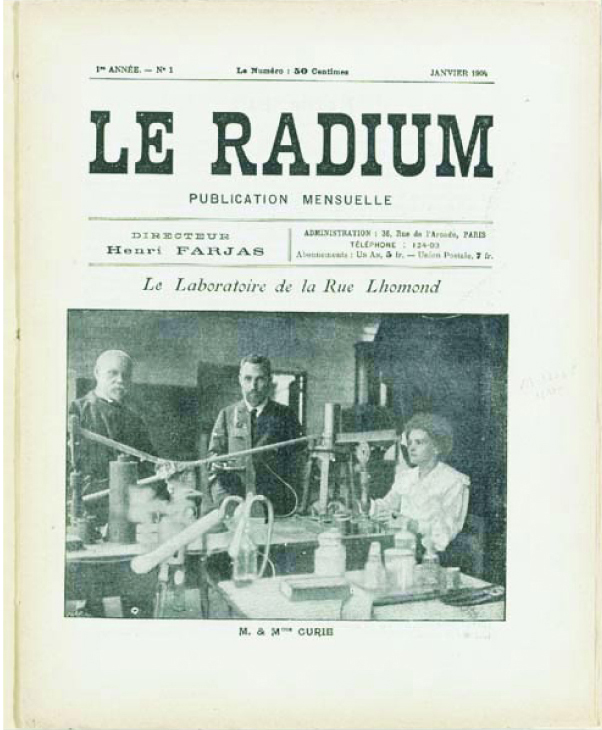
Le Radium , the first journal to focus on radium, launched in 1904 and featuring Henri Becquerel (left) and Pierre and Marie Curie on the cover, sold for $2868 at a Christie’s auction.
CHRISTIE’S

More about the authors
Toni Feder, American Center for Physics, One Physics Ellipse, College Park, Maryland 20740-3842, US . tfeder@aip.org