Physicists Seek to Aid Developing Countries
DOI: 10.1063/1.2169435

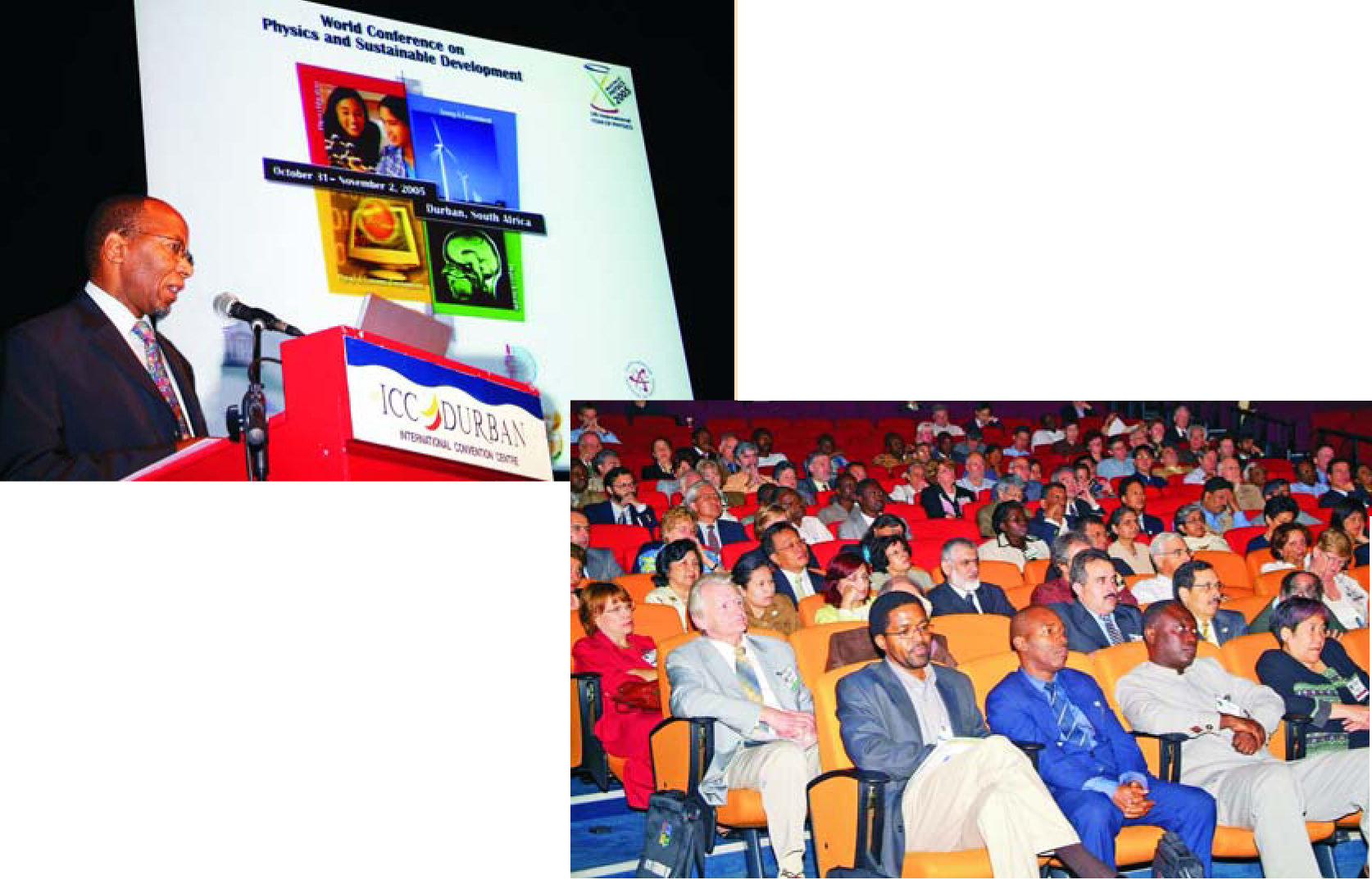
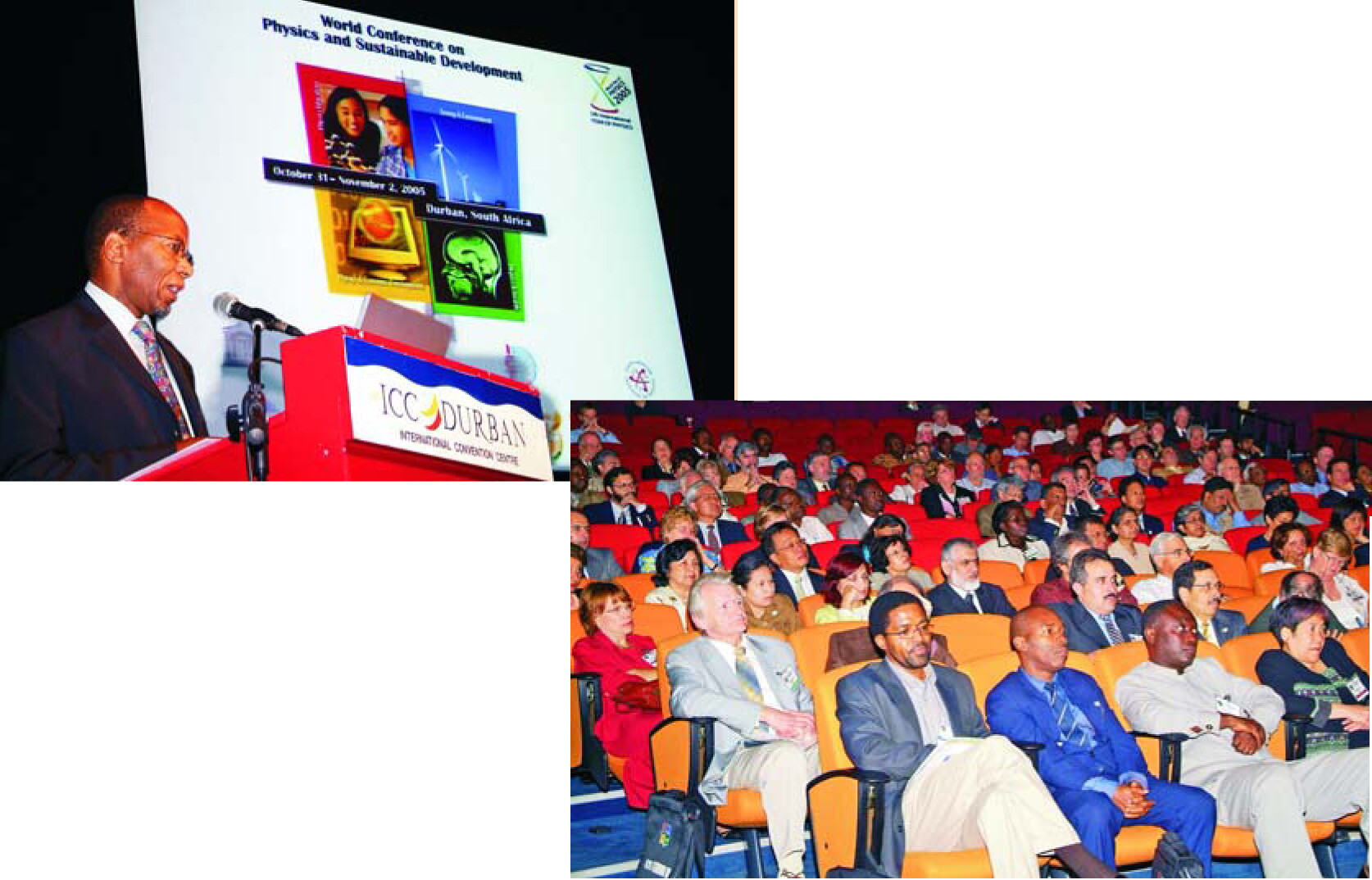
The World Conference on Physics and Sustainable Development drew more than 300 physicists from 70 or so countries to Durban, South Africa, from 31 October through 2 November.
The conference was intended “to bring the physics community together and have it make a commitment to working collectively on the problems of sustainability,” says Judy Franz, executive director of the American Physical Society and secretary general of the International Union of Pure and Applied Physics. The conference’s four leading sponsors were IUPAP, the United Nations Educational, Scientific and Cultural Organization (UNESCO), the Abdus Salam International Centre for Theoretical Physics (ICTP), and the South African Institute of Physics.
The crux of the conference was the drafting of proposals for ways physicists in industrialized countries can work with those in developing countries in four areas: economic development, energy and environment, education, and health. “Our first measure of success,” says Amy Flatten, APS’s head of international affairs and a conference organizer, “is that the program committees came together around concrete actions. Some will be refined, and some can be started tomorrow. There’s a lot of energy coming out of this.”
Action plans
The proposals in economic development include forming a network on nanoscience and nanotechnology focusing on water, air, and energy and forming a separate network on physics in agriculture. While the two networks had been considered ahead of time, a third plan, to run month-long courses in entrepreneurship for physicists, was born at the conference. “This is the one we are most enthusiastic about,” says committee cochair Peter Melville of the UK’s Institute of Physics. IOP will commit money and ICTP will host pilot courses, he adds.
Enhancing efficiency and reducing pollution in transportation, promoting the use of solar energy, and developing inexpensive facilities to generate energy from local biomass for small communities were the aims laid out by the conference delegates who focused on energy and the environment. In Africa today, says cochair Osman Benchikh, who is responsible for energy in UNESCO’s division of basic and engineering sciences, “Seventy-seven percent of the population does not have access to electricity. The only option that is really viable and could also be economically viable is renewable energy.”
Citing a worldwide shortage of medical physicists, the physics and health group sought ways to accelerate training, says cochair Debbie van der Merwe, director of medical physics at the Johannesburg Hospital in South Africa. “There was a consensus that the same basic education should be offered worldwide.” One initiative is a website with educational resources for physicists and engineers in health care (see http://www.wcpsd.org/health/perhd.cfm ). In addition, this group sees a need for regional training centers focusing on the physics of radiation therapy and for partnerships among hospitals and medical physicists.
Making teaching materials available on the Web, developing locally and culturally relevant instructional materials to help students understand how physics is related to sustainable development, and holding workshops for people who train physics teachers in Africa, Asia, and Latin America were goals set by the group that considered education from kindergarten through college. The workshops would be organized locally with help from people in developed countries, says committee cochair Priscilla Laws of Dickinson College in Carlisle, Pennsylvania. “We would try to get leaders, who would then go out and replicate what they had learned.” An initiative that already has funding, from the Schlumberger Foundation, is to electronically link “physics on the road” programs and other roaming physics demonstrations so they can work cooperatively.
“Tread with care”
“All four themes are interesting for us,” says Phuc Xuan Nguyen, a delegate from Vietnam. “We understand that the environment, energy, new technologies, all these issues are important for development in countries like ours. It starts with education.” For his part, Nguyen says he is particularly keen to follow up on the nanotechnology network idea.
Taking off his UNESCO hat and speaking as a physicist from Algeria, Benchikh says that in his discussions with people from developing countries at the conference, “there was a lot of enthusiasm. Now they expect concrete actions.”
The next steps are to identify leaders and funding. On the last day of the conference, Rob Adam, director of South Africa’s department of science and technology, warned that solving societal problems—or realizing the action plans laid out at the conference—is different from solving physics problems: “Sustainable development is more complex and harder to reduce to a set of laws which embody its essence. This means it is less amenable to a classic physics approach,” he said. “Tread with care.”

Mosibudi Mangena, South Africa’s Minister of Science and Technology, gave the opening remarks at the World Conference on Physics and Sustainable Development (left). Some 55% of delegates (below) came from developing countries.
ROY REED
More about the authors
Toni Feder, American Center for Physics, One Physics Ellipse, College Park, Maryland 20740-3842, US . tfeder@aip.org