Passive radiative cooling: Not such an off-the-wall idea
DOI: 10.1063/pt.uvjs.akkn
The atmospheric greenhouse has a hole in it. Although carbon dioxide, methane, and other gases absorb radiation across much of the IR spectrum and reradiate it back toward Earth, they’re nearly transparent between 8 µm and 13 µm, the wavelengths most strongly emitted by a blackbody at 300 K. When a material is engineered so that all, not just most, of its thermal radiation is concentrated in that window, it beams energy straight into outer space. Its temperature spontaneously drops several degrees below that of its surroundings. If spread over 1–2% of Earth’s surface, it could even help cool the planet .
That may sound outlandish, but it’s not. Over the past decade, researchers have developed several designs for cooling materials, typically based on substances with strong vibrational resonances in the 8–13 µm window, such as silicon dioxide (see Physics Today, April 2017, page 16 ). But there’s a catch: The materials work only on rooftops and other upward-facing surfaces. If applied to a vertical wall, they’d exchange energy just as readily with the ground as with the sky. And because the ground is usually warmer than its surroundings, it negates the whole cooling effect.
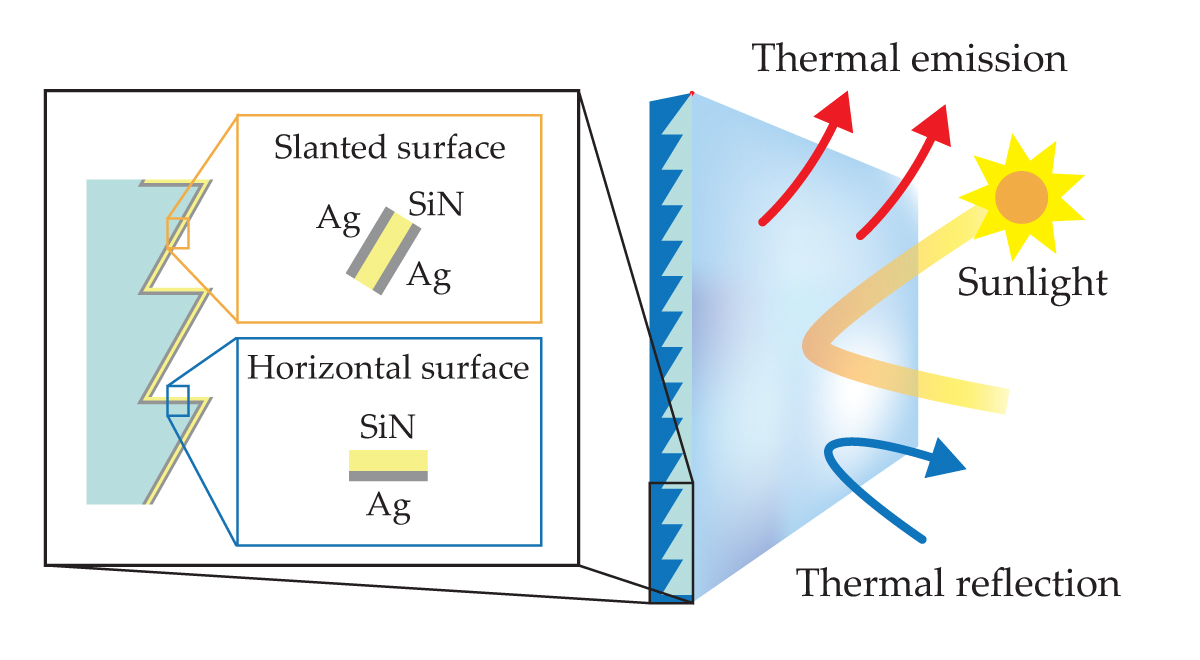
Now an international team of researchers, led by Wei Li of the Chinese Academy of Sciences, Shanhui Fan of Stanford University, and Andrea Alù of the City University of New York, has developed a passive radiative cooling material that works on walls. As shown in the figure, the material has a sawtooth profile, with horizontal facets that face up and slanted facets that face down. The horizontal surfaces are coated with silicon nitride, which emits radiation in the 8–13 µm window. The slanted surfaces are coated with silver to reflect the thermal radiation from the ground.

To cool a wall, a material must emit IR radiation toward the sky while reflecting the radiation coming at it from the ground. It can do that with a sawtooth pattern of facets, with the upward-facing surfaces made of IR-emitting silicon nitride and the downward-facing surfaces made of highly reflective silver. (Figure adapted from F. Xie et al., Science 386, 788, 2024.)

The researchers tested the material on a hot, sunny day in Beijing. Although the air temperature peaked at 41 °C and the ground temperature reached a scorching 58 °C, the sawtooth cooling material remained below 38 °C. For comparison, a conventional radiative cooling material—designed for horizontal surfaces but deployed on a vertical surface—reached 42 °C, and ordinary white paint was heated to 46 °C.
The material probably won’t replace power-hungry cooling technologies, like mechanical air conditioning, all by itself. But cooling an air conditioner’s heat sink by just a few degrees can greatly increase its efficiency. And the researchers have their eye on a wide variety of applications, including not just the walls of buildings but also vehicles and clothing. (F. Xie et al., Science 386, 788, 2024 .)
This article was originally published online on 15 November 2024.
More about the authors
Johanna L. Miller, jmiller@aip.org