One photon’s transmission usefully controls another
DOI: 10.1063/PT.3.4586

Prime numbers are the keys to encrypting sensitive information (see the Reference Frame by N. David Mermin, Physics Today, April 2007, page 8 ). If an adversary wanted to decipher a message protected by today’s most often-used encoding method, known as RSA encryption, they would need to identify the prime factors of numbers with thousands or tens of thousands of digits. That feat is beyond the capability of classical computers, although not for quantum-based ones. 1
In a quantum computer, the information stored as zeroes and ones in classical bits can be encoded as a superposition of quantum states in various physical systems, such as trapped ions and large groups of cold, neutral atoms (see the article by Ignacio Cirac and Peter Zoller, Physics Today, March 2004, page 38 ). A qubit stores more information than a classically equivalent bit, and a unitary transformation of a qubit can operate on all the information simultaneously. With that parallel processing power, quantum computers could deploy brute-force techniques or other, more clever algorithms to efficiently solve the prime factorization problem.
Much like energy, mass, and other physical quantities that obey the conservation laws, quantum information can neither be created nor destroyed. But when, for example, quantum information encoded in a photon’s transverse position travels some distance through a fiber-optic cable, stray light destroys the correlations in the quantum system. “Noise that destroys quantum resources is one of the most important issues which hinder a practical and large-scale development of quantum technologies,” says Rosario Lo Franco, a physicist working on quantum systems at the University of Palermo in Italy.
Recovering the original quantum state would require a quantum-error correction (see Physics Today, February 2005, page 19 , and the article by John Preskill, June 1999, page 24 ). One approach to limit the effects of noise, or decoherence, uses a qudit, which is a generalization of the two-level qubit to systems with d levels. A variable such as the spin of an electron can only take one of two values, but the position or momentum of a photon is continuous and can have many values, the number of which depends on the capabilities of the measuring device. A high-dimensional quantum state, such as one in which the various spatial patterns of a two-photon system are entangled, can carry a lot more information than zeroes and ones in its spatial and temporal structure.
Such a state is also more resistant to decoherence than ones based on light polarization or electron spin. That’s because the information encoded in the position and momentum of photons is discretized across more dimensions than a binary quantum state, and the environmental noise is consequently diluted across the additional quantum levels. 2
Physicists have demonstrated that the correlations in a photon pair with position–momentum entanglement can be maintained while being transported up to 300 km through a single-mode fiber, which acts as a waveguide that only allows one light pattern through.
3
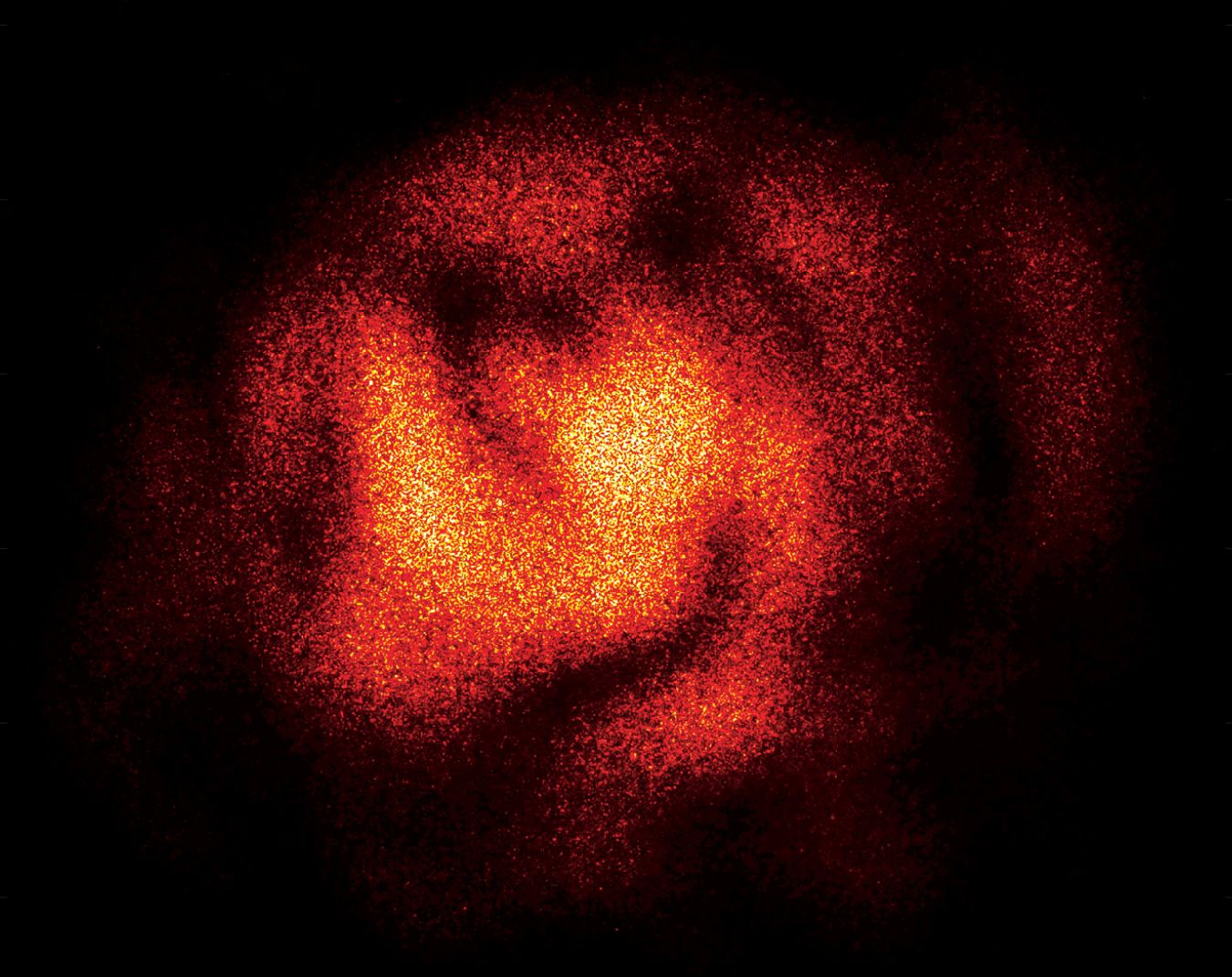
An approach with more storage capacity would use hundreds of light modes, each carrying unique bits of information, that could be transported through a multimode fiber-optic cable. Maintaining the entangled light state in such a noisy environment is challenging because of the scattering and interference the light experiences. Figure
Figure 1.

The red–yellow speckle pattern formed from light that interferes with itself as it travels through a multimode fiber-optic cable. The effects of such scattering must be corrected for an entangled state to transmit error-free information in a quantum computer. (Image courtesy of Mehul Malik.)

Now Natalia Herrera Valencia and Mehul Malik, both of Heriot-Watt University in Edinburgh, and their colleagues have demonstrated that they can preserve the quantum correlations of two photons in a multimode fiber-optic cable. They do so by determining how the transmitted photon was scattered from the entangled quantum state itself. 4
Seen in a quantum light
The researchers take advantage of a process called spontaneous parametric down-conversion, which transforms a higher-energy photon into a pair of lower-energy ones by splitting the photon beam from a UV laser with a nonlinear crystal. That optical process entangles the pair such that the position–momentum of each photon is linked: Because of the conservation of momentum, measuring one photon’s momentum affects the entire quantum state and reveals that of the other.
After the two photons are produced, a polarizing beamsplitter separates them: One is measured locally, and the other is sent through a two-meter-long multimode fiber-optic cable. In the experiment, two spatial light modulators display the modes of each photon’s quantum state as seven individual pixels on various holograms, which the researchers examined to determine the particular spatial modes of light.
The position–momentum state of the photon pair was then measured by the light intensity of each pixel to determine how the fiber scattered the transmitted photon. Those data and phase information retrieved from a copropagating reference mode are contained in the transmission matrix—an array of complex numbers that connects the transmitted photon’s input modes to the set of observed output modes.
Figure
Figure 2.

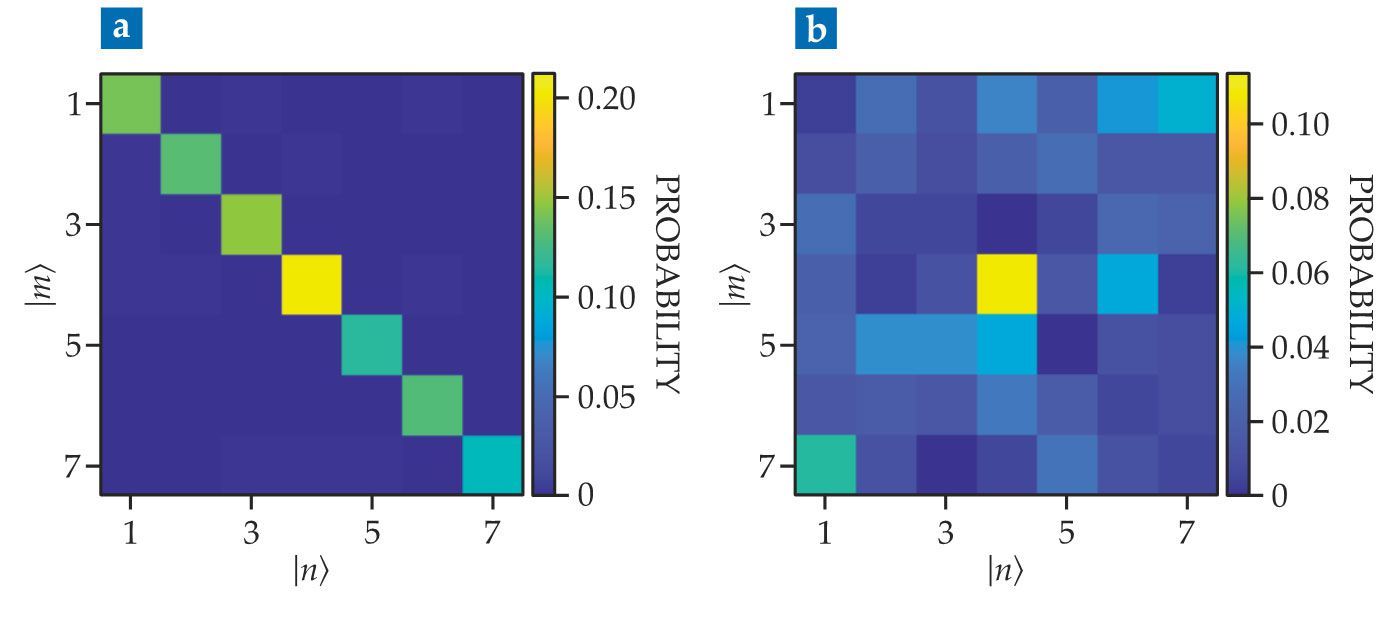
Preserving entanglement. The position and momentum patterns of two entangled photons |m⟩ and |n⟩ were measured in seven dimensions. (a) The quantum correlations of the spatial modes for the system were preserved before one of the photons was transmitted through a two-meter-long multimode fiber-optic cable. (b) Scattering of the transmitted photon in the fiber destroyed the correlations, as shown here. By mapping that scattering onto the two-photon correlations, the researchers restored the system’s entanglement. (Adapted from ref.

To remove the decoherence caused by that noisy environment, the researchers used the transmission matrix to define an operator that scrambles the untransmitted photon. Then they tested the post-transmission quantum state for entanglement, although some problems, such as matrix-inversion issues and measurement uncertainty, prevented them from verifying the presence of a 7D entangled state.
Despite those issues, the researchers demonstrated that a 6D entangled state of light could be maintained through a multimode fiber-optic cable with an accuracy of 84%. “We were very surprised when it worked right away,” says Malik. “I just started my group two years ago, and this was the first big experiment that we had set up.” That accuracy is good enough to show that the technique works, and the group is striving to improve the process. Lo Franco says, “The next goal is to further develop quantum information protocols that make use of high-dimensional states.”
More modes, larger spaces
The researchers could have mapped the inverse of the transmission matrix to the transmitted photon to restore the entangled state. But in a quantum communications scenario in which a secure key is established between two parties via the entanglement shared between them, one party could use the transmission matrix on its part of the entangled state to undo the noise effects experienced by the other. The person receiving the scrambled photon would not need any specialized equipment or resources.
Malik and his team also showed from theoretical calculations that each photon could travel through its own independent scattering channel and have the noise effects removed by performing a correction operation on only one photon. That possibility and the observed results would help make it feasible for a sender to preserve the quantum correlations of an entangled state even without having physical access to both photons.
The experiment used 7 of the approximately 400 modes of light that are supported by the multimode fiber, and Malik’s group is currently working on exploring the full number of available modes. But reconstructing large quantum states is difficult because of the many measurements that need to be made and the time it takes to process those data. “Just characterizing this (100 × 100)-dimensional Hilbert space is quite challenging,” says Malik. “It shows you that we as classical beings have a big challenge ahead of us to characterize the quantum world, even on the level of a few qubits or a fiber.”
References
1. P. W. Shor, Proceedings 35th Annual Symposium on Foundations of Computer Science, IEEE Computer Society Press (1994), p. 124.
2. S. Ecker et al., Phys. Rev. X 9, 041042 (2019). https://doi.org/10.1103/PhysRevX.9.041042
3. T. Inagaki et al., Opt. Express 21, 23241 (2013). https://doi.org/10.1364/OE.21.023241
4. N. Herrera Valencia et al., Nat. Phys. (2020), doi:https://doi.org/10.1038/s41567-020-0970-1 .
More about the authors
Alex Lopatka, alopatka@aip.org