Nuclear waste dump doubles as low-radiation site for science
DOI: 10.1063/1.3293407

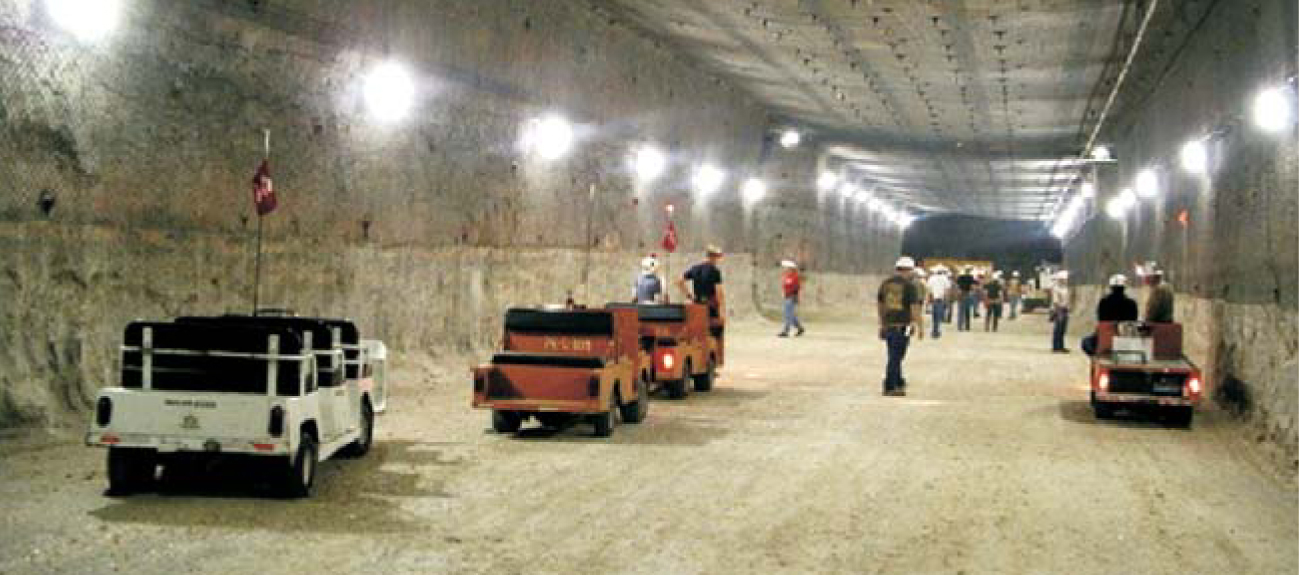
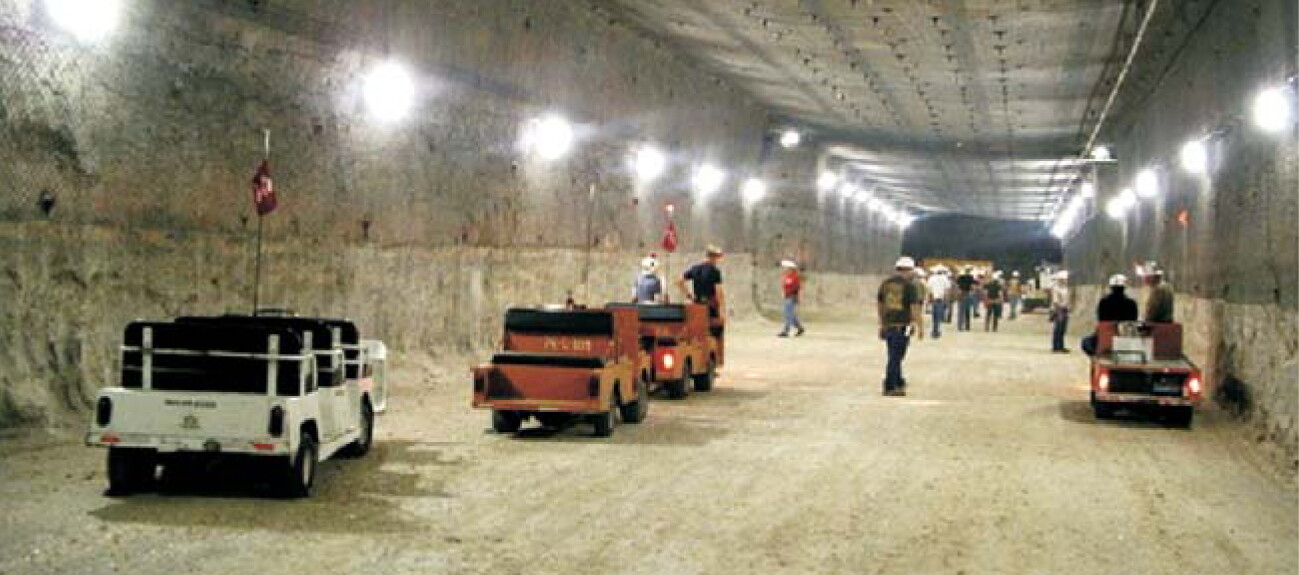
Scientific experiments that require a low-radiation environment may seem unlikely bedfellows with long-lived transuranic waste from nuclear weapons, but in the US Department of Energy’s Waste Isolation Pilot Plant near Carlsbad, New Mexico, the relationship appears to be mutually beneficial. Some 655 meters down in a salt formation, the background radiation level is much lower than at the surface, and the DOE can point to the sensitive experiments WIPP hosts as evidence that the controversial waste repository poses no hazard to the public.
For science, says Norbert Rempe, WIPP’s liaison for researchers, “the big advantage we have is the nature of the host rock. Radiologically, it is extremely quiet. Salt has practically no thorium or uranium, and the level of potassium is minute.” WIPP is host to the Enriched Xenon Observatory–200, a prototype double beta decay detector (see the story on
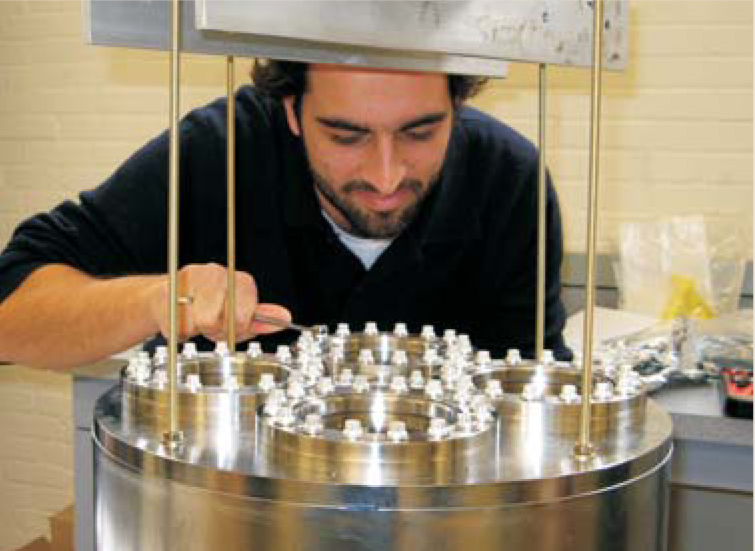
A team of scientists from Boston-area universities is setting up a dark-matter time projection chamber in WIPP. The idea is to look at the recoil tracks of fluorine nuclei knocked out of the experiment’s carbon tetrafluoride gas molecules by collisions with dark-matter particles. “What’s really different about this experiment,” says MIT’s Peter Fisher, “is that it does not just measure dark matter that bumps into a nucleus and leaves some energy but also measures the direction the dark matter comes from.” Because of Earth’s rotation and its motion through the galaxy, the direction of incidence of dark matter should shift about 96° in 12 hours, he says. “If we measure the wind from this prediction, it would be decisive proof we had observed dark matter.” The detector’s four view ports (getting a tweak here by MIT postdoc James Battat) will be instrumented with CCD cameras, which will image a two-dimensional projection of recoil tracks, and photomultiplier tubes will go in the center to measure the tracks’ third dimension. The experiment is intended as a proof of principle; the team hopes to later expand the target volume from 18 liters to 1000 liters.
Geoffrey Smith, a microbiologist at New Mexico State University, Las Cruces, heads up studies on the effects of radiation on cells. Cell growth is being compared under three different radiation exposures—a reduced level underground at WIPP, a surface level, and a slightly elevated level. “These are not levels we know as harmful,” Smith says. “The point is to get data to test the linear no-threshold hypothesis.” For two types of bacteria, Smith and his group track cell growth, protein production, and absorbance of the cell culture media. For the underground tests, Smith says, “the cells experience unnaturally low radiation levels because they are grown in a chamber made from 7-inch-thick, pre–World War II steel, which does not have radiation fallout from atomic bombs.” From the first round of experiments last summer, he says, “it looks like cells may not be doing as well underground, but it’s not statistically different from aboveground.” He plans another round of experiments this summer. Smith is also involved in other research in WIPP that doesn’t require low radiation levels, namely, the search for 250-million-year-old bacteria in saturated-brine inclusions.

GABRIELLA SCIOLLA, MIT


DOE
More about the authors
Toni Feder, tfeder@aip.org