NIST neutron source restarts after prolonged closure


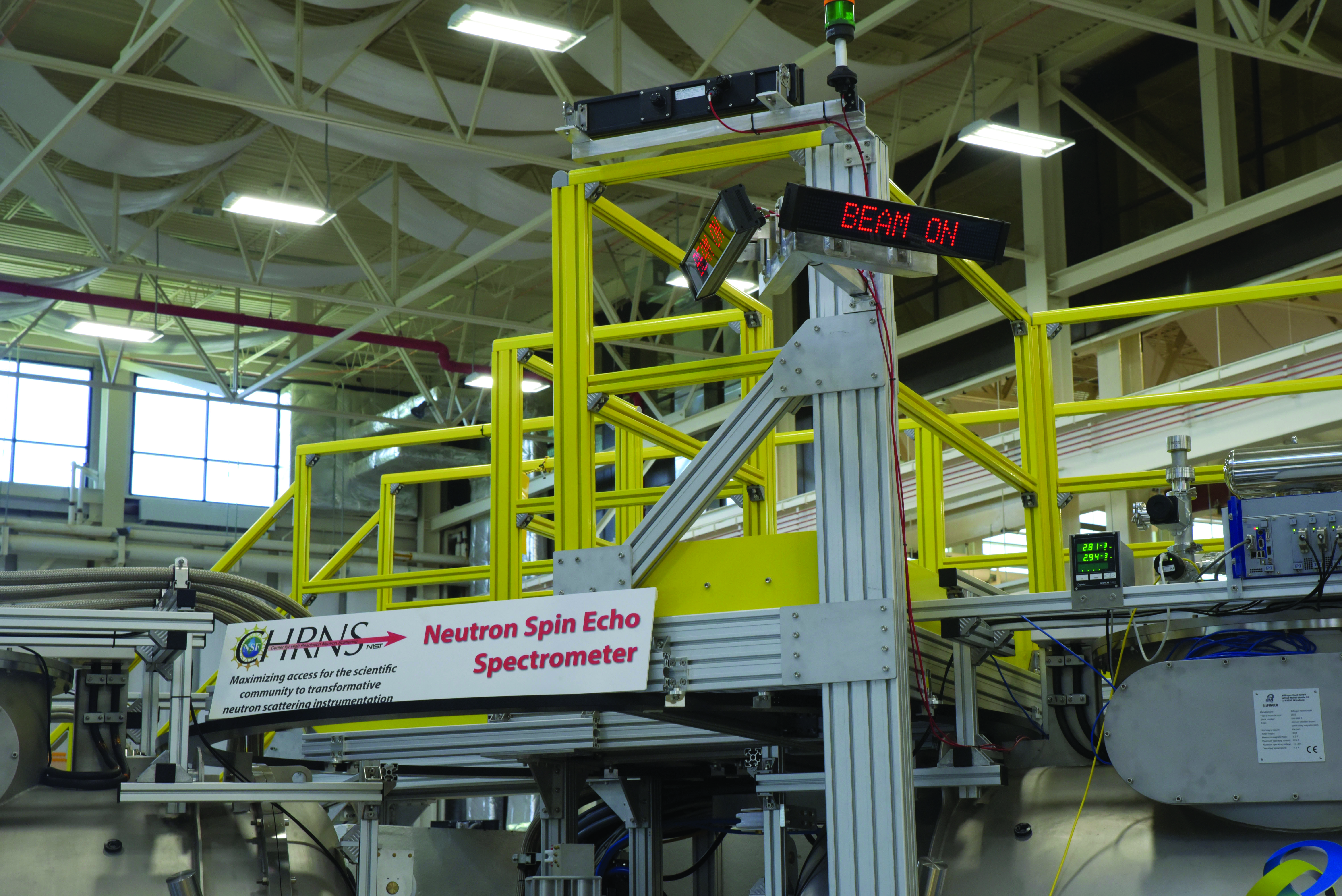
The Neutron Spin Echo Spectrometer is among the new instruments coming on line as the NIST Center for Neutron Research reopens after a prolonged shutdown.
(Photo by Rich Press/NIST.)

The NIST Center for Neutron Research (NCNR) started up in August after a five-and-a-half-year shutdown. The research reactor that supplies the neutrons is ramping up to its full power of 20 MW, and the facility plans to welcome outside users in late November. But with the president’s fiscal year 2027 budget proposal requesting less for the NCNR than its pre-shutdown level, users fear that underfunding will limit staff positions, instrument availability, and hours of operation.
A refueling incident in February 2021 forced NIST to shutter the NCNR (see the 2021 PT story “Scientists dismayed by interruption at US’s most productive neutron source ”). One of 30 nuclear fuel elements was not latched into place, leading to fission products circulating within the reactor’s primary cooling system and some escaping into the confinement building. Radiation levels, both inside and outside the building, remained well below regulatory health and safety limits, says NCNR Director James Adams.
The Nuclear Regulatory Commission (NRC) gave the NCNR the green light to restart in 2023, but Adams opted to do a second cleanup. He says that in addition to the physical remediation at the site, the culture was changed “to make sure everyone feels safe bringing issues to leadership.” The tab for the cleanup and associated activities came to tens of millions of dollars, he says.
Neutrons can uniquely probe the structure, dynamics, mechanics, and magnetic properties of materials in areas such as quantum information, energy storage, superconductivity, and aerospace. The NCNR has 29 instruments, representing nearly 40% of the US’s neutron scattering capability and 10% of the world’s. Before the shutdown, the facility served about 3000 users a year. The NCNR restart marks the first time that an NRC-licensed reactor has reopened after a significant incident involving the melting of nuclear fuel.
Celebrating more neutrons
Efrain Rodriguez, a professor of materials and solid-state chemistry at the University of Maryland in College Park, is one of the many users excited about the reopening. “I have a generation of students who have never been to the NCNR,” he says. “We are thinking about what experiments we want to do there and what instrument configurations we will need.”
While the NCNR has been down, Rodriguez and his students have mostly used the other main US-based neutron sources—the High Flux Isotope Reactor and the Spallation Neutron Source, both at Oak Ridge National Laboratory. They have also used neutron sources in the UK, France, and Switzerland; other US researchers got beam time in Japan, Australia, and Europe. One plus of working in other countries, Rodriguez says, is that his international network has grown. But if an experiment doesn’t quite work out, “there is no going back the next weekend.” And, he adds, “I ate through my travel budget really fast.”
Rodriguez estimates that his publication pace dropped by about a quarter while the NCNR has been offline. And, he says, he hasn’t been able to train his students as thoroughly because of reduced beam-time access. “My students may have less of an edge when they look for jobs,” he says.
For physicist Rana Ashkar, the timing of the NCNR’s closure and the resulting slowdown in her research was especially stressful because she was still on the tenure track. Her Virginia Tech group turned to Oak Ridge for their neutron experiments probing the mechanical and dynamical properties of lipid membranes. The demand for beam time at Oak Ridge has been “insane,” she says, but “traveling outside the US was financially prohibitive.” She had to abandon some projects; for others, she turned to alternate techniques, which, she says, offered new insights but “could not address the same scientific questions” as neutrons.
The squeeze on access to neutrons, says Ashkar, “has been disruptive to training, research programs, and grant proposals. It was a cascading problem.” The unpredictable and scarce resources deterred some students from going into neutron scattering research, she says.
Seeking more money
Adrian Brügger is director of Columbia University’s Robert A. W. Carleton Strength of Materials Laboratory and president of the Neutron Scattering Society of America. The US neutron community is in “survival mode” because of the NCNR shutdown, he says. Because of the time it takes graduate students to do their PhDs, he says, “it will take five years for the damage to manifest.” He points to three new neutron sources in China that have come on line “while we blinked.” He notes that for the US to stay a leader in neutron scattering, the NCNR—and the field more generally—needs more federal funding.
At this point, four NCNR workhorse instruments have been mothballed. And another four may also go down, Brügger says. “That would be highly disruptive. It would impact the science community in a wide range of research fields.”
The NCNR’s budget for FY 2026 was about $53 million, out of NIST’s total budget (excluding earmarks) of roughly $1.2 billion. Before the shutdown, the NCNR’s annual budget was around $55 million. The request in the president’s budget for the next fiscal year is $45 million.
Operating the reactor costs $35 million–$40 million a year, according to Adams. For safety reasons, that part of the budget is untouchable, he says, so it’s the user interface and experimental capabilities that are affected by trimming the total NCNR funding. “If I have more money, I do more,” he says.

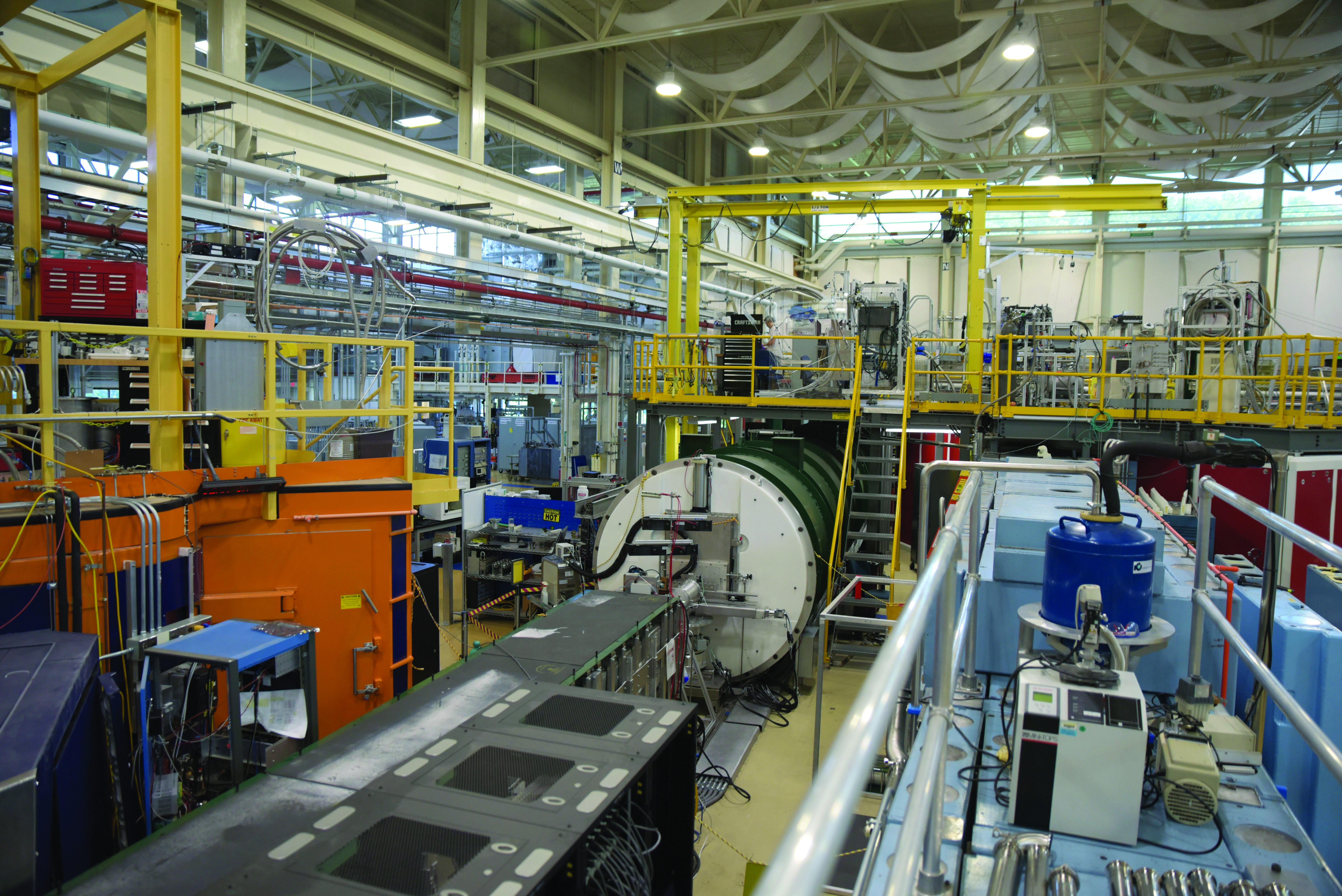
A view of the guide hall at the NIST Center for Neutron Research, which is ramping up after a shutdown of five-plus years that was triggered by a refueling incident. The black infrastructure and the large cylinder are parts of the Very Small Angle Neutron Scattering instrument. To its right is a beamline feeding another instrument, the Disk Chopper Spectrometer. The orange machine at left is part of the High Flux Backscattering Spectrometer.
(Photo by Rich Press/NIST.)

Alongside researchers’ worries about being able to fully exploit the NCNR comes excitement about the facility’s new capabilities. The main ones are three improved guides, which roughly double the flux of neutron beams; automation and upgrades to various instruments; and a spin-echo instrument that can probe dynamics on time scales of a tenth to hundreds of nanoseconds. The spin-echo instrument will allow researchers to probe membranes, gels, polymers, and monoclonal antibodies with improved energy resolution and faster data rates, says Norman Wagner. He is director of the Center for Neutron Science—a partnership between NIST and his home institution, the University of Delaware—which developed the new instrument.
Over the summer, the Neutron Scattering Society of America created an ad hoc committee to lobby Congress to earmark money for the NCNR. A 2024 study by RTI International estimates “that for every dollar invested in U.S. neutron scattering research facilities, $2.67 in benefits are realized.”
The committee is making two asks, says Brügger. One is for the NCNR to be funded at $65 million. The other is for the NCNR budget to be allocated as a line item in the congressional budget. “I am cautiously optimistic,” he says.