New telescope in Turkey
DOI: 10.1063/PT.3.2544

A 4-meter optical–IR telescope promises to catapult Turkey into astronomical modernity. The state-of-the-art Eastern Anatolia Observatory (DAG) is also intended to build up the country’s strengths in engineering, data mining, analysis, and modeling. First light is slated for 2019.
The idea for DAG originated with young Turkish astronomers who were frustrated with the light pollution and other limitations of the 1.5-m and smaller telescopes at the national observatory near the coastal city of Antalya in southern Turkey. Around the same time, in the late 2000s, Cahit Yesilyaprak, now principal investigator for DAG, was making observations of weather conditions outside Erzurum, a few hundred kilometers from Turkey’s borders with Armenia and Iran. The conditions looked good for a telescope, and he and colleagues proposed to build “the biggest telescope in Turkey, from scratch,” as project spokesman Sinan Kaan Yerli puts it. “We will switch from 1.5 meters to 4 meters, and from visible to IR.” DAG will observe optical wavelengths (0.4–0.8 μm) and up to 2.5 μm in the near-IR. Says Yerli, “Engineering-wise, observation-wise, DAG will be a revolution for Turkey.”
A no-nonsense workhorse
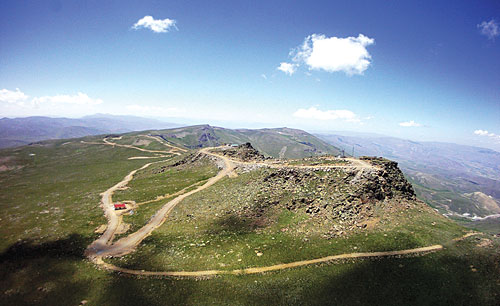
The government gave the green light for DAG in 2012. The tab is expected to exceed €20 million ($26 million); adaptive optics and instruments will be extra. DAG is being built atop a 3170-m-high plateau. Nearby Atatürk University is managing the observatory and will host a room from which the telescope can be remotely controlled. Eventually, a second operations location may be established elsewhere in Turkey, says Yerli, who is on the physics faculty at the Middle East Technical University in Ankara. About 80% of the civil infrastructure—roads, electricity, fiber optics, and the like—for DAG is in place.

Preparations for a 4-meter telescope at the Karakaya Tepeleri site, a few kilometers from Atatürk University, have Turkish astronomers and engineers working hard.
DAG/ATASAM

A couple of decades ago, a 4-m telescope was large, but now it’s “moderate,” Yerli notes, and to get the best use of DAG, “it has to be done really quickly. There are a lot of satellites being launched. We can efficiently and effectively do follow-up observations.” He adds that anything larger would have been unaffordable. Infrared astronomy is “a hot topic in science and is where we have a gap in wavelength” for observing, he says. “So the choice was 4 meters and near-IR.”
Among the topics likely to be explored with DAG are exoplanets, transient objects, stellar evolution, galaxy formation and evolution, and galaxy clusters. Astronomers from anywhere will be able to apply for time on the telescope. And, says Yerli, the location should make it useful for working with other telescopes to follow interesting objects over time as Earth turns. “Telescopes in South Africa, Chile, and Australia cover the Southern Hemisphere,” he says. “For the Northern Hemisphere, there are not many big telescopes in the east. DAG will cover a missing link.”
“This telescope is not supposed to be special,” says Lorenzo Zago, an engineer at the University of Applied Sciences Western Switzerland. “Let’s say its specialty is not to be special. It must be used for a wide range of observations. What we want is a no-nonsense, state-of-the-art telescope.” Zago was recruited as a project manager but says he sees himself as a coach. “The Turkish community doesn’t have experience in such a large project,” he says, “so they asked a few people from outside Turkey to help.”
“A bold step”
Perhaps DAG’s most notable advance is that adaptive optics will be incorporated from the start rather than retrofitted. “We designed the mirror surface and specifications for an adaptive optics system. The DAG telescope will be one of the best-performing telescopes in the world,” says Onur Keskin, the national project manager.

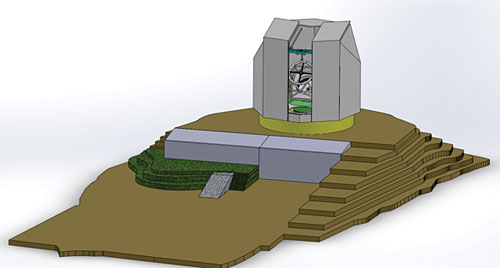
The current conception of the Eastern Anatolia Observatory telescope, dome, and related facilities.
DAG/ATASAM

Actuators on the 16-cm-thick primary mirror will compensate for gravity and thermal contraction or expansion. Such effects are relatively slow: The “active optics” applied to the primary mirror work at a maximum frequency of 10 Hz. Fast actuators that compensate for atmospheric turbulence, which may vary at frequencies up to 1000 Hz, will be fitted onto a smaller deformable mirror. “We took a bold step,” Keskin says. “We reduced the number of actuators [on the primary mirror] because we are going to correct better with the adaptive optics. That lowers the cost of the telescope.” The compact design is also meant to keep down costs.
The mirrors, active optics, telescope dome, and other parts of DAG are being built outside Turkey. But Keskin, a faculty member in engineering at Isik University in Istanbul, is in charge of the adaptive optics and control systems for the telescope. He plans to design and build a ground-layer adaptive optics system. The method uses a few bright stars to measure the wavefront perturbations in different directions and to implement corrections over a large field of view. It’s a versatile approach, says Keskin. “If the angle of the guide stars is decreased to zero, the system becomes a classical adaptive optics system. By changing the algorithm it can be turned into a tomographic system. Or by adding an extra deformable mirror, the system can even be turned into a multi-object adaptive-optics system.”
Ground-layer adaptive optics is pricey, but Keskin says the cost will be kept below €5 million because he and a team of students will do the design and fabrication work. And if the state won’t pony up for the adaptive optics, the DAG team will look to universities and other sources. “We will do it one way or another,” says Keskin. “What we used to do is transfer technology, know-how, the whole thing.” He is optimistic that funding for fancy adaptive optics will come through somehow, partly because of pride in having the technology be homegrown.
More about the authors
Toni Feder, tfeder@aip.org