New European agency introduces internationally competitive funding for basic research
DOI: 10.1063/1.2911170

Just a few months into a postdoc at Harvard University, Katerina Aifantis is leaving for greener pastures: She is headed for Aristotle University in Thessaloniki, Greece, where, with more than €1 million ($1.5 million) over five years from the European Research Council, she hopes to nucleate a nanomechanics center.
Aifantis is one of roughly 300 awardees among more than 9000 applicants in the ERC’s first grant competition. The agency announced the winners of the “starting grants”—intended to jump-start careers—in February, around the time of its first birthday. Says ERC president Fotis Kafatos of Imperial College London, “We are not looking for the sure bets, we are looking for the most visionary and interesting bets that we feel have a reasonable chance of success.”
“Added value”
The ERC marks the beginning of European funding for basic research; traditionally, basic research has been the purview of national funding agencies, and the European Commission—which launched the ERC—supported applied and industrial research. Starting grants went to researchers in the physical sciences and engineering (45%), life sciences (40%), and the humanities (15%).
“About 10 years ago, some of us involved in science, especially in life science, got together and said we needed strong support for research at the European level, as well as at the national level, to focus on top-quality research,” says Kafatos, who at the time was director of the European Molecular Biology Laboratory in Heidelberg, Germany. By involving all of Europe, rather than just one country, he adds, “you sharpen the competition. If you are in a small country, and you and your friends are the only excellent scientists in a field, it’s stagnant.”
In political circles, however, “the prevailing orthodoxy was that we didn’t need an ERC,” Kafatos continues, noting that the surprise support of the UK’s then science minister David Sainsbury in 2004 was key. “On his way to a meeting of the council of ministers, he read the brief [prepared by his aides] and background documents. He called his aides to ask why he was supposed to vote ‘no.’” Unsatisfied with the answer, Sainsbury voted yes. “The fact that the UK was in favor was not expected. It was the spark that got everyone enthusiastic,” says Kafatos.
The ERC’s budget of €7.5 billion for 2007–13 comes directly from the European Commission, not from member states. “This is important because otherwise they’d say, ‘This is my money, I want it back,’” says Kafatos. “There was no political interference,” adds Ernst-Ludwig Winnacker, the ERC’s secretary general and former president of Germany’s main research agency. “It’s really bottom up. Nobody told us to fund some fashionable things. Nobody said, ‘Take care of the Baltic states.’ For this the [European Union] has other programs.” Anyone may apply for ERC funding; the only requirements are that the work be based at a research institution in Europe or a paying associate member country such as Israel or Turkey and, for the starting grants, researchers must be two to nine years post-PhD. The ERC will also award money to established researchers, via its “advanced grants,” for which applications were due over the past few weeks.
“The idea was to create added value, not copy what the national agencies do,” says Winnacker. The ERC offers larger grants generally, and more money to junior scientists, than do most national agencies. “There are very bleak perspectives in many European countries for junior scientists,” Winnacker says. “And most scientists tend to be quite conservative if it comes to changing their funding strategies. They don’t jump onto projects where the probability of getting funding is lower. So the [ERC grants] create a lot of independence. We hope to get people to discontinue what they do and come up with something risky.”
Best performance
Winning an ERC grant landed Sander Woutersen a job. “It’s so prestigious that the University of Amsterdam offered me a permanent position,” says Woutersen, a physicist who uses laser techniques to study protein folding. “It’s a large amount of money and personnel, a big responsibility, so I wrote a proposal that was a mixture of safe and risky parts. I want to make sure my two PhD students get results and can write articles.” The “risky” aspect, he adds, will be “to try new experimental methods. Many time-resolved methods that should be sensitive to protein conformation have not as yet been investigated.”
For her part, Aifantis—at 24 the youngest recipient of an ERC starting grant—is working on making smaller, less fracture-sensitive lithium batteries. “What’s of interest is to make anodes with higher capacities,” she says. “I am working on a theoretical framework to help develop design criteria. This will help predict what materials will be the most effective anodes.” The ERC grant, she adds, “is really good for people who love science. It can help you perform at your best since you don’t have to worry about administrative or other issues.”
“I would like to introduce new interdisciplinary graduate and undergraduate programs in nanoscience” to Aristotle University, says Aifantis. “In Greece, the best students usually go out of the country to get their master’s and PhD degrees. The local environment often prevents those who stay behind from seeing science as something imaginative and creative. I want to open their horizons to show them something very exciting. I like that I can bring something new, instead of going to, say, Cambridge or Oxford, where they already have these big nanotechnology groups. Some people are telling me it might be more difficult if you are by yourself, but I kind of like the challenge.”
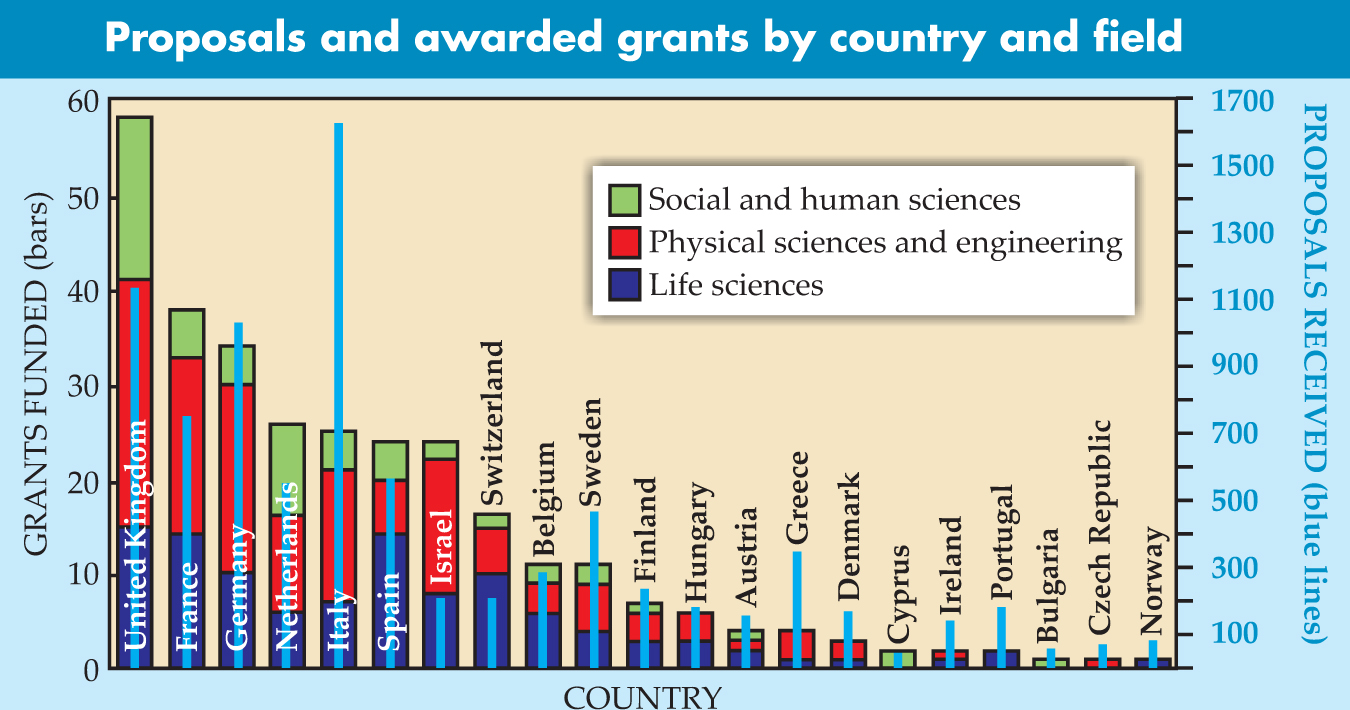
It’s too early to say what impact the ERC will have. But, says Winnacker, “we are getting a lot of calls. Universities now ask themselves, ‘Why didn’t we have a candidate for a grant? Why are the UK, the Netherlands, Switzerland, and Israel so successful?’” Governments take the number of grants hosted by each country seriously, he adds. “The French prime minister invited all the grantees who work in France, not only French people, to his office. Angela Merkel [the German chancellor] supposedly does the same thing.” Tamás Vicsek, a biological physicist at Loránd Eötvös University in Budapest, Hungary, who has applied for an advanced grant, notes that starting-grant applicants who did well in the competition but didn’t make the final cut will be “favorably treated” by Hungary’s national research funding agency. The ERC grants, he adds, are “particularly significant” in countries with a low R&D budget.

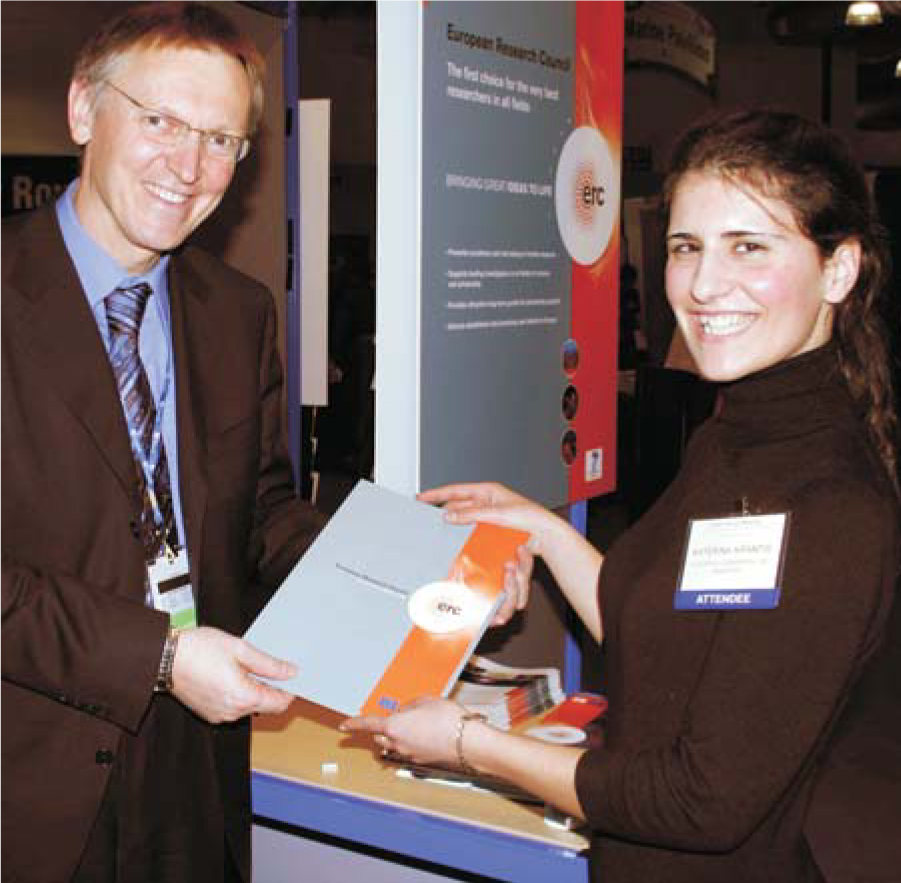
Katerina Aifantis with Janez Potočnik, the European commissioner for science and research.
EUROPEAN COMMISSION

Awarded grants (left axis, bars) and proposals (right axis, blue lines) in the European Research Council’s first grant competition. The colors show the successful grants by subject. Proposals submitted from countries that did not receive any grants are not shown.
(Data provided by the European Research Council.)
More about the authors
Toni Feder, tfeder@aip.org