New Atomic Magnetometer Achieves Subfemtotesla Sensitivity
DOI: 10.1063/1.1603066

Measuring small magnetic fields plays an important role in many areas of physics. Mapping small variations in Earth’s magnetic field, tracing the history of geodynamo reversals as recorded in ancient rocks, characterizing new superconductors and other materials, searching for deviations from the standard model of particle physics, mapping the fields and currents of heart or brain activity—all require precise measurements of magnetic fields that are orders of magnitude smaller than Earth’s.
A key benchmark in such applications is a device’s sensitivity—the square root of the mean square field noise per unit bandwidth of the device. The device front-runner in most magnetometry applications is the superconducting quantum interference device (SQUID). Formed from superconducting rings interrupted by Josephson junctions, SQUID magnetometers for applications such as magnetoencephalography have sensitivities of around
Another class of sensitive magnetometers, which has been around for more than 40 years, exploits the effects of magnetic fields on the unpaired spins of individual atoms. Atomic magnetometers have achieved sensitivities comparable to SQUIDs, but at a price: They are large, which reduces their spatial resolution and limits their usefulness for magnetic imaging applications.
Now, Michael Romalis and colleagues from Princeton University and from the University of Washington in Seattle have demonstrated a new atomic magnetometer that achieves subfemtotesla sensitivity with high spatial resolution. 1 “This combination of high sensitivity and good spatial resolution is a real breakthrough,” says Dmitry Budker of the University of California, Berkeley.
Measuring the Zeeman splitting
Atomic magnetometers measure, in various ways, the Zeeman effect: the magnetic-field-induced shift of the energy levels of an atom’s spin states. Alkali atoms, such as rubidium and potassium, are most commonly used because their single unpaired electron makes for a simple spin-1/2 system. Bulk alkali metal placed in a magnetometer will generate a vapor whose density depends on the operating temperature.
To get a vapor magnetization large enough to measure, atomic magnetometers optically pump the gaseous atoms into a polarized state. Romalis and coworkers use circularly polarized light for pumping; some other magnetometers use linearly polarized light. The light’s frequency is resonant with the transition from the atom’s ground state to a higher, excited state. In the case of circularly polarized light, angular momentum conservation allows only electrons in one spin state to absorb photons. But the excited state can relax back to either spin orientation in the ground state. The net effect of the pumping process is a depletion of the population in the ground spin state that couples to the light. The resulting spin polarization is appreciable and can, for some magnetometers, approach 100%.
Many different styles of atomic magnetometers have been developed. One approach, championed by Eugene Alexandrov at the Vavilov State Optical Institute in St. Petersburg, Russia, is a double-resonance technique that combines optical pumping with radio-frequency radiation. 2 When the alkali vapor is fully polarized, no electrons are in the appropriate spin state to absorb a photon, and the optical pumping beam is fully transmitted. If an RF field is applied to the magnetometer and the frequency is swept, the vapor becomes depolarized when the frequency is resonant with the Zeeman splitting of the ground-state, and the intensity of the transmitted light drops. The frequency at which the drop occurs is a measure of the magnetic field strength. Such magnetometers have attained sensitivities approaching 1 fT/Hz1/2, and magnetometers based on the double-resonance technique are commercially available.
Robert Wynands and colleagues at the University of Fribourg in Switzerland have recently used two double-resonance magnetometers, configured as a gradiometer, for magnetocardiography—the mapping of the heart’s magnetic field. 3 One magnetometer was rastered near the heart to measure the 100-pT field it produced; the other magnetometer was farther away and was used to measure and subtract stray fields. The measurement sensitivity was about 100 fT/Hz1/2.
Another approach used by Wynands and coworkers for atomic magnetometry is based on a phenomenon known as coherent population trapping (CPT). 4 Two lasers are used to excite transitions from different hyperfine levels of the ground state to a common excited state. When the lasers are properly tuned to the field-dependent energy levels, they drive the electrons into a coherent superposition of the two hyperfine states—a so-called dark state that doesn’t couple to either laser. The resulting trough in the atoms’ absorption spectrum is very narrow and thus provides a sensitive determination of the magnetic field: This technique has achieved sensitivities around 1 pT/Hz1/2.
In yet another approach, developed by Budker and coworkers, a single beam of linearly polarized light both pumps the magnetometer and probes its polarization. The detection technique, which utilizes nonlinear magneto-optical rotation, has a theoretical sensitivity limit of 0.3 fT/Hz1/2, and its dynamic range can be expanded to include fields on the order of Earth’s. 5
The sensitivities of atomic magnetometers can be limited by the lifetime of the spin coherence—the T 2 in magnetic resonance terms. A limiting factor in atomic magnetometers is often spin-exchange collisions. When two atoms collide, angular momentum can be transferred from one spin to another. Although that process conserves angular momentum, such collisions are still a problem, because they can switch atoms between different hyperfine states. Electrons precess in opposite directions in the two states, and thus they lose coherence.
Most atomic magnetometers operate at a vapor density low enough for the line broadening due to spin-exchange collisions to be tolerable. But spin exchange need not be a liability. In the 1970s, Will Happer (now at Princeton) and colleagues considered the limiting case of very low magnetic field and high vapor density. In that regime, the spin exchange rate is much larger than the precession frequency; the more frequent the collisions are, the more slowly the phases of the different spin states diffuse from each other, and thus, in that limit, the vapor remains polarized. 6 The net effect of spin exchange is merely to slow down the precession slightly. Capitalizing on the reduced decoherence rate in that regime, Romalis and coworkers have demonstrated a sensitivity of 0.54 fT/Hz1/2.
High sensitivity, low volume
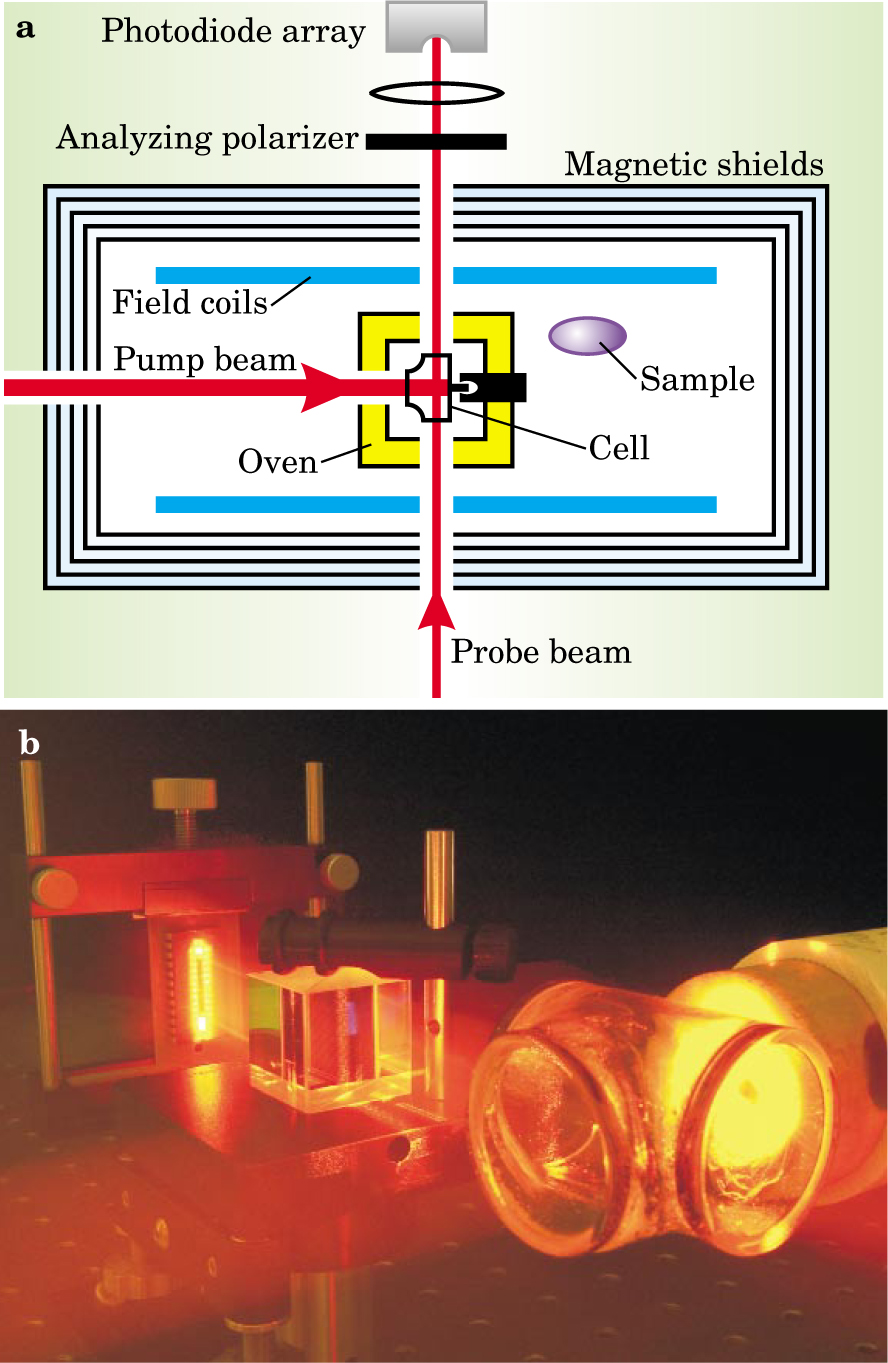
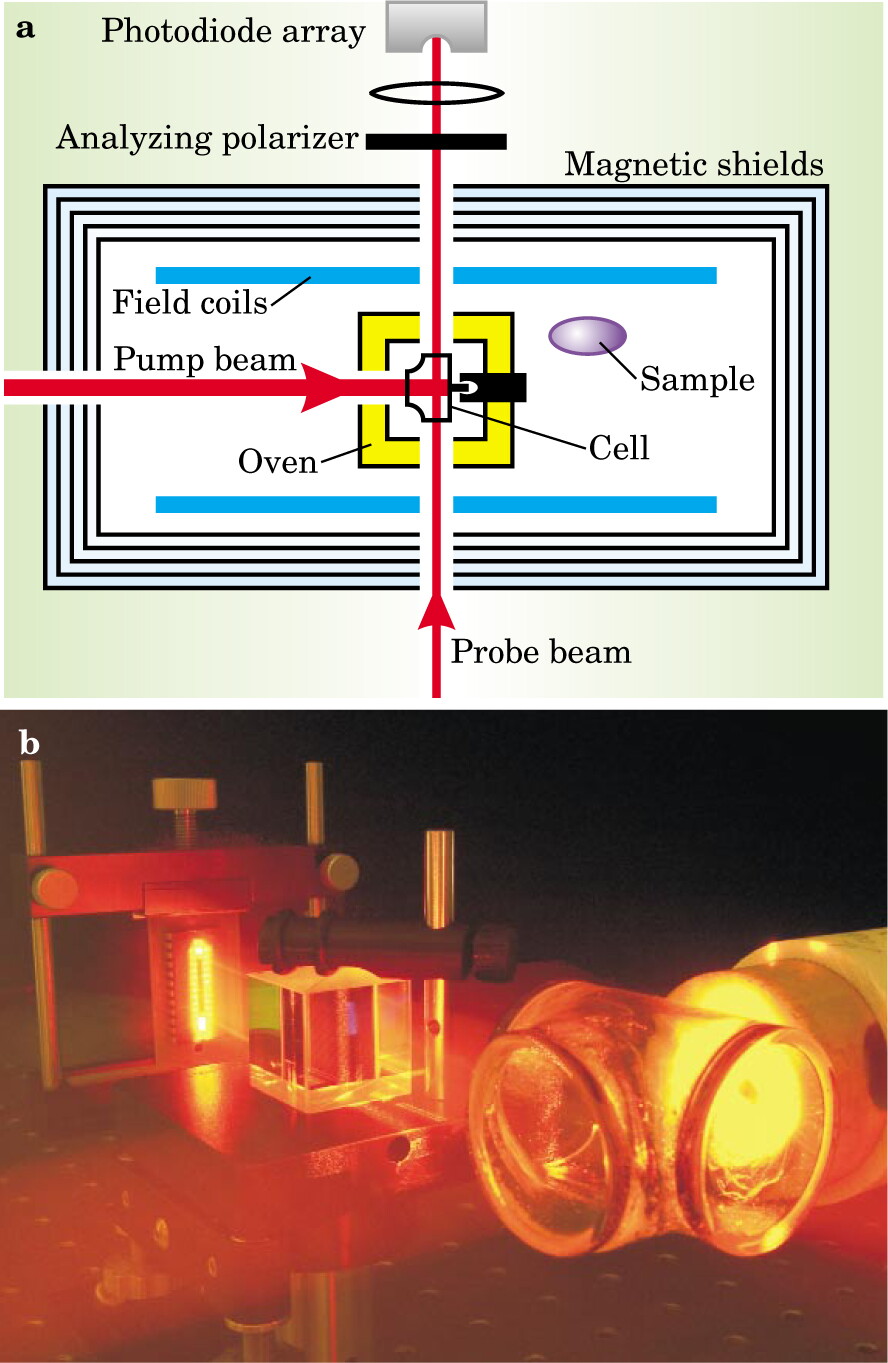
Figure 1 shows the experimental setup used by Romalis and company. A glass cell containing potassium metal is heated by hot air in an oven to 180°C to generate a potassium vapor density of 6 × 10¹³ atoms/cm3—about four orders of magnitude larger than the typical density of other magnetometers. Circularly polarized light from a 1-mW broadband diode laser optically pumps the vapor, while a second, orthogonal single-frequency laser beam probes the polarization. The probe beam is detuned from resonance to avoid additional optical pumping.

Figure 1. Experimental setup of an atomic magnetometer with subfemtotesla sensitivity. (a) This schematic illustrates the major components. A T-shaped cell, 3 cm × 3 cm × 4 cm, contains potassium metal along with helium and nitrogen buffer gases. The cell is heated to generate a potassium vapor. The spins of the unpaired electrons in the vapor are oriented by a circularly polarized pump laser. A linearly polarized probe beam, which passes through the cell and a polarization analyzer before reaching an array of photodiodes, detects the effect on the vapor’s magnetization of the magnetic field from a nearby sample. Magnetic shields and electromagnet coils around the cell and sample reduce the ambient magnetic field by six orders of magnitude for better sensitivity. (b) A picture of the apparatus with the oven, coils, and shields removed.
(Adapted from ref. 1.)
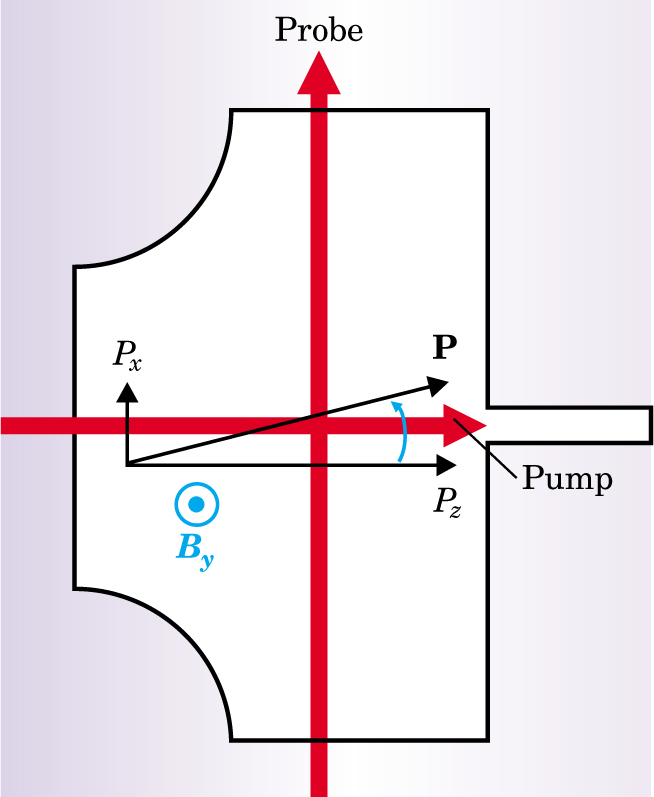
Whereas many atomic magnetometers are scalar—that is, they measure the magnitude of the magnetic field, whatever its direction—this one is a vector magnetometer. Romalis and coworkers configured it to be sensitive only to the component of the magnetic field that’s perpendicular to both the pump and the probe beams. When both the collision frequency and the polarization are high, the spin precession frequency depends on the polarization. 7 The new magnetometer avoids that potential source of decoherence by operating quasi-statically near zero field. As figure 2 illustrates, the polarization of the optically pumped potassium vapor, initially aligned in the direction of the pump beam (the z direction), is rotated in the xz plane due to the torque from the y-component of the magnetic field. The linearly polarized probe beam, traveling in the x direction, undergoes optical rotation as it traverses the cell: The beam’s polarization is rotated by an angle proportional to the x-component of the spin magnetization. The angle of rotation is effectively detected by passing the probe beam through a linear polarizer: Only the perpendicular polarization induced in the probe beam is detected by the photodiode array.

Figure 2. Optical rotation is used to measure By , the component of the magnetic field perpendicular to both the pump and probe laser beams. That field component rotates the potassium polarization P, giving it a projection Px onto the x-direction. The polarization angle of the probe beam is rotated by an angle proportional to Px .
(Adapted from ref. 1.)

Atomic magnetometers can be susceptible to another major cause of spin relaxation: collisions with the cell wall. Paraffin coatings are often used to reduce wall-induced spin decoherence; the Princeton–Washington group instead filled their magnetometer cell with several atmospheres of helium-4 buffer gas. At that pressure, the diffusion of potassium atoms is severely reduced, so that the atoms typically diffuse only a few millimeters during the polarization lifetime.
The short diffusion length has another important benefit: Since the spins drift so little during a measurement, different slices of the magnetometer cell can be used for simultaneous, essentially independent multichannel measurements. The effective volume of the magnetometer is thus only about 0.3 cm3, much smaller than the 1000 cm3 or so typically found for other atomic magnetometers. The photodiode detection array, with seven elements separated by about 3 mm, illustrates the potential of the device: The array provides a one-dimensional map of the magnetic field in the cell. By numerically combining the signals from different channels, background magnetic noise can be rejected, and first- and higher-order field gradients can be obtained.
One inescapable constraint of the new magnetometer is that, to be in the requisite limit of fast spin exchange, the background field needs to be very small, well below 100 nanotesla (1 milligauss) or so, orders of magnitude below Earth’s field. Screening is therefore required. Furthermore, variations in the laboratory and Earth’s field can be on the order of 100 picotesla, and can thus dwarf the extremely small fields sought in the most sensitive experiments. Romalis and company utilized several magnetic shields made of so-called mu-metal, a high-permeability alloy, to screen their experiment from background fields; three orthogonal sets of Helmholtz coils within the shielded enclosure were used to further control the field.
Thermally induced currents in the magnetic shields were the largest source of noise in the initial demonstrations of the magnetometer; they limited the sensitivity to about 0.5 fT/Hz1/2. Romalis notes that through optimization—using superconducting magnetic shields, for instance—the magnetometer should be able to get much closer to its theoretical shot-noise sensitivity limit of 0.01 fT/Hz1/2.
References
1. I. K. Kominis, T. W. Kornack, J. C. Alfred, M. V. Romalis, Nature 422, 596 (2003) https://doi.org/10.1038/nature01484 .
2. See, for example, E. B. Aleksandrov et al., Laser Physics 6, 244 (1996).
3. G. Bison, R. Wynands, A. Weis, Optics Express 11, 904 (2003) https://doi.org/10.1364/OE.11.000904 .
4. C. Affolderbach et al., Appl. Phys. B 75, 605 (2002) https://doi.org/10.1007/s00340-002-0959-8 .
5. D. Budker et al., Phys. Rev. A 65, 055403 (2002) https://doi.org/10.1103/PhysRevA.65.055403 .
6. W. Happer, H. Tang, Phys. Rev. Lett. 31, 273 (1973) https://doi.org/10.1103/PhysRevLett.31.273 ;
W. Happer, A. C. Tam, Phys. Rev. A 16, 1877 (1977) https://doi.org/10.1103/PhysRevA.16.1877 .7. J. C. Alfred et al., Phys. Rev. Lett. 89, 130801 (2002) https://doi.org/10.1103/PhysRevLett.89.130801 .
More about the authors
Richard J. Fitzgerald, rfitzger@aip.org