Neutron Source Revs Up with Bomb-Grade Fuel
DOI: 10.1063/1.1603072

Having apparently outwaited its opponents, the research reactor near Munich in the southern German state of Bavaria is set to turn on late this summer and could be running at full power within a year.
The FRM2, as the reactor is known, had sat finished but fallow for about two years on the Garching campus of the Technical University of Munich. As the first reactor in years built to burn highly enriched uranium (HEU), it has attracted concern at home and abroad about nuclear proliferation (see Physics Today, March 1999, page 78 ). Now, although the reactor will start up using HEU, Germany’s federal government has stipulated that it be converted to a lower enriched uranium fuel before 2011.
Ironically, it fell to the antinuclear Social Democratic—Green coalition government to give the FRM2 the green light. Incremental permits had been issued by the previous government, says Jürgen Maass, a press officer in the environment ministry. “It’s very difficult to stop it after that. We haven’t been very glad that Bavaria wanted this type of reactor, but there is a big need of diplomacy.” This past February, Maass adds, FRM2 officials submitted documents that satisfied the government’s safety concerns in the case of an airplane crashing into the reactor, a steam explosion, and other emergency scenarios. For his part, Bavaria’s science minister, Hans Zehetmair, greeted the permission—needed before the state could issue the actual startup permit, which it did on 16 May—by saying that “the federal environment ministry has finally abandoned its blockade posture and agreed to the startup of this topnotch facility.”
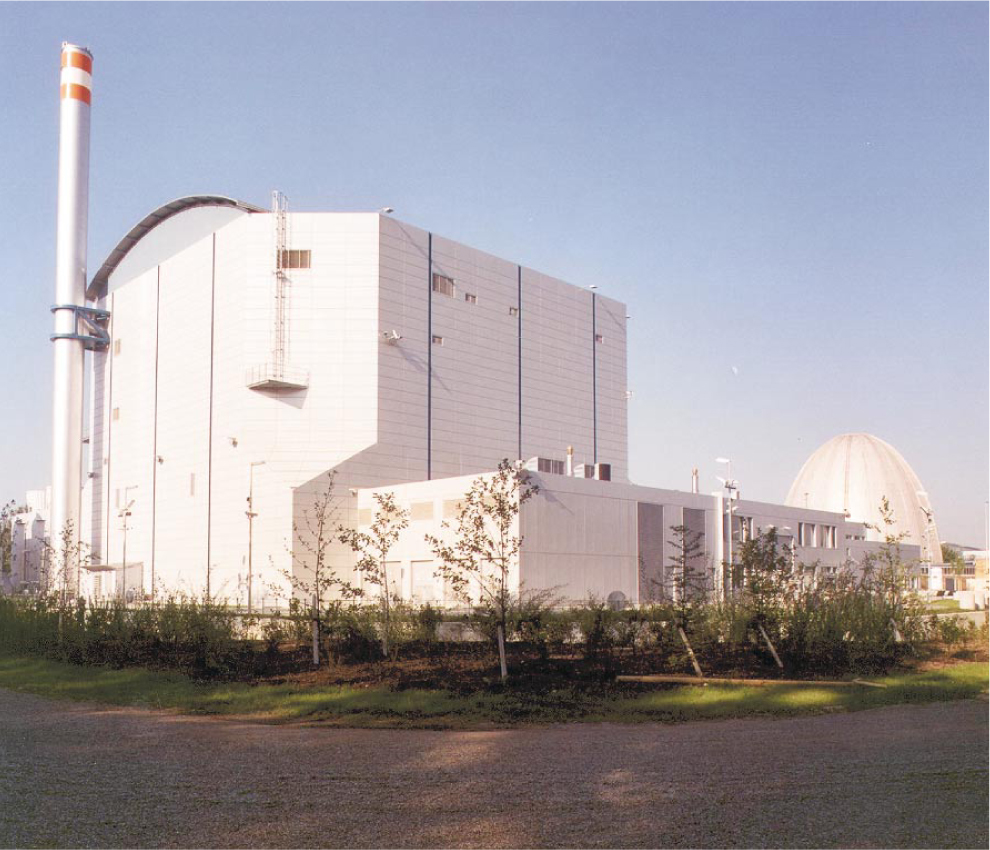
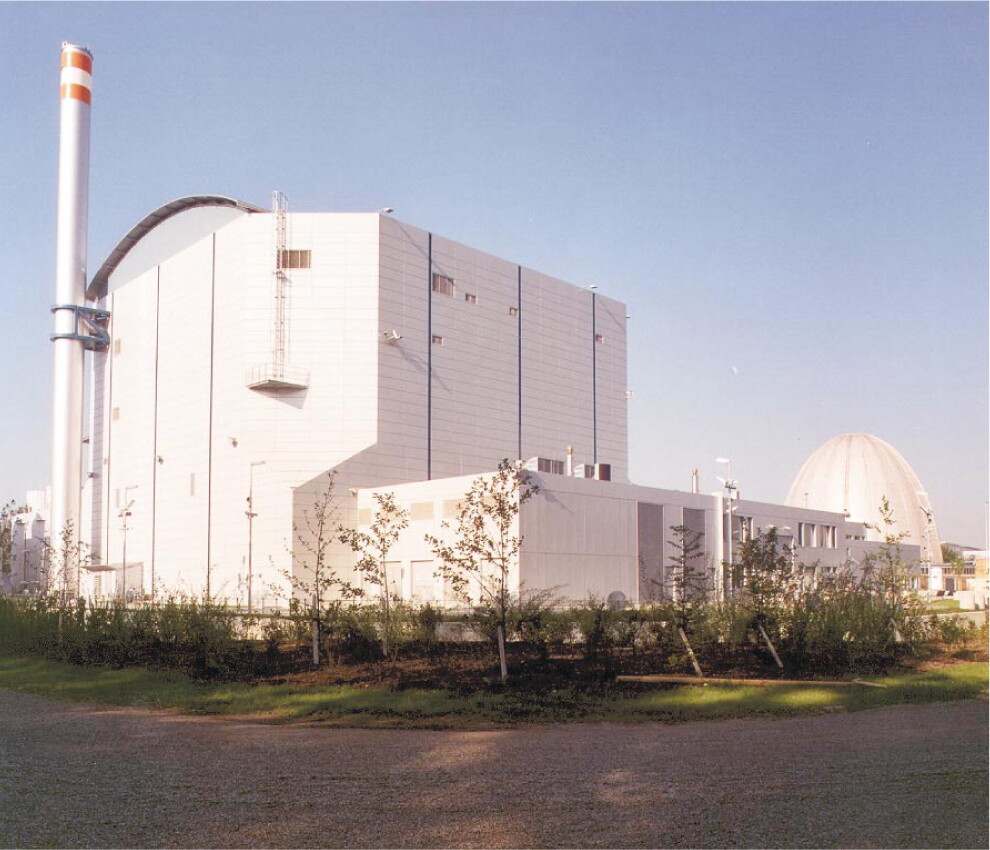
The 20-MW FRM2 is designed to produce a continuous flux of 8 × 10¹⁴ neutrons/(cm2 · s) at its core, and five or so orders of magnitude less at the sample sites. The reactor’s dozen beam lines will provide neutrons from 3 meV to 1 MeV. The lowest-energy, or “cold,” beam lines will stretch into the atomei, or atom egg, the shell of the site’s first reactor and now a local icon. Neutrons will also be used to generate an intense beam of positrons for detection of microcracks, Auger spectroscopy of surfaces, and other things, says Winfried Petry, the facility’s scientific director. Research planned for the reactor spans physics, chemistry, biology, materials science, engineering, tumor treatment, and contract work for industry.
It’s clear that this will be a unique research tool, says Thomas Brueckel, who studies magnetic nanostructures at the Jülich Research Center and chairs Germany’s committee on neutron scattering. “There are a lot of enthusiastic scientists who built the instruments. They are waiting to do science.” The cash-strapped government “could not both postpone the ESS and keep the FRM2 on hold,” adds Kurt Clausen, a Danish neutron physicist currently at Jülich, referring to Germany’s cool response to the proposed European Spallation Source (see Physics Today, April 2003, page 35 ). Moreover, the FRM2 is already paid for, mostly by Bavaria, although the federal government is supposed to reimburse about half of the €435 million ($518 million) construction tab. Bavaria and the Technical University of Munich, with contributions from the federal government, will also foot the FRM2’s expected €20 million annual running costs.
But critics are not assuaged by plans to convert to a lower enriched uranium. For one thing, the new fuel will be enriched to roughly 50% with uranium-235 (HEU is 93% 235U), which is higher than the rule-of-thumb cutoff of 20% for nuclear bomb usability. “I would even say that such a conversion is counterproductive,” says Franz Fujara, a neutron physicist at the University of Darmstadt. “It makes the public believe that the nonproliferation goal might be reached. All those who have in the past converted their reactors down to below 20% are betrayed. And in the future, the motivation to go down to 20% will be lost.”
Critics further doubt that, once the reactor is running, the conversion will actually be carried out. FRM2 officials say they will switch if a fuel is developed that doesn’t require modification of the reactor core and if the neutron flux doesn’t drop by more than a few percent. Groups in France and the US are working on high-density uranium-molybdenum fuels that might work. “We are confident that we are able to change to a lower enriched fuel. But we are concerned that the timing is tight,” says Petry. “FRM2 has never been, and never will be, a proliferation risk,” he adds.
Says Clausen, “From a technical point of view, the FRM2 will be a good reactor. From a political point of view, it’s a disaster.”

Germany’s controversial neutron reactor looks set to start up with highly enriched uranium.
FRM2
More about the authors
Toni Feder, American Center for Physics, One Physics Ellipse, College Park, Maryland 20740-3842, US . tfeder@aip.org