NASA saves SOFIA by slashing planet-finding funds
DOI: 10.1063/1.2364232

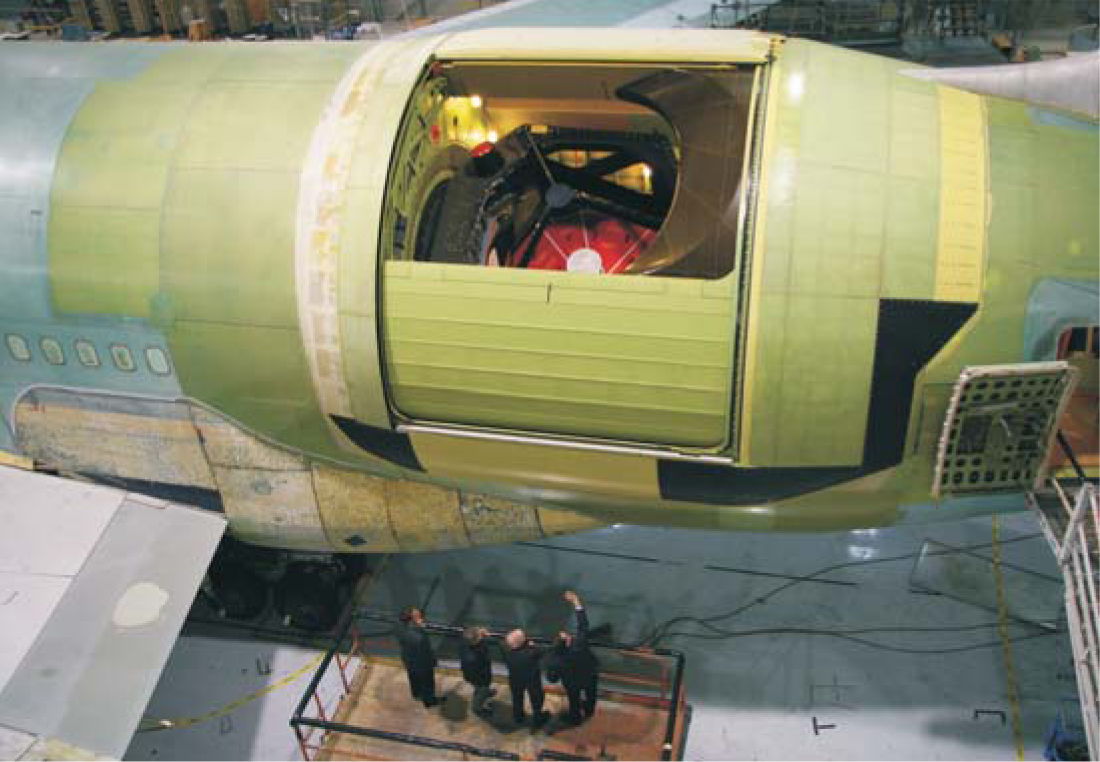
A winged telescope got a reprieve this summer when its funding was restored by NASA. The Stratospheric Observatory for Infrared Astronomy (SOFIA), a 2.5-meter telescope aboard a modified Boeing 747 jet, is now expected to take its maiden test flight this winter and to begin collecting data at the end of the decade.
NASA has already spent $485 million on SOFIA and will have to pony up another $250 million to $300 million for the science to get off the ground, according to Rick Howard, the agency’s acting astrophysics division director. Last February NASA struck SOFIA from its budget plans for fiscal year 2007 and beyond. The cut “was mainly due to budgetary constraints and the fact that [SOFIA] did have a number of problems and continued cost growth and schedule slips,” Howard says.
Contributing to SOFIA’s increased cost and delays were the modifications to the plane, which had been a commercial passenger jet for nearly 20 years. “It was a bigger project than anyone had anticipated,” says SOFIA chief scientist Eric Becklin of UCLA. “We also got hit hard when United [Airlines] pulled out [as a SOFIA partner] because of bankruptcy.” And after the Columbia space shuttle accident, he adds, “NASA had to refocus safety efforts. The number of people overseeing safety increased on the [SOFIA] program.”
Still, the door was left ajar for SOFIA pending an independent review, which was carried out this past spring. The review found “no technical showstoppers. [SOFIA] just needed some very sound management structuring and schedule realism,” says Howard.
As part of resurrecting the project, NASA has shifted oversight of test flights and the remainder of the aircraft modification from its Ames Research Center, which is still responsible for SOFIA science, to its Dryden Flight Research Center. Astronomers’ opposition to killing SOFIA, plus NASA’s desire to make good on its collaboration with the German Aerospace Center, which has a 20% stake in SOFIA, may also have been instrumental in the decision to save the project. Germany is providing the telescope and two of the nine initial instruments. The US is contributing the other seven instruments and modifying the aircraft.
Infrared access
By flying at altitudes up to 41 000 feet, SOFIA will get above most of the moisture in Earth’s atmosphere, which blocks IR radiation. “We are like a space telescope, but we come home every night,” says Becklin. SOFIA will initially observe in a band that spans UV to submillimeter wavelengths, 0.3–700 micrometers, and later instruments could go out to longer wavelengths.
The SOFIA telescope’s better detectors and nearly three times bigger diameter will make it 10 to 100 times more sensitive than its predecessor, the Kuiper Airborne Observatory, which NASA flew from 1974 to 1995 before starting work on SOFIA a year later. Airborne telescopes are cheaper than satellite missions, and have the advantage that instruments can be easily changed and updated. Jürgen Stutzki, a University of Cologne astronomer who is on the design team of a high-resolution spectrometer for SOFIA, says, “We will always fly state-of-the-art instruments, whereas with a satellite you build your instrumentation five years or so before launch, so by the time it’s launched it’s already out of date.”
Star formation will be one of SOFIA’s specialties. “We have spectrometers that will measure the temperature and density of materials where stars and planets are forming,” says Becklin. “Many key signatures from simple molecules, including hydrogen, are in the infrared.” Adds Stutzki, “There are particularly important lines in the far-infrared regime, like the line of ionized carbon near 150 microns. It’s one of the strongest cooling lines of the interstellar medium, so it’s very bright wherever star formation activity happens.”
SOFIA will also “do some of the best measurements” of newly discovered potential planets and other large objects in our solar system, says Becklin. By studying the drop in a background star’s signal when an object passes in front of it, the object’s size and the chemical composition of its atmosphere can be determined. With SOFIA, “you can fly to where a planet is going in front of a star,” he adds. So, whereas a ground-based observatory might witness a few such occultations a year, scientists expect SOFIA to see a couple hundred.
For teaching purposes, adds Dana Backman, SOFIA associate director for education and outreach, “we will match teams of educators with astronomers. We will train them ahead of time, then they will fly on the plane for a flight series, and go back to enhance science and math education in their home communities.” Perhaps 100 teachers and other educators will join some of SOFIA’s roughly 100 flights each year. This program will take about 1.5% of SOFIA’s operating budget, Backman says. NASA’s 80% share in running SOFIA is expected to be $60 million to $80 million annually; an updated estimate of the operating costs is due early next year.
Mission decisions
To feed SOFIA, NASA is starving the planet-finding Space Interferometry Mission. Both projects were high priorities in the astronomy and astrophysics community’s 1990 decadal survey, Howard notes, but SOFIA was higher on the list and is at a more advanced stage than SIM.
“It’s a misconception to trade SOFIA for SIM,” says Charles Beichman, executive director of Caltech’s Michelson Science Center, which is responsible for SIM science operations. “Killing SOFIA would not have made enough money to get SIM back on the books.” What troubles Beichman most is the broader neglect of planet finding. “We have a young field that is enormously exciting. Young people are turned on by it. But it’s taking a back seat compared to traditional astronomy.”
Stanford University’s Roger Blandford, who until recently was cochair of the National Research Council’s committee on astronomy and astrophysics, says he wishes the agency “would engage the scientific community more in facing up to the hard choices, which undoubtedly NASA has to make at this stage.” NASA, by making top-down decisions, he adds, “invites the scientific community to find other ways of defending their missions—politicians are getting involved in the detailed choices. It’s a shame it’s going this way.”
But political involvement could save SIM and other science missions: This fall, Congress is expected to vote on a bill by Senators Barbara Mikulski (D-MD) and Kay Bailey Hutchison (R-TX) that would give NASA an extra $1 billion over two years.

A retired passenger jet with a lightweight and sturdy telescope aboard is being readied for forays into Earth’s stratosphere.
L-3 COMMUNICATIONS

More about the authors
Toni Feder, American Center for Physics, One Physics Ellipse, College Park, Maryland 20740-3842, US . tfeder@aip.org