Multiple detectors to watch for double beta decay
DOI: 10.1063/1.3293405

Are neutrinos their own antiparticles? Is lepton number conserved? What is the neutrino mass? A host of international experiments to look for neutrinoless double beta decay may shed light on these questions. “They are all fantastic projects, and they use different technologies,” says the University of North Carolina’s John Wilkerson, project director of an experiment called Majorana.
Beta decay, in which a neutron turns into a proton by ejecting an electron and an antineutrino, is common. In double beta decay, two neutrons in a single nucleus each eject an electron. The process has been observed with the emission of two antineutrinos. But more scientifically interesting is neutrinoless double beta decay, which would require the antineutrinos to effectively annihilate each other, indicating that they are Majorana particles, that is, their own antiparticle. To date, just one unconfirmed sighting has been reported. Says Wilkerson, “I think the groups completely agree that to convince the community and ourselves that we have discovered neutrinoless double beta decay, it’s important to see it in at least three different isotopes.”
Neutrinoless double beta decay has an expected lifetime greater than 1025 years. Events can be recognized by measuring the sum of the energies of the ejected electrons. In two-neutrino double beta decay, the energy is a spread, whereas in the neutrinoless case, the full energy is carried by the two electrons, so the sum spikes. It’s such a rare event that for all of the experiments, says Wilkerson, “reducing background drives everything we do.” The experiments are underground; Majorana, for example, will be in the former Homestake gold mine in Lead, South Dakota.
Overview of next-generation double beta decay experiments
| Name | Nucleus | Mass |
Method | Location | Expected start date | Estimated capital cost (millions of US dollars) |
|---|---|---|---|---|---|---|
| CUORE | 130Te | 200 kg | Bolometric | LNGS | 2012 | 21 |
| EXO-200 | 136Xe | 160 kg | Liquid TPC, ionization, scintillation | WIPP | 2010 | 10 |
| GERDA I/II | 76 Ge | 35 kg | Ionization | LNGS | 2010 | 21 |
| Majorana | 76 Ge | 26 kg | Ionization | Homestake | 2012 | 15 |
| SNO+ | 150Nd | 40 kg | Scintillation | SNOlab | 2011 | 10 |
| SuperNEMO | 82Se, 150Nd, or 48Ca | 100 kg | Tracking, calorimetry | LSM | 2013 | 45–60 |
Double beta decay isotopes.
TPC = time projection chamber; LNGS = Gran Sasso National Laboratory, Italy; WIPP = Waste Isolation Pilot Plant, New Mexico; Homestake is a former gold mine in South Dakota; SNOlab = Sudbury Neutrino Observatory, Canada; LSM = Laboratoire Souterrain de Modane, France.
Overview of next-generation double beta decay experiments
CUORE |
130Te |
200 kg |
Bolometric |
LNGS |
2012 |
21 |
EXO-200 |
136Xe |
160 kg |
Liquid TPC, ionization, scintillation |
WIPP |
2010 |
10 |
GERDA I/II |
76 Ge |
35 kg |
Ionization |
LNGS |
2010 |
21 |
Majorana |
76 Ge |
26 kg |
Ionization |
Homestake |
2012 |
15 |
SNO+ |
150Nd |
40 kg |
Scintillation |
SNOlab |
2011 |
10 |
SuperNEMO |
82Se, 150Nd, or 48Ca |
100 kg |
Tracking, calorimetry |
LSM |
2013 |
45–60 |
Double beta decay isotopes.
TPC = time projection chamber; LNGS = Gran Sasso National Laboratory, Italy; WIPP = Waste Isolation Pilot Plant, New Mexico; Homestake is a former gold mine in South Dakota; SNOlab = Sudbury Neutrino Observatory, Canada; LSM = Laboratoire Souterrain de Modane, France.
Source as detector
Working underground provides shielding from cosmic radiation. To block local environmental radiation, Wilkerson says, Majorana will “use conventional shielding with a twist: We have developed a technique to make ultrapure electroformed copper that reduces internal background.” At the heart of Majorana—shielded by several inches of ultrapure copper, regular copper, and lead—will be 105 germanium crystals totaling 60 kg. Nearly half will be enriched to 76 Ge, one of the 30 or so naturally occurring isotopes in which neutrinoless double beta decay is predicted to occur.
Because it acts as a massive semiconductor diode, the Ge is both the source and detector of double beta decay. If an event takes place, the electrons emitted produce ionization, and the energy of the original electrons can be deduced from the charge measured. Majorana will use point-contact detectors, in which contacts to read the signal are on the surface of the Ge crystals, rather than drilled into them. The method was explored but rejected commercially years ago for other purposes because it has disadvantages for high count rates. “It turns out that this technique is ideal for us,” says Wilkerson. “We will have very low count rates, and it has very good position resolution and low capacitance, which means you can also measure low energies.”
Compared with Majorana’s “classic and well-tested technique,” the Germanium Detector Array will use “a clever aggressive style,” says Majorana spokesman Steve Elliott of Los Alamos National Laboratory. GERDA is also based on 76 Ge. But the crystals will be shielded by liquid argon, which also acts as a high-purity coolant, and could eventually function as “an active veto, not just a passive shield,” says project spokesperson Stefan Schönert of the Max Planck Institute for Nuclear Physics in Heidelberg, Germany. “A passive shield just absorbs radiation, but an active one has the advantage that you register when energy is deposited. Background radiation typically deposits energy inside the crystal and the liquid argon simultaneously, so if there is a scintillation flash in the liquid argon, you know it had nothing to do with double beta decay.”
As with the Ge-based detectors, the isotope in the Enriched Xenon Observatory—200 kg of Xe—doubles as source and detector. In EXO-200, electrons from double beta decay will ionize other Xe atoms. “The scintillation and ionization signals are collected with the usual fancy electronics,” says Stanford University’s Giorgio Gratta, the project’s principal investigator. With both signals, he adds, “you get a better measurement of the energy, which is important for distinguishing neutrinoless from two-neutrino decay.”
Gratta started stockpiling Xe about seven years ago. The US Department of Energy and Stanford split the cost of enriching it to 80% 136Xe in centrifuges in Russia as part of an effort to redirect people and facilities in that country to work in nonweapons areas. A couple of years ago, the EXO-200 apparatus started moving into the Waste Isolation Pilot Plant, the salt formation in New Mexico where DOE stores long-lived, defense-related transuranic waste. (It’s the first major science project there; see the story on page 24 .) Since salt moves, says Gratta, “our buildings are on stilts.” The detector will be filled this summer with nonenriched Xe for tests. “The xenon doesn’t degrade,” says Gratta, “but if something breaks, or if there is a leak, it is a gas, you can lose it.”
The EXO team hopes to later increase the detection of neutrinoless double beta decay by going to a one-ton experiment, with an eye to being located either at SNOlab (the former Sudbury Neutrino Observatory) in Canada or in the old Homestake mine, if a national underground lab is developed there. Those sites, or somewhere in Europe, are also possible for a combined Majorana–GERDA follow-on. As a crosscheck, the next-generation EXO would incorporate barium tagging to identify the ions resulting from double beta decay of 136Xe.
Recycling SNO
The SNO+ experiment, the brainchild of Mark Chen of Queen’s University in Kingston, Ontario, will use neodymium-150. After SNO stopped collecting solar neutrino data about three years ago, says Chen, the experiment’s heavy water was returned to the Canadian government and “we had an empty detector where everything still worked. We will add liquid scintillator where [heavy] water was. The intensity of the flash of light produced by the scintillator will give us energy, and the timing will give us location” for double beta decay events.
Neodymium-150 “has long been an appealing candidate for this type of experiment,” Chen says, “because it’s predicted to have the fastest decay rate if neutrinos are Majorana particles.” In addition, the summed energy of the electrons in neutrinoless double beta decay, 3.4 MeV, is high; calcium-48 is the only isotope with a higher double beta decay energy. Says Chen, “The drawback was that there was not a way to make a large detector using neodymium until we [the SNO+ collaboration] figured out we could dissolve a substantial amount of it into a liquid scintillator.”
The experiment will be made up of 800 tons of scintillator containing about one part per thousand Nd. “With 5.6% of neodymium the isotope we need, that’s about 40 kg of 150Nd. The largest amount used previously was 37 g,” says Chen. SNO+ scientists are researching methods to enrich to higher fractions of 150Nd.
In SNO, the heavy water was, of course, heavier than the normal-water shielding around it, so ropes held up the heavy-water tank. In SNO+, the scintillator is buoyant so ropes over the top of the detector will keep it in place. The scintillator is made from linear alkyl benzene, which will not dissolve the experiment’s acrylic vessel. Says Chen, “It has a higher flashpoint at which it will ignite, it’s less toxic, and as an extra bonus, it’s cheaper than most scintillators.”
Sensitivity game
Tellurium-130 is the isotope of choice for CUORE, the Cryogenic Underground Observatory for Rare Events. The experiment, which will run in Italy’s Gran Sasso National Laboratory, will consist of 19 towers of tellurium oxide crystal planes; each tower will be about 75 cm tall and 13 cm by 13 cm across, and in total they will contain some 740 kg of TeO2. CUORE will look for temperature rises due to the energy imparted by the electrons released in 130Te double beta decay. When CUORE starts up in 2012, says technical coordinator Oliviero Cremonesi of Italy’s National Institute for Nuclear Research and the University of Milano–Bicocca, “it should be the most sensitive [double beta decay] experiment in the world.” The main advantage of Te is the natural abundance of 130Te, so the expensive step of enrichment can be skipped.
The option of swapping isotopes is one advantage of SuperNEMO, a project getting under way in an underground lab in Modane, France. In addition, says spokesman Fabrice Piquemal, “we are the only detector to see directly the two emitted electrons. Our source is sandwiched by the tracking volume and surrounded by a calorimeter.” The source is an array of roughly 60-micron-thick foils of, for starters, selenium-82, 150Nd, or 48Ca, for a total of about 100 kg of enriched isotope. That, says Piquemal, “is more than a factor of 10 more [than in the earlier NEMO 3]. We will reduce the background and improve the efficiency of the detector. We should have a sensitivity 100 times better” and be able to detect events with a half-life of up to 1026 years.
“High risk, high payoff”
“If we observe neutrinoless double beta decay, then we know neutrinos are Majorana particles and that lepton number is violated. Those are discoveries,” says Wilkerson of the Majorana experiment. “Then you extract the mass of the neutrino.” Violation of lepton number, adds Jesse Wodin, a postdoc at Stanford who works on EXO-200, “would point to very exciting physics. There are arguments for why lepton-number nonconservation leads to bariogenesis, explaining why matter, not antimatter, dominates our universe. It’s a very high-risk, high-payoff field. It’s a hard problem that needs to be attacked from many avenues. It’s a very exciting time for neutrino physics.”
The next generation of experiments aims for a 10-fold or greater increase in sensitivity to neutrino mass, down to 50–100 meV. Another bunch of smaller, more specialized, or less developed experiments are also in the works. For example, scientists in Japan are considering retooling the KamLAND neutrino detector by dissolving Xe into a subset of the facility’s 1000 tons of scintillator to look for double beta decay. “If we don’t see a signal, we can only set limits,” says Schönert. “Then the quest will be to design an experiment that scrutinizes the 1-meV mass range”—one of the scenarios predicted by neutrino oscillation experiments. That would require operating background-free with 10 to 100 tons of isotope for several years, he adds. “It is yet science fiction.”
In any case, says Wodin, extracting the mass involves a “smudge. Predicted events depend on nuclear matrix elements, and there are multiple ways to do the calculations. No one knows the right way to do it yet. I suspect when we get a real signal, there will be a flurry of theoretical work.”

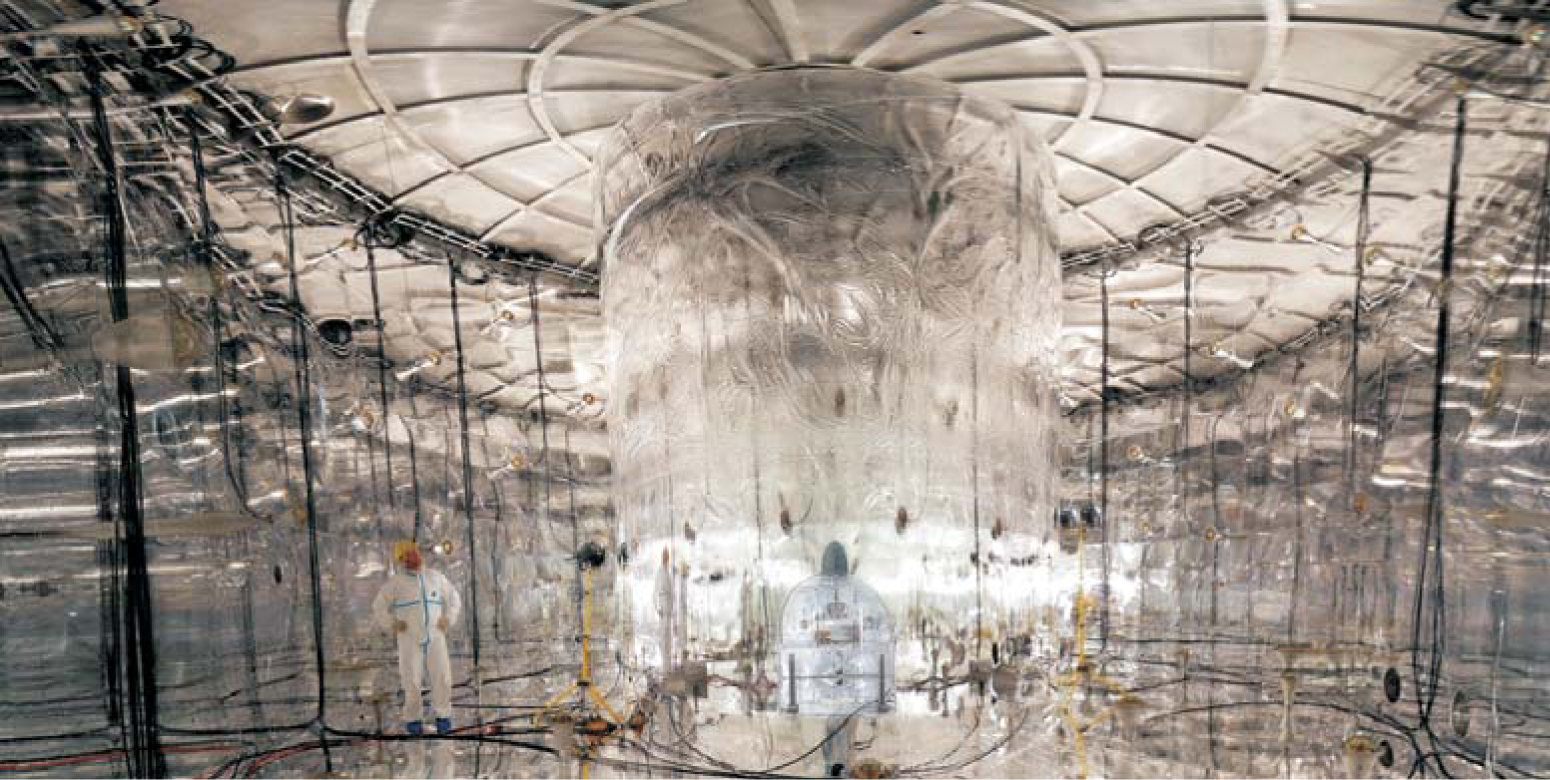
About 600 tons of water will shield against external radiation in the Germanium Detector Array; liquid argon fills the central cryostat, which contains the germanium-76 crystals at the heart of this double beta decay experiment.
GERDA COLLABORATION


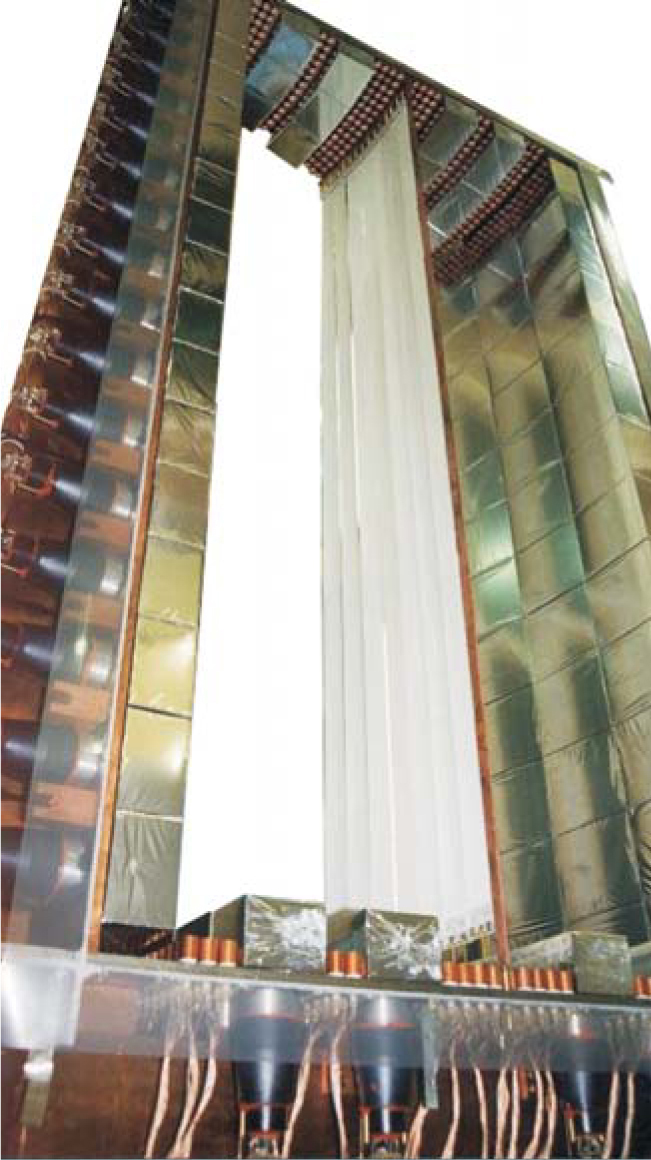
Strips of source foil that can be swapped out to look for double beta decay in different isotopes form the heart of NEMO 3 (above). The next-generation facility, SuperNEMO, will be 10 times as big. The foil strips, 60 microns thick and 2.7 meters tall, are sandwiched in a tracking volume of helium gas and alcohol and surrounded by plastic scintillators and photomultiplier tubes.
LSM

More about the authors
Toni Feder, tfeder@aip.org