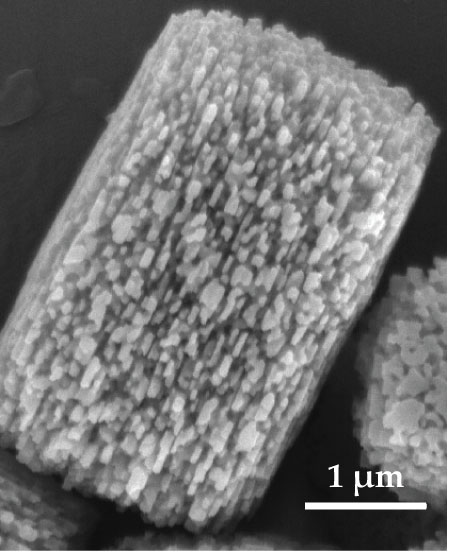
Mesoporous crystals
DOI: 10.1063/PT.3.1969

Solar cells and many other optoelectronic applications can benefit from semiconductor or ceramic materials that have a large surface area and also high charge mobility. Although nanoparticles have the large surface area, producing electrodes from them typically involves sintering them together, which introduces numerous interfaces that reduce the mobility. Attempts to fabricate mesoscopic, pore-filled materials often yield a porous assembly of nanocrystals with similar interface problems. Now Henry Snaith and colleagues at the University of Oxford have demonstrated a straightforward, inexpensive, versatile method for creating mesoporous single crystals of semiconducting titanium dioxide. The team started with a template, a close-packed array of silica beads of diameter 20–250 nm. In an insightful advance, Snaith and company “seeded” the template by bathing it in titanium tetrachloride; nanocrystals or other residues served as nucleation sites for growing TiO2 crystals within the template’s voids. The result was a near-perfect yield of mesoscopic single crystals; the silica could then be etched in such a way as to leave high-surface-area pores. A prototype solar cell the team made by filling the mesoporous crystal with a photosensitive dye had 7.3% efficiency—a record for dye-filled cells produced at temperatures below 150 °C. Moreover, the material, seed density, reaction temperature, reaction time, and bead diameter can all be adjusted to tweak numerous crystal properties for different applications. (E. J. W. Crossland et al., Nature 495, 215, 2013, doi:10.1038/nature11936 .)


More about the authors
Richard J. Fitzgerald, rfitzger@aip.org