Life beyond stellar death for an unusual exoplanet

By all accounts, the gas giant exoplanet WD 1856+534 b is an oddity. The planet is extremely large, more than 10 times as massive as Jupiter. And it orbits its star, a white dwarf that is smaller than it by about a factor of seven, at a distance only 1⁄50 of that between Earth and the Sun. Typically, a planet orbiting its star so closely would be destroyed as the star expanded into a red giant before shutting down, cooling, and condensing into a white dwarf. So, wondered Ryan MacDonald from the University of St Andrews in Scotland and colleagues, how did it survive?
The research team developed two competing hypotheses. 1 The first proposes that the exoplanet initially orbited at a much farther and safer distance from the red giant but that two additional stars in the system pulled it closer to the white dwarf after the end of the star’s life. The second borrows a model from binary stars and proposes that WD 1856+534 b survived inside the red giant’s swelling hydrogen envelope because of aerodynamic drag. That process would create enough kinetic energy to expel the star’s gas envelope and leave the exoplanet orbiting the red giant’s exposed core. In that scenario, the researchers expected that WD 1856+534 b’s atmosphere would become relatively rich in hydrogen through accretion from the red giant and that, as a result, it would have comparatively less carbon and nitrogen.

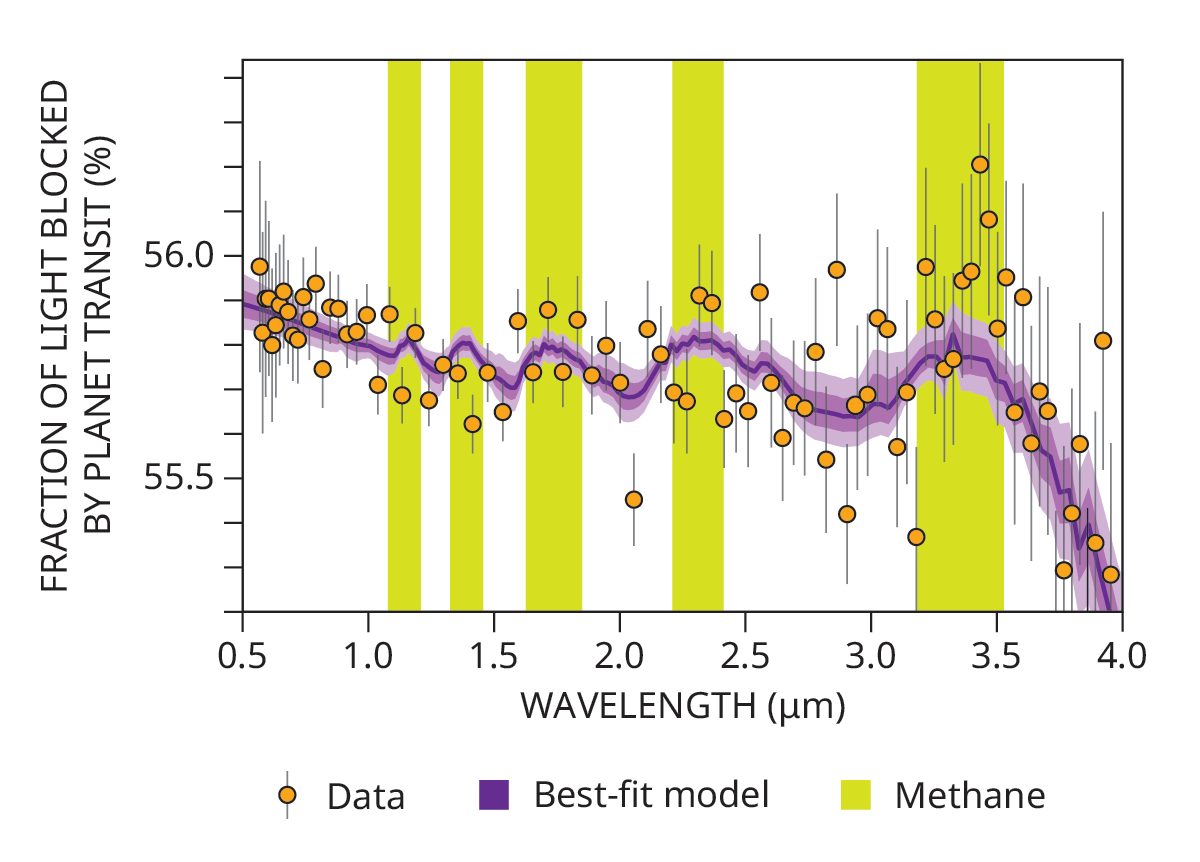
The transmission spectrum of exoplanet WD 1856+534 b provides insight into how the planet survived its star’s transition to a white dwarf. The data points show the spectrum measured by the James Webb Space Telescope, and the curve represents the best-fit model. The presence of the methane absorption peaks (green) suggests that the planet migrated inward after the white dwarf formed.
(Image adapted from ref. 1 .)

To determine which scenario was more likely, MacDonald and colleagues used transmission spectroscopy to analyze IR and red-light (0.55–5.5 µm) spectral data collected by the James Webb Space Telescope. When the exoplanet transits in front of the white dwarf, its atmosphere absorbs some of the light from the star. From the spectrum of the transmitted light, shown in the figure, the researchers could extract the atmosphere’s chemical composition. The transit data also enabled them to determine the planet’s temperature and mass.
The researchers found that the exoplanet was much hotter (roughly 400 K) than expected for a giant planet of its age and that its atmosphere contained a high percentage of methane. Based on cooling models for planets of that size, they determined that WD 1856+534 b had undergone a period of reheating after its star had become a white dwarf. That history and the abundant carbon are strong signals that the exoplanet started its life much farther from the star and that tidal interactions heated it as it migrated in to its current position.
Although WD 1856+534 b’s system is different from our own, the work still offers potential insight into what may happen to Jupiter, Uranus, and Neptune billions of years in the future when our sun exhausts its fuel and evolves into a white dwarf. Similar to WD 1856+534 b, the outer planets may then find their orbits affected by gravitational interactions that heat them up and send them inward. In the meantime, MacDonald says he hopes to find a rocky planet orbiting a white dwarf, which could teach scientists more about the potential future of Mars or even Earth.
Reference
1. R. J. MacDonald et al., “Aerosols and hydrocarbons in the atmosphere of a white dwarf planet ,” Nature 655, 76 (2026).