Leap Second Debate Heats Up
DOI: 10.1063/1.1628996

Keep leap seconds, and glitches in telecommunications, navigation by satellite, and legal marking of time could become more frequent and serious. Lose them, and astronomers will have trouble pointing their telescopes, and eventually the time of day will get out of sync with Earth’s rotation.
At the crux of a debate about whether to continue inserting leap seconds into Coordinated Universal Time (UTC), the standard in many countries, is the unpredictability of Earth’s rotation. Millennia-old eclipse data show that Earth has long been slowing down. Nowadays, Earth’s rotation is measured by observing quasars with very long baseline radio interferometry. The deceleration is chiefly due to the tidal pull of the Moon; fluctuations on shorter time scales come from, among other things, the oceans and atmosphere and core-mantle interactions.
A leap second every year or two has been the norm, though none has been added since 1999, and timekeepers predict that more leap seconds will be needed in the future. Without leap seconds, official time will diverge from solar time by an estimated two minutes by the end of this century; in 3000 years, the drift might be about eight hours.
This month, a special rapporteur group (SRG) will submit its recommendations on the leap second to the International Telecommunication Union, where the matter will wend its way through various committees before a final decision is reached—a process that could take years. Says SRG chair Ron Beard, a physicist at the US Naval Research Laboratory, “The issue is: Is relating to the solar day of significance? And how does that weigh against the problems that come with introducing integral seconds?”
Before 1972, clocks were corrected with fractions of seconds and by adjusting the length of the second. Since then, leap seconds have been added to keep UTC within nine-tenths of a second of solar time and synchronized with international atomic time, but with an offset—currently 32 seconds. The atomic second is based on the frequency of a hyperfine transition in cesium.
But with technology relying increasingly on the precision of atomic time, the leap second has come under scrutiny. Abolishing it would have political, economic, legal, religious, and safety implications. Says SRG secretary William Klepczynski, an astronomer and timekeeping consultant, “There are all sorts of little technical problems that you can see start to raise their heads in our society. Before they become big problems, we should have one time for everybody.” For example, he says, bank recordings of interaction times run into trouble when computers can’t distinctly label a leap second. When leap seconds were inserted in 1994 and 1997, he adds, the Russian global positioning system, GLONASS, went off the air for several hours. Mistakes in timekeeping could lead to flight accidents, says Felicitas Arias, who heads the time section of the Bureau International des Poids et Mesures near Paris. Leap seconds are “a nuisance, and they could be a danger,” she adds.
The SRG hasn’t reached consensus, says Dennis McCarthy, director of time at the US Naval Observatory in Washington, DC. “But we came up with a draft recommendation that asks for the leap second to go away, arbitrarily in 2022—-fifty years after its introduction.” That should give astronomers and others time to cope with software glitches, he says.
But some astronomers worry that leap seconds will be dropped sooner and without adequate notice. “Some people would like never to insert another leap second,” says Steve Allen, a telescope programmer at the University of California, Santa Cruz’s Lick Observatory. “Telescope pointing systems are one of the first things that would break.” It’s like a Y2K analysis, he says. “You have to go through and figure out where there are places that have assumptions that will become untrue.” It’s hard to make a good cost estimate, he adds, “but it could easily come to $10 000 to $100 000 per telescope.”
“Leap seconds may cause technological bugs, but getting rid of them will cause bugs too,” adds Robert Seaman, a programmer at the National Optical Astronomy Observatory in Arizona. As an example, he points to Motorola satellite receivers that, in a few weeks, are expected to be confused about the day because their software can’t cope with such a long gap between leap seconds. Moreover, Seaman says, “it doesn’t make sense to worry [about leap seconds] right now. There’s no hurry. We have hundreds of years.”

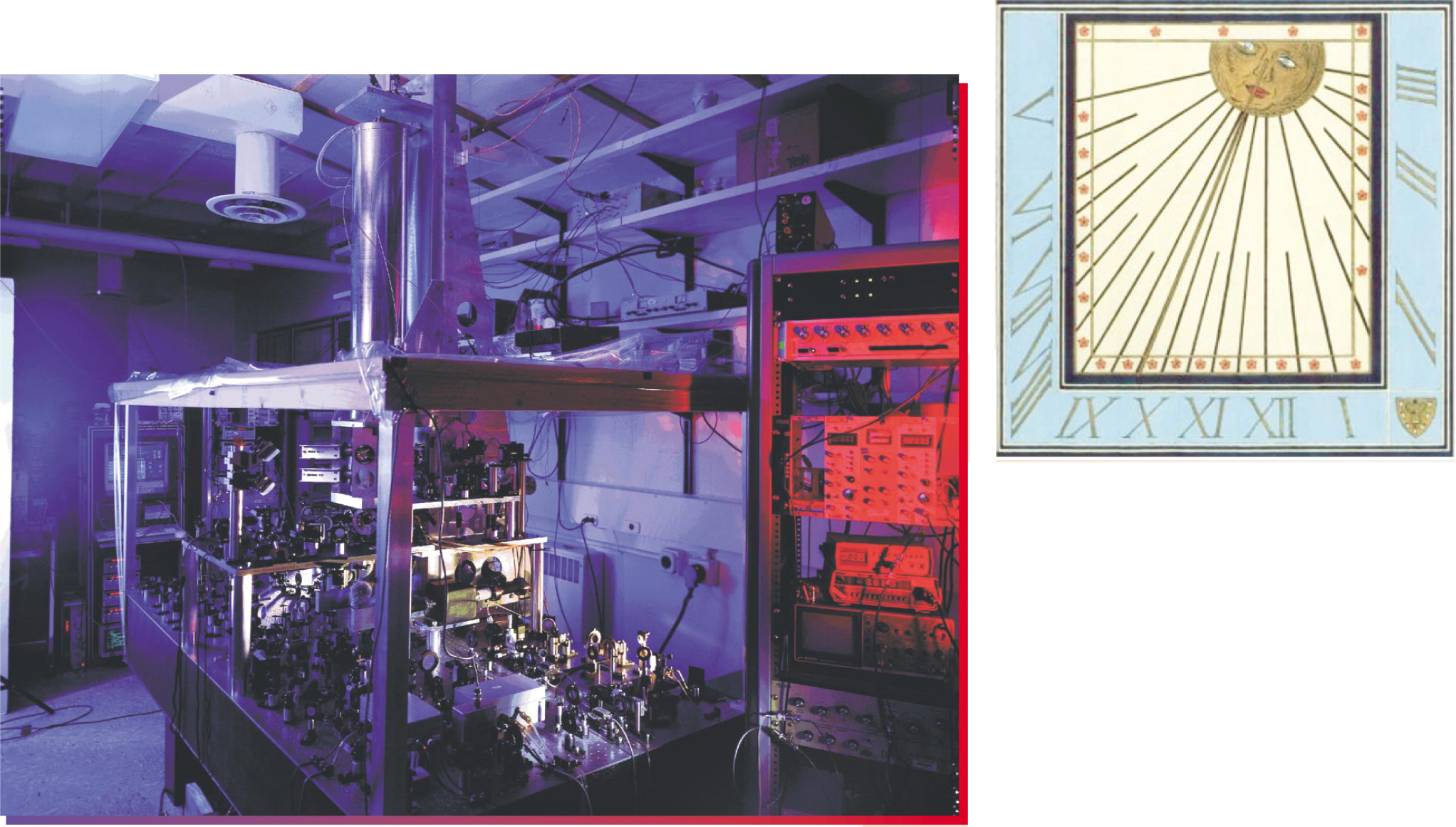
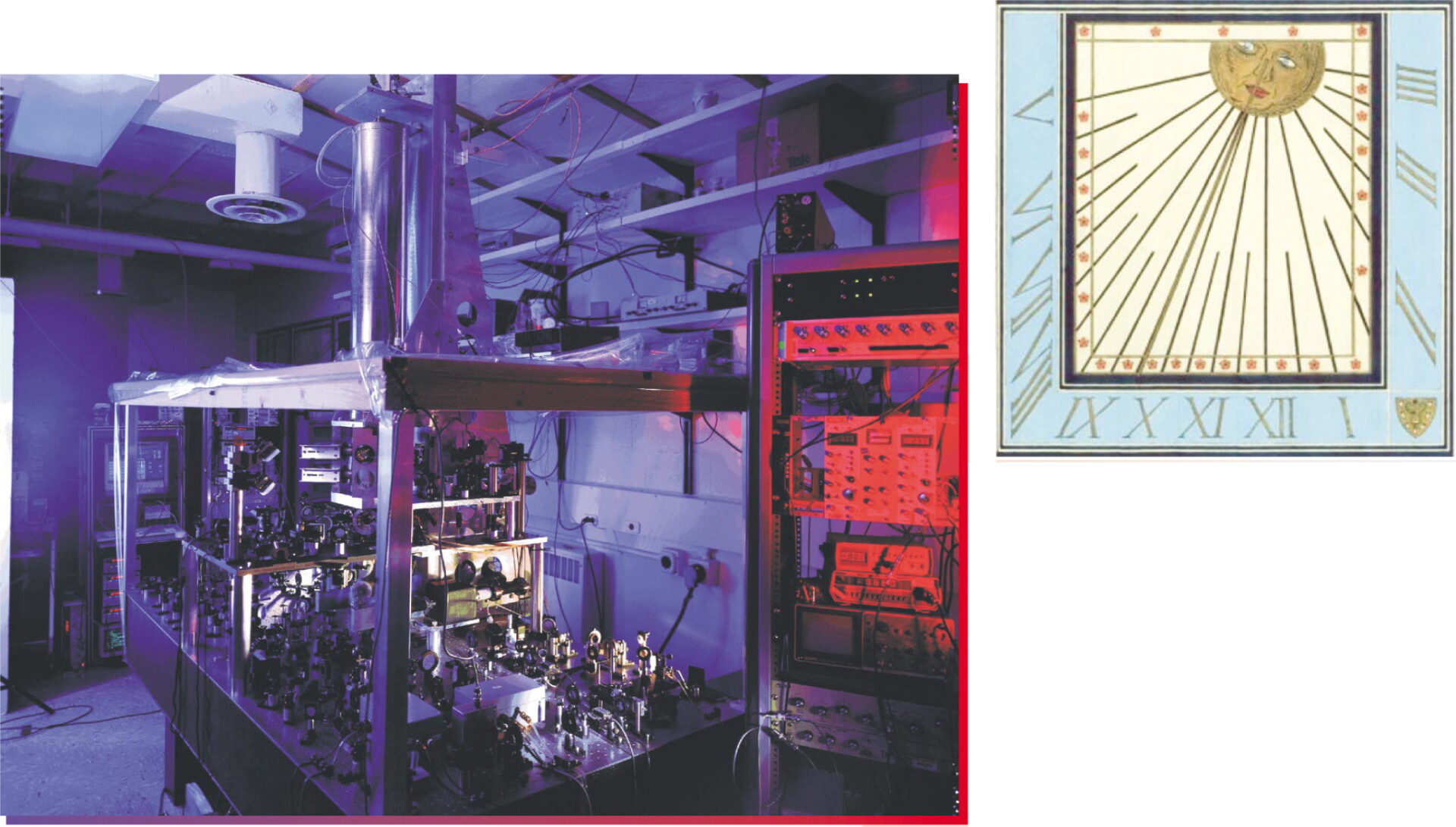
Sundials are the only clocks that mark time directly from Earth’s rotation around the Sun. The cesium fountain standard atomic clock (left) at NIST in Boulder, Colorado, keeps time to about one second in 30 million years. It is one of several clocks worldwide used by the Bureau International des Poids et Mesures to monitor international atomic time. (Sundial image used with permission of the Master and Fellows of Gonville and Caius College, Cambridge, UK.)
GEOFFREY WHEELER/NIST
More about the authors
Toni Feder, American Center for Physics, One Physics Ellipse, College Park, Maryland 20740-3842, US . tfeder@aip.org