LANL Resumes Work, Morale Stays Low
DOI: 10.1063/1.1839372

In response to a safety violation and a supposed security breach this summer, Los Alamos National Laboratory has fired four people and punished eight others. In a 15 September memo to lab staff, LANL Director G. Peter Nanos wrote, “It is now time to begin conscientiously moving forward in a safe, secure and compliant manner. The period of the last several months marks a new beginning for this institution.” But many lab scientists, bitter about Nanos’s handling of the safety and security lapses, are skeptical about how new the beginning really is. “Nanos sowed the seeds of discontent, and there is now a lush garden,” says Rhonald Keinigs, a longtime LANL weapons scientist.
Nanos halted work across the lab in July, after two electronic storage devices containing classified data reportedly went missing and a student’s eye was damaged by a laser (see Physics Today, September 2004, page 32 ). Later in the summer, reports surfaced that the storage devices had never existed; the real error, it seemed, was one of inventory, not of mishandling sensitive information. By press time, LANL had completed its own investigation, but lab officials would neither confirm nor deny the existence of the storage devices. External investigations were still under way; David Cremers, a laser physicist, was preparing to appeal his firing in connection with the eye injury and an alleged cover-up; and lab staff were passing the hat for legal funds for other scientists.
As of early October, administrative tasks, much theoretical work, and some experiments at the lab had resumed. A lab spokesman said most activities would be back to normal by mid-October, and everything should be running by year’s end. The work stop-page cost taxpayers $4–5 million a day; or, as the spokesman put it, “the focus on safety and security didn’t cost anything above normal operating costs.”
Despite being glad to be working again, lab scientists say morale remains low. Many say Nanos overreacted and that he insulted them. “We don’t have what Nanos has characterized as a bunch of arrogant butthead cowboys at Los Alamos,” says Brad Lee Holian, a theoretical physicist who has been at the lab for 32 years (see his upcoming Opinion piece in Physics Today). With time on their hands during the work shutdown, Holian and a colleague compared safety records at various national labs and industries. “From 2000 onwards, Los Alamos took over the lead in safety performance among comparable labs in the DOE [Department of Energy] complex,” he says. It might have been useful, he adds, “to have spent one day each on safety and security, but to shut down for two months just doesn’t make sense.”
As for security, Keinigs says, “there is always something one can do better. But the people with whom I work are all very cognizant of security issues. The idea that Nanos promulgated—that we have a scientific culture that led to these problems—is simply not true.”
“The problems at Los Alamos are assuming the proportions of a national tragedy,” says John Holzrichter, a retired Lawrence Liver-more National Laboratory employee who is now president of the Hertz Foundation, a California-based organization that gives grants to graduate students in the physical sciences. “I cannot tell you how disturbed my colleagues and I are by all of this.” Holzrichter and others worry that young scientists will shun LANL and other national defense laboratories, and that those who do come will lack mentors due to experts leaving or retiring early.
Concerns about both security and management at Los Alamos have been festering for a few years and have led to much talk among scientists there and beyond as to whether the University of California will continue to oversee the lab. DOE is expected to put lab oversight up for bid this fall. UC officials say the university will bid for the new contract—possibly, it’s rumored, together with Bechtel Corp. Referring to the shutdown and firings, an observer familiar with all three weapons labs says that Nanos’s “actions seem to be precipitous. We still don’t know all the issues. But the lab has been rattled, and morale is damaged. The most significant questions the events of this summer raise are, Is Los Alamos a failed lab? And do you need to bring in a major culture change? The question that follows is, Is UC capable of it?”

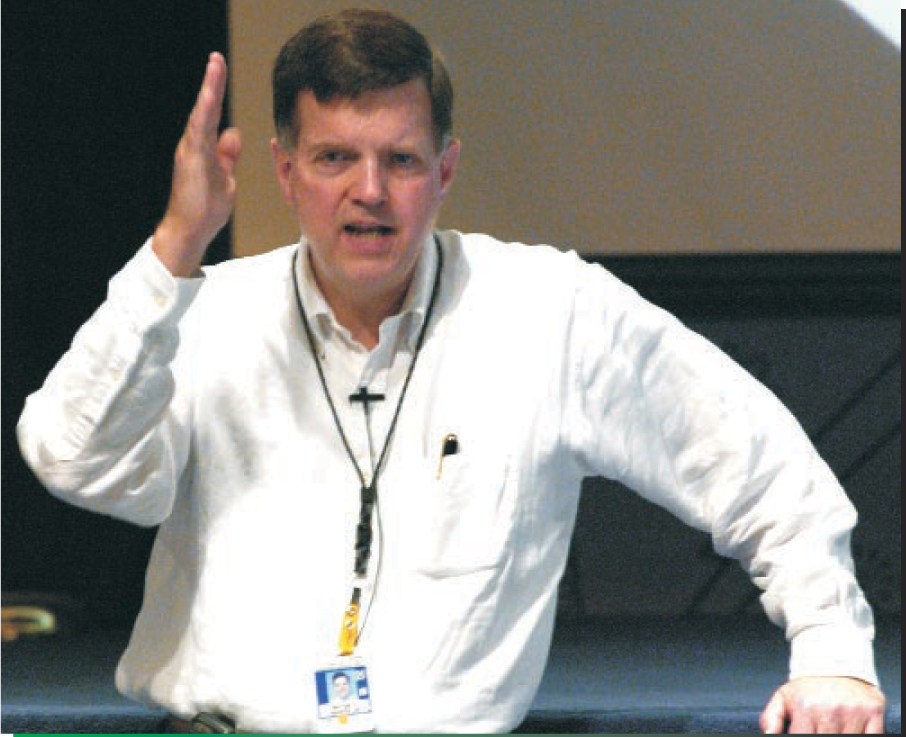
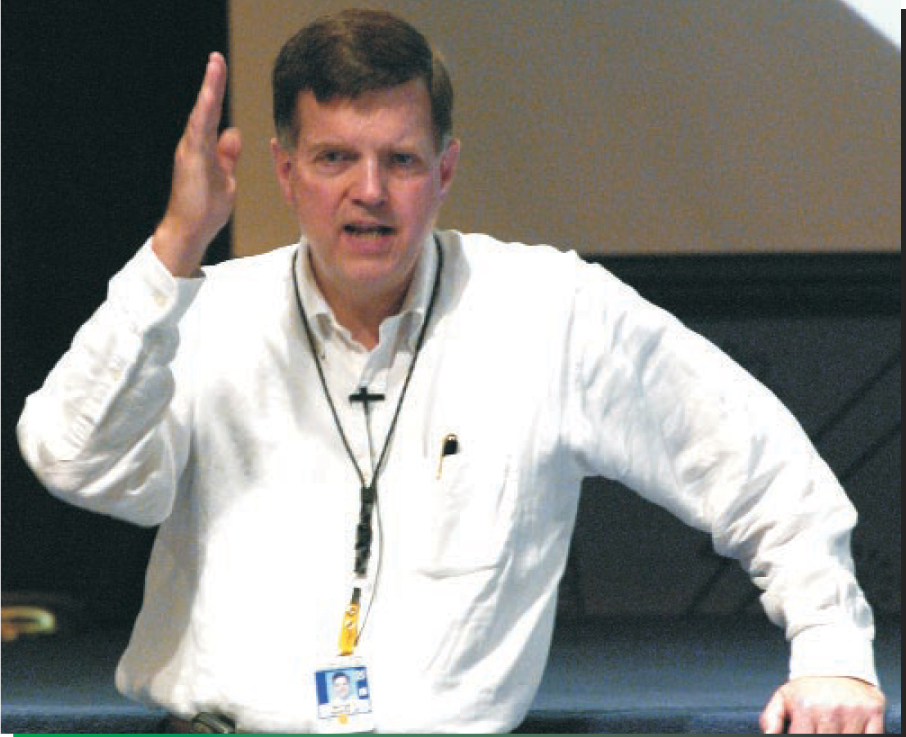
G. Peter Nanos, the director of Los Alamos National Laboratory, addresses employees at a lab-wide meeting.
LANI
More about the authors
Toni Feder, tfeder@aip.org