Kilometer-scale oceanic warm fronts can rapidly alter the atmosphere

Three aircraft, a fleet of autonomous vehicles on and beneath the ocean surface, and a ship, shown in figure 1 , set out off the California coast in October 2022 to collect nearly a month’s worth of ocean and atmospheric data. It was the second of three legs of NASA’s Sub-Mesoscale Ocean Dynamics Experiment, which aimed to quantify the effect of kilometer-scale air–sea exchanges on climate and biological processes. 1
Figure 1.

NASA’s Sub-Mesoscale Ocean Dynamics Experiment used aircraft, ships, and a fleet of autonomous vehicles to collect comprehensive data on kilometer-scale, fast-moving features in the ocean and atmosphere. The research vessel Bold Horizon, shown here, was used to take measurements during the experiment’s October 2022 research expedition.
(Photo courtesy of Nick Statom, Air–Sea Interaction Laboratory, Scripps Institution of Oceanography, UCSD.)

A new analysis of the 2022 data by PhD student Igor Uchoa and his adviser Jacob Wenegrat, at the University of Maryland in College Park, and their colleagues shows that warm sea-surface temperature fronts in the ocean can quickly transfer energy to the air and cause turbulent mixing of the lower atmosphere. 2 Similar kilometer-scale temperature variability is found across global oceans, and the resulting air–sea energy fluxes can affect larger-scale climate processes.
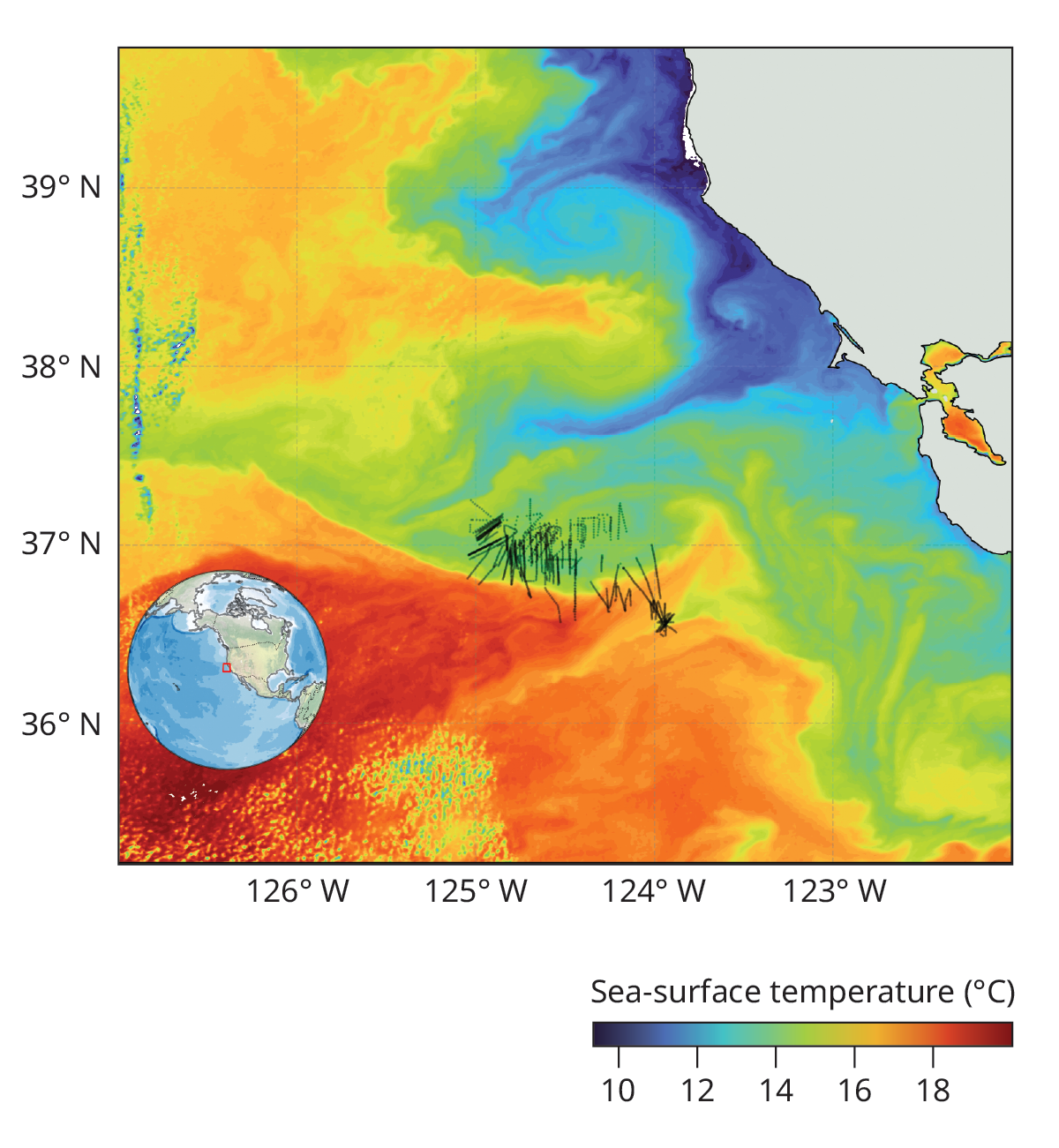
Previously, high-resolution physics-based models of air–sea interactions had suggested that kilometer-scale (also known as submesoscale) temperature gradients in the ocean could generate the effects observed by the research team. Large-scale winds that blow down the West Coast of the US push warm surface water offshore, and deep, cool water rises to replace it. That produces sharp temperature fronts and mixing features like eddies and filaments, shown in figure 2 . Those sharp gradients of cold and warm water then in turn exchange energy with the air and alter kilometer-scale wind patterns. “Winds are basically decelerated over cold parts of the front and accelerated by warm parts of the front,” says Uchoa.
Figure 2.

The highly variable sea-surface temperatures off the coast of Northern California lead to sharp fronts, eddies, and filaments like the ones shown here. Black lines depict 63 transects along which detailed temperature and velocity measurements were collected from the ocean and atmosphere during NASA’s Sub-Mesoscale Ocean Dynamics Experiment.
(Figure adapted from ref. 2 .)

Until now, there were no real-world observations that could confirm what had been seen in high-resolution models. The small scale of such features and the speed at which they move make them challenging to observe. Orbiting satellites, for example, don’t collect repeat measurements quickly enough.
During the study, researchers collected ocean temperature profiles that extended 40 m deep along 63 transects, shown in figure 2 . Other observations came from the airborne DopplerScatt instrument, which records simultaneous measurements of wind and ocean currents. Uchoa and colleagues used those measurements and others to analyze how temperature changes in the water altered wind patterns and atmospheric mixing. They found that in addition to altering wind speed, small-scale temperature gradients in the ocean induce vertical circulation in the atmosphere. And the rate at which variable ocean temperatures drive changes in wind speed is similar to the rate observed at larger scales, but with the changes occurring along sharper boundaries.
“I was surprised that we saw such a strong signal,” says Wenegrat. “At these very small length scales, there’s a lot of atmospheric physics that you might expect to sort of smear out or broaden the response.”
Though global climate models do not resolve features at the kilometer scale, better real-world constraints on localized energy exchange processes can be used to improve how such models account for energy fluxes at air–sea interfaces. “Submesoscale processes are unlikely to be a primary control on global climate sensitivity,” says Paul Palmer, a climate scientist at the University of Edinburgh in the UK. “But they may have outsized importance because they occur at critical interfaces where the ocean, atmosphere, biogeochemistry, and larger-scale circulation interact and exchange energy, momentum, heat, and carbon.”
References
1. J. T. Farrar et al., “S-MODE: The Sub-Mesoscale Ocean Dynamics Experiment ,” Bull. Am. Meteorol. Soc. 106, E657 (2025).
2. I. Uchoa et al., “Observed rapid adjustment of the atmospheric boundary layer to submesoscale sea surface temperature fronts ,” Proc. Natl. Acad. Sci. USA 123, e2605662123 (2026).