Jenna Tempkin organizes activities for kids at a science museum

“What can physicists do? ” is an interview series that profiles physicists who opted for careers outside of academia.
Jenna Tempkin
STEM educator, Liberty Science Center, Jersey City, New Jersey
BA, physics, Lafayette College, 2024

(Photo by Sabrina Hale.)
What were you looking for in a job?
As an undergraduate, I did an REU [NSF’s Research Experiences for Undergraduates] at Rutgers in physics education research. The next summer, I was the public engagement intern at the American Physical Society through the Society of Physics Students. Those experiences showed me the wider realm of what you can do with physics. I decided to not go to graduate school right away. I started looking at museums. I wanted to be in science education and to interact with people.
How do you spend your time?
As part of the STEM education team, which includes the planetarium staff and other educators, I present 45-minute science workshops at schools around New Jersey and sometimes New York. We bring resources that teachers may not have access to. I mostly work with 3rd to 5th graders, but it can be through 12th grade. The workshops are mostly in the physical sciences, Earth science, and engineering.
I also help out with things in the museum. We do seasonal programming, such as a Halloween-themed potions lab. And I develop new programs and plan future events for the museum.
What do you find most challenging?
Learning the content that we teach. In addition to physics, there is biology and chemistry content that I am less familiar with. And the schedule can be a challenge. Sometimes, I have to come in early and stay late. And I’d never had to manage a classroom of 25 eight-year-olds.

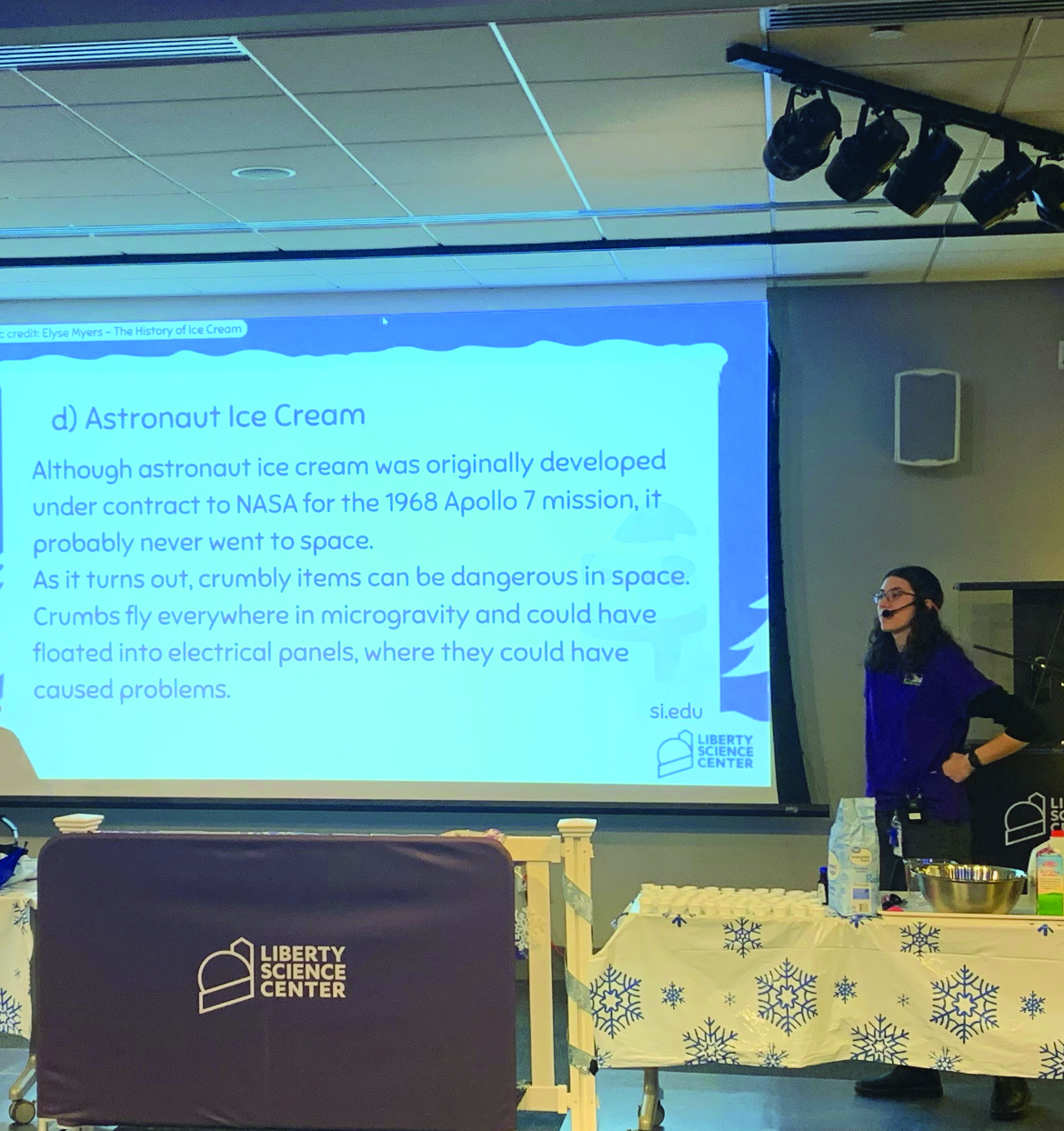
Jenna Tempkin demonstrates how to flash freeze ice cream with liquid nitrogen.
(Photo by Michelle Tempkin.)

How do you use your physics training?
There is the content side: How do I take what I know and make it appropriate for the kids’ level? And there are critical thinking and organizational skills that I learned as a college student.
What do you like about your job?
I get to keep up in physics and grow my teaching skills. One of the best parts is being able to share my knowledge and love of physics with the kids. It’s rewarding. The other day, for example, we got a note from a school where the kids wrote, “This was so exciting. We hope you come back.”