Interdisciplinary Prize
DOI: 10.1063/1.2405548

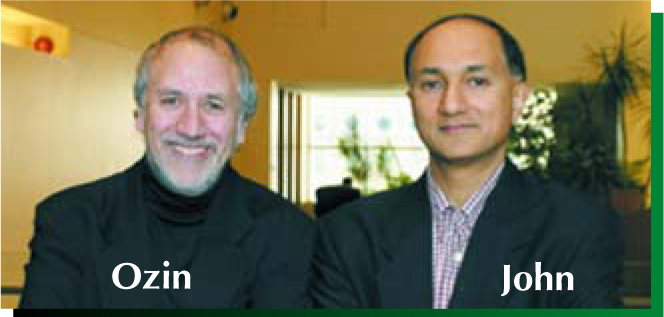
A new prize honors the late Canadian physicist and 1994 Nobel laureate Bertram Brockhouse. The first recipients of the prize, which recognizes outstanding research by interdisciplinary teams of scientists, are Sajeev John and Geoffrey Ozin, both of the University of Toronto.
Together, John, a theoretical physicist, and Ozin, a materials chemist, design and make crystals that trap light. An early joint creation was a silicon-based inverse opal structure that traps light in the 1.5-micron bandgap range. “It was the first self-assembled photonic bandgap material on a length scale relevant to telecommunications,” says John.
The collaboration began when John approached Ozin. “I hadn’t heard of him,” says Ozin. “He started talking about photonic crystals, and I hadn’t heard of them either. He showed me incredible structures, and I thought, ‘My God, they are materials filled with holes.’ “ Ozin, who had “always worked with materials riddled with periodic arrays of holes,” scaled up from the nanometer to micron scale. In working together, he says, “there has to be trust, respect, friendship, collegiality. It’s just like a marriage.”
The annual Brockhouse Canada Prize for Interdisciplinary Research in Science and Engineering was founded and funded by the Natural Sciences and Engineering Research Council of Canada, a federal agency. Recipients should be in Canada and must plow the prize’s purse of Can$250 000 (US$210 000) back into research.

CAMELLA LINTA/UNIVERSITY OF TORONTO

More about the authors
Toni Feder, American Center for Physics, One Physics Ellipse, College Park, Maryland 20740-3842, US . tfeder@aip.org