Hot dust evinces a violent planetary collision around a nearby star
DOI: 10.1063/1.3248458
Rocky planets like our own are thought to form by accretion. Small dust grains agglomerate to make bigger grains, then pebbles, rocks, boulders—all the way up to objects the size of Mars. At that threshold—about 1/10 of Earth’s mass—a rocky protoplanet has consumed all the locally available material. To grow further, Mars-sized protoplanets must collide and merge.
That picture comes from theory and simulation, but there’s ample evidence in the solar system for impacts of the scale needed to complete Earth’s formation. The rotation axes of Venus and Uranus have been knocked far out of alignment with those of the other solar-system members. Mercury has been stripped of its outer crust. Mars is distinctly asymmetric: Its southern hemisphere features high mountains and ancient impact craters; its northern hemisphere has been scoured flat by massive lava flows that followed an impact. And, given that lunar and terrestrial crusts have identical isotopic compositions, the Moon almost certainly formed when a Mars-sized object smashed into Earth (see the article by Robin Canup, PHYSICS TODAY, April 2004, page 56 ).
Now, a team led by Carey Lisse of the Johns Hopkins University in Baltimore, Maryland, has found evidence of a giant impact outside the solar system, in a dusty disk around a nearby star.
1
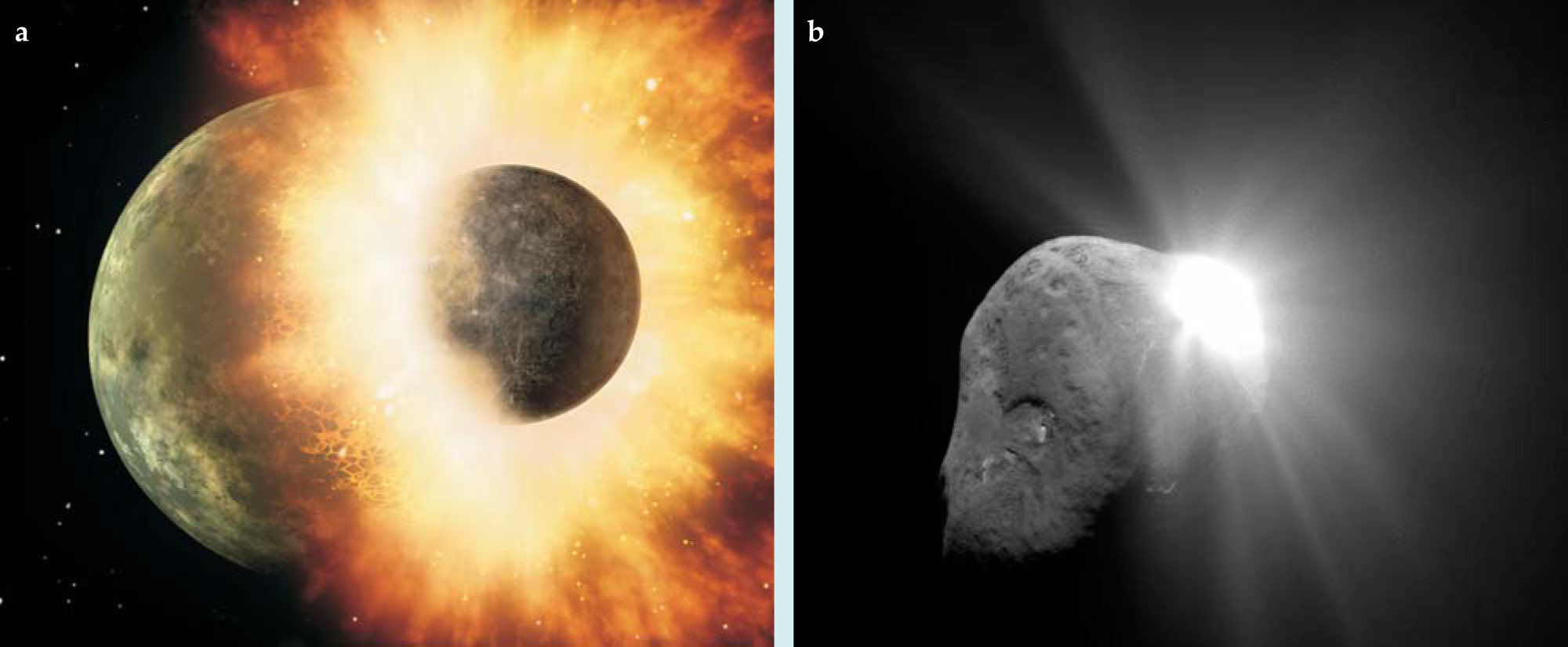
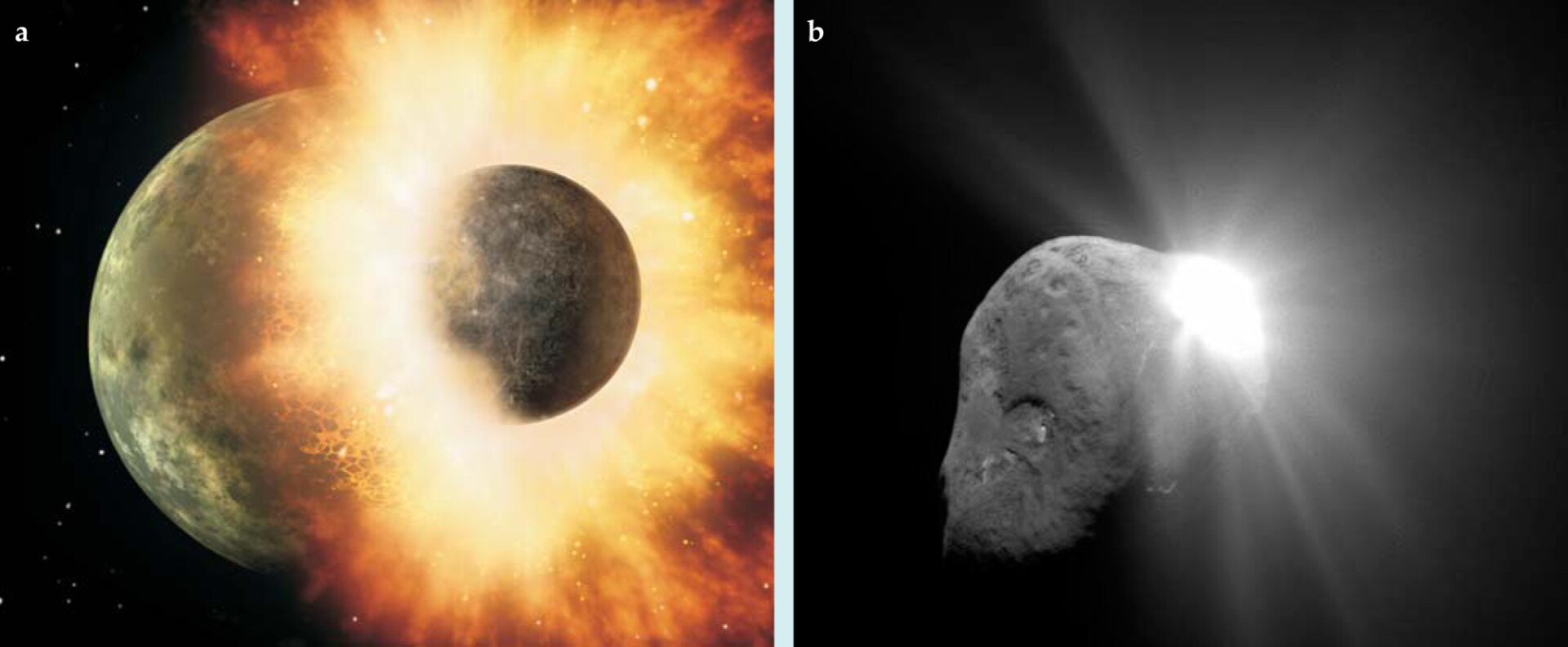
The impact itself, depicted in figure

Figure 1. Two impacts, one imagined and one observed, illustrate the destruction wrought when a massive, high-speed projectile slams into a solid celestial body. (a) The artist’s impression shows what might have happened when a protoplanet around the star HD 172555 was hit by an object the size of Mars. (b) The optical image shows what did happen when, in July 2006, Comet 9P/ Tempel was hit by a 374-kg, instrument-laden projectile loosed from a spacecraft.
(a) NASA/JPL-CALTECH
Fittingly, Lisse’s spectral analysis used techniques he and his colleagues developed for NASA’s Deep Impact mission, which in 2006 sent a dishwasher-sized projectile to crash into a comet’s nucleus. Figure
The observation of an extrasolar impact around a nearby star supports not only theories of planet formation but also proposals to find terrestrial planets—or at least their immediate forebears—by looking for the impacts that form or alter them.
HD 172555
The star whose planetary disk hosted the giant impact is known as HD 172555. It belongs to what astronomers call a moving group, a litter of same-age stars that wander together through the Milky Way. HD 172555’s membership in the group, named after its most prominent member, β Pictoris, puts the star’s age at 12 million years—young enough to harbor a disk where planet formation is still going on.
Although Lisse and his collaborators didn’t set out to find a giant impact in the HD 172555 system, the star has two other properties that make it an ideal hunting ground. At 29.2 parsecs (9.01 × 10¹⁷ m), HD 172555 is among the 1000 or so closest stars. And its unusually high ratio of IR emission to total emission suggests the presence of the ingredients and byproducts of rocky planet formation: warm dust.
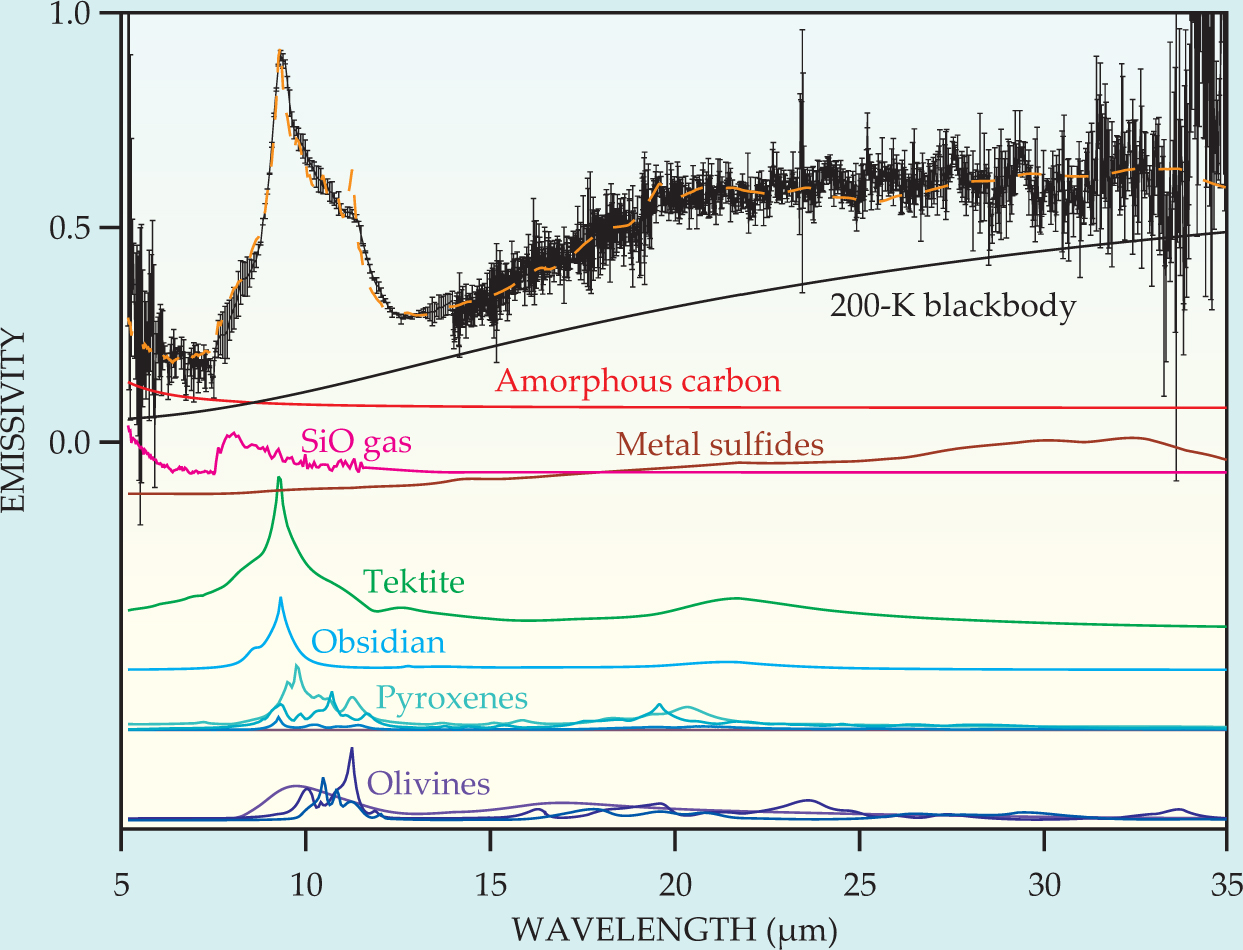
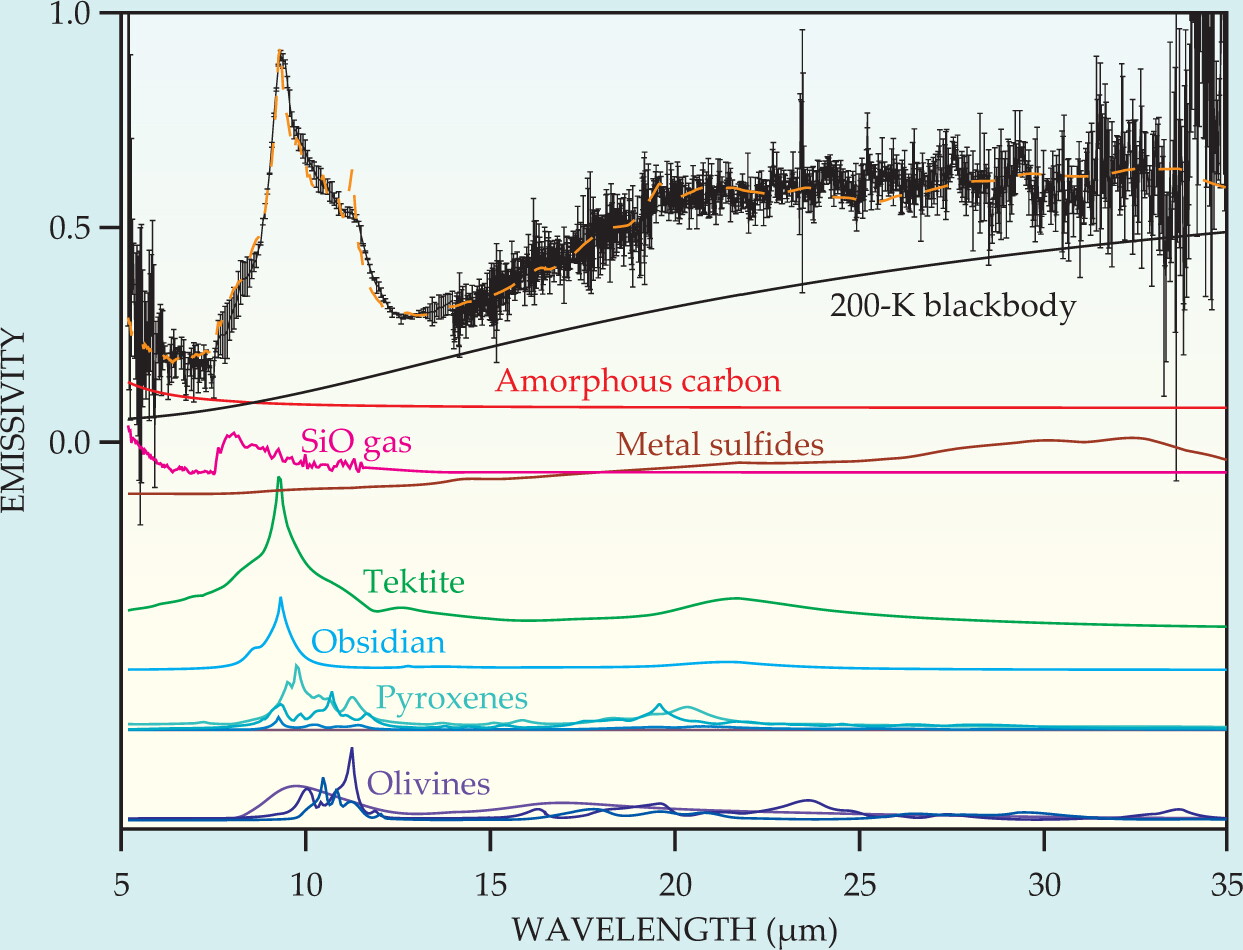
HD 172555’s bright IR emission was first measured by the Infrared Astronomical Satellite in the 1980s. The evidence of a giant impact came from one of the satellite observatory’s more sensitive successors, the Spitzer Space Telescope. Figure

Figure 2. The IR spectrum of the star HD 172555 in the range 5–35 µm (black data points) originates from gas and dust that surrounds the star. To emphasize lines and other spectral features, the data have been divided by the spectrum’s brightest component, the 335-K blackbody emission from fine dust grains. The next-biggest components of the best-fitting model (dashed orange line) come from large grains (the 200-K blackbody), amorphous carbon (soot, a common circumstellar material), silicon monoxide, tektite, and obsidian. The model components have been vertically offset for clarity.
(Adapted from ref. 1)
Objects bigger than 100 µm emit as blackbodies. From such simple spectra, one can deduce only the objects’ distances from the star. Smaller grains are more informative. The smaller the grain, the stronger and narrower its characteristic emission lines are. Moreover, once a grain’s size approaches what would otherwise be its peak blackbody wavelength, the grain’s emissivity drops. To stay in thermal equilibrium, the grain shifts its emission to shorter wavelengths—it gets hotter.
In principle, the spectra emitted by small grains can yield their sizes, compositions, and distances from the central star. The numerous silicate minerals, for example, feature silicon and oxygen bound to each other and to other elements in different, characteristic ways. On the one hand, those differences are a blessing: One can distinguish, say, olivine from feldspar. On the other hand, to identify either of those two silicates, one needs a comprehensive spectral model that incorporates not only olivine and feldspar, but also hundreds of other minerals.
Lisse created such a model for analyzing the spectra from the target of the Deep Impact mission: Comet 9P/Tempel. The model revealed that the comet—and, by implication, dust from the Sun’s former protoplanetary disk—is made up of a few materials: crystalline silicates such as pyroxene and olivine, water ice and vapor, carbonates, amorphous carbon, polycyclic aromatic hydrocarbons, and metal sulfides. The same materials turned up in model fits of spectra from four other comets and from numerous protoplanetary disks, but not in the spectrum of HD 172555 shown in figure
Roughly speaking, the broad, asymmetric hump from 8 to 13 µm originates from materials that contain Si–O bonds. As is the case for other cool, dusty environs around stars, the best fit to the HD 172555 spectrum includes crystalline silicates, such as pyroxene and olivine, but those minerals do not predominate. Rather, the three biggest contributors to the Si–O peak turned out to be micron-sized grains of two amorphous silicas—tektite and obsidian—and SiO gas. Tektite and obsidian are found on Earth as flash-frozen magma. SiO gas is what you get when you vaporize silicate rock. While not a smoking gun, the tektite, obsidian, and SiO are, perhaps, the smoke itself. (The “perhaps” is necessary because Lisse’s model incorporates known materials; unknown materials could conceivably be present.)
The model also yielded the size distribution and temperature of the small grains that contribute to the 8–13 µm hump. In Earth’s asteroid belt, the steady bumping and grinding of rocky objects yields dust whose size distribution falls with a power law of index 3.5.
The fine dust in HD 172555 has a steeper distribution, indicating a faster, nonequilibrium origin. As for temperature, the small grains emit at 335 K, which places them at a distance of 6 AU from HD 172555.
The population of small grains is complemented by a population of larger objects of indeterminate size that emit as 200-K blackbodies. Like the small grains, the larger objects are located at 6 AU from HD 172555, a distance at which one would expect to find the star’s asteroid belt.
How much mass is contained in the dust and gas? In general, luminosity yields mass, provided one knows the size of the emitting objects. The SiO gas, being made up of identical molecules, was the easiest to gauge. Lisse and his colleagues derived a mass of 1022 kg, which is about the mass of Pluto or
The energy required to vaporize 1022 kg of silicate rock and turn it into SiO gas is about 1043 J. Flares and shockwaves emanating from HD 172555 could contain such a large amount of energy but only a small fraction would reach a protoplanetary body. A giant impact would be far more efficient. If the mass of fine dust and gas corresponds to the size of the impactor, then the SiO vaporization energy implies an impact speed greater than 10 km/s. Such high relative velocities are not uncommon in the solar system. Indeed, the object that struck Earth to form the Moon had a relative velocity of that magnitude.
Rare and common
The hot grains of tektite and obsidian that show up in HD 172555’s IR spectrum are small enough that the star’s radiation pressure would drive them away from their current 6-AU orbit within 0.1 million years. The SiO molecules would likely condense and reform minerals on the same time scale. Given that rocky planets take 100 My to form, catching a giant impact in HD172555, despite its being an ideal setting, seems fortunate, though not wildly improbable.
The odds of catching other giant impacts would be higher if one could detect not just the ground-up, kicked-out debris but also the hot glowing surface of the impacted planet. As Michael Meyer of ETH Zürich and his collaborators pointed out in a recent paper, a single stellar system could experience several impacts as its rocky planets form. 2 If a system has two Earth-sized planets, each might have suffered two collisions with Mars-sized objects to reach its final mass. The impacted surfaces could glow for 2 My, so the chance of spotting one glowing surface during the 100 My of rocky planet formation would be roughly 1 in 10. Not bad.
Surprisingly, thanks to its bigger combined area, the ground-up dust from a Pluto-sized impactor is far brighter than the hot glowing surface of an Earth-sized impactee. The next generation of giant ground-based telescopes will be needed to spot those surfaces. Still, the evidence of one impact outside our solar system suggests that other Earth-like planets do lie within a detectable range.
References
1. C. M. Lisse, C. H. Chen, M. C. Wyatt, A. Morlok, I. Song, G. Bryden, P. Sheehan, Astrophys. J. 701, 2019 (2009). https://doi.org/10.1088/0004-637X/701/2/2019
2. E. Miller-Ricci, M. R. Meyer, S. Seager, L. Elkins-Tanton, http://arxiv.org/abs/0907.2931 .