High Schoolers Debate Physics at International Tournament
DOI: 10.1063/1.2169438

“Physics fights” are at the heart of the International Young Physicists’ Tournament, an annual competition in which high-school students debate selected physics topics.
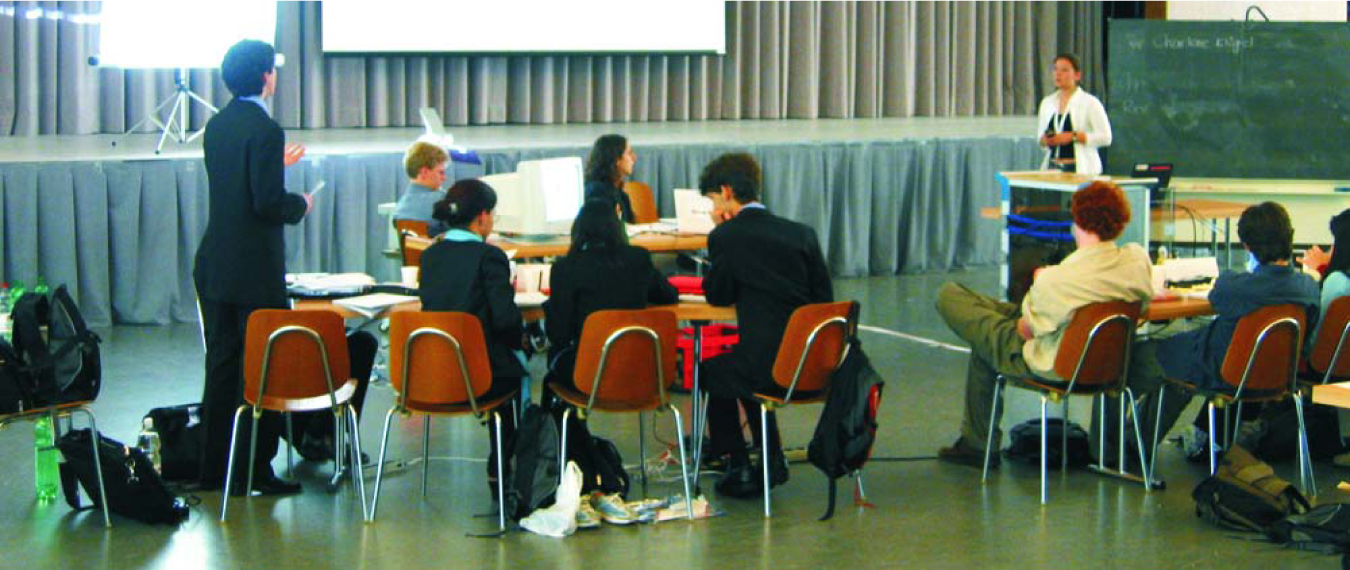
In a physics fight, a reporting team leads with a discussion—on, say, what causes the noise when a drop of water hits a hot skillet—an opposing team questions the reporter’s arguments, and a third team reviews the first two. In the course of the tournament, teams take turns at the different roles. A jury of physicists judges the teams.
A list of 17 problems is published nearly a year before the annual tournament, which is held in July. The topics for the 2006 tournament include, for example, the propagation of sound in foam, the flight characteristics of a sheet of paper on a table, and the behavior of a stream of fluid when it strikes the surface of a sponge-like material. The full list of topics and other information about the IYPT are available at www.iypt.org .
Phillip Schwartz, now a senior at Wildwood High School in Los Angeles California, says he spent about 300 hours working on his problems last year. He made the five-member 2005 US team, which tied with Belarus for second place at the IYPT in Switzerland; Germany came in first. “The atmosphere during the tournament is tense,” Schwartz says. “But getting up in front of a panel of physicists and debating physics I am passionate about is really a rush. The beautiful thing is, after the tournament, everyone is friendly.”
Whereas the better-known International Physics Olympiad is a competition among individuals, the tournament is a team event. Tengiz Bibilashvili, who in Soviet Georgia helped students prepare for both competitions and now teaches at Wildwood and is head US coach for the tournament, says that the olympiad “requires a deep and broad knowledge” while the tournament requires “communication skills, computer skills, research skills. The tournament is maybe more like real scientific research rather than puzzle solving.”
In the US so far, tournament participants have come from just three private high schools. Some nations’ teams have corporate sponsorship, but US students have to pay their own way.
To boost US involvement and get newcomers up to the international level, “we are launching a national tournament in 2007,” says Bruce Oldaker, a physics teacher at Rye Country Day School in Rye, New York, and executive director of the USAYPT, the US affiliate of the IYPT. “It’s really a matter of finding teachers who are willing to make the commitment. The students will follow.”
Teams from more than two dozen countries are expected to fight it out at the 2006 IYPT, which will be held 5—12 July in Bratislava, Slovakia.

Teams from Brazil and Switzerland engage in a physics fight at the 2005 International Young Physicists’ Tournament.
TENGIZ BIBILASHVILI

More about the authors
Toni Feder, American Center for Physics, One Physics Ellipse, College Park, Maryland 20740-3842, US . tfeder@aip.org