Germany forms alliance for terascale physics
DOI: 10.1063/1.2761795

Germany’s high-energy particle physicists have formed a network to increase their international visibility and competitiveness as their field gears up for the start next year of the Large Hadron Collider (LHC) at CERN and, eventually, the International Linear Collider.
The terascale alliance, as it’s known, gets started this month with €25 million ($33 million) over five years from the Helmholtz Association. The German government puts about €150 million annually into CERN. But, says the University of Wuppertal’s Peter Mättig, who is co-coordinator of the alliance with the German Electron Synchrotron’s (DESY’s) Rolf-Dieter Heuer, “Universities get only €12 million per year of federal funds to exploit CERN. This disproportion is in some sense rectified through the alliance.” The alliance will focus on the study of elementary particles, the forces acting between them, and related technological advances.
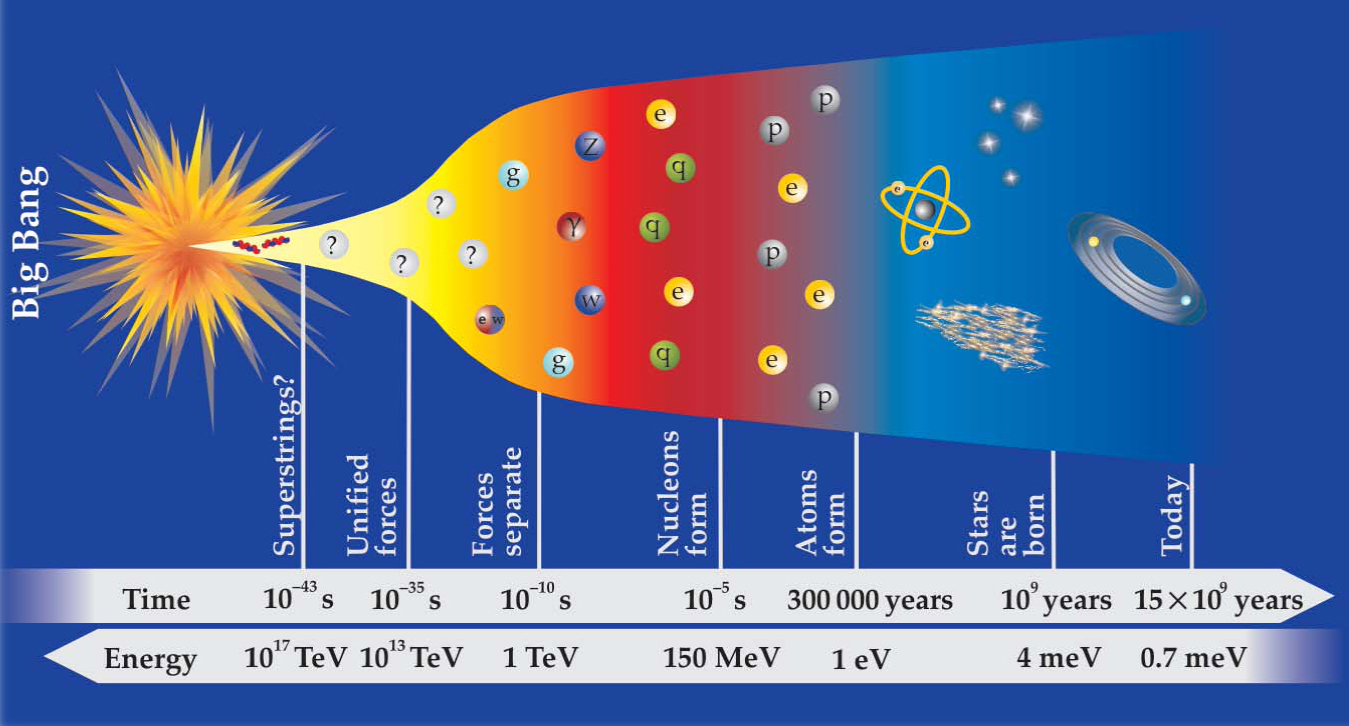
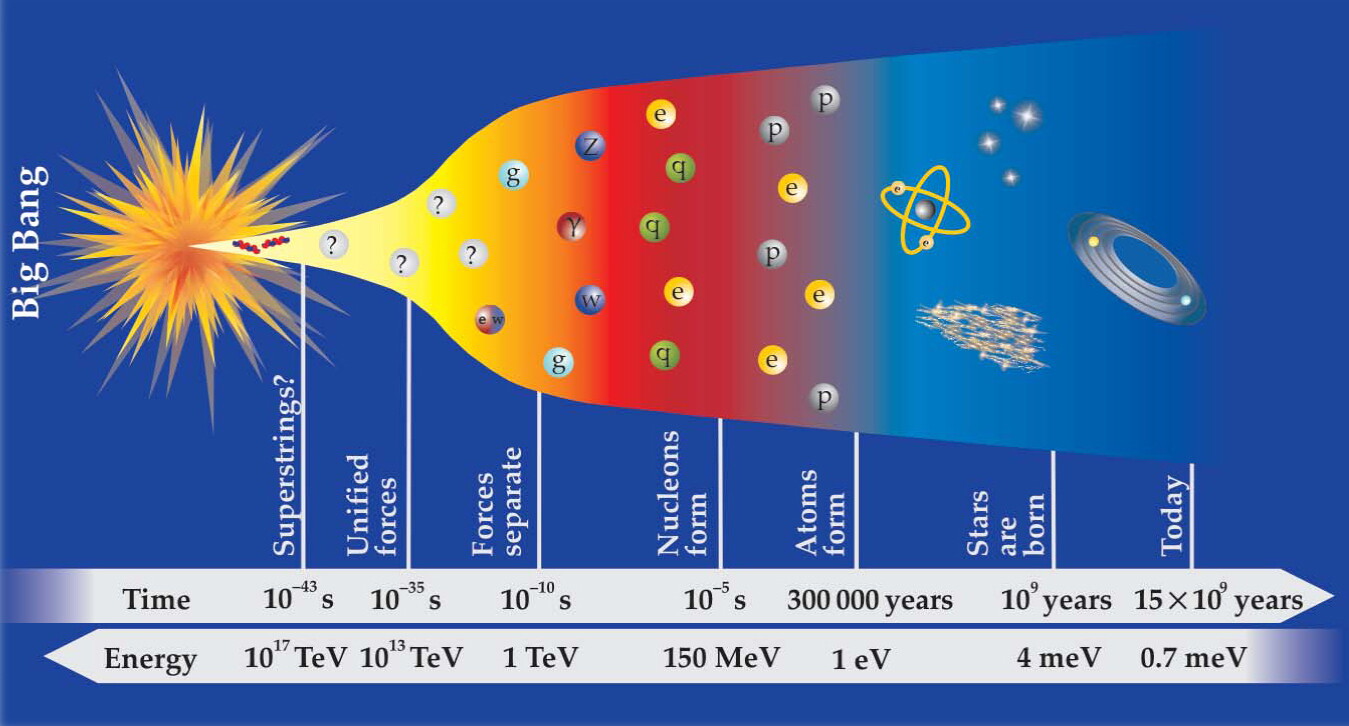
The alliance encompasses two Helmholtz centers—DESY and the Karlsruhe Research Center—plus the Max Planck Institute for Physics in Munich and 17 universities. “The overall goal is to combine the complementary aspects of what we have in Germany to shape one body,” says Mättig. “The alliance is pretty huge,” Heuer adds, “but I think it’s very well focused on particle physics at the high-energy frontier.” With the LHC, the energy frontier moves to the terascale, or 1012 eV (see the figure).

The Big Bang to the present. This schematic shows some states of matter and events as nonlinear functions of time (increasing left to right) and energy (increasing right to left). Particle collisions with energies around 1012 eV are the focus of Germany’s terascale alliance.
DESY
A large portion of the alliance money, roughly €15 million, will go toward 50–60 new jobs for researchers and technicians. “We want to create long-term positions for young people by offering tenure track,” says Heuer. So far, universities and DESY have committed to more than 20 new permanent positions—if the researchers they hire pass muster—after the alliance pays the salaries for the first five years.
Most of the rest of the money will be used for infrastructure, including a data analysis center at DESY. “One university might have a specialty in chip design, and another might have experience in readout electronics,” says Heuer. “We want to develop more tools in grid computing and to improve existing infrastructure for detector development.” With the alliance, infrastructure will be bolstered, technical support will be added, and scientists at any of the participating institutions will have access to the facilities located at all alliance partners.
Smaller sums, Heuer adds, will be used to pay replacement lecturers so alliance members can make extended visits to the LHC; promote accelerator science in German universities—which he notes has gone down in the past decades—by freeing up researchers to teach and bringing students to DESY for internships; and contribute to the salaries of trailing spouses. “We try to have a few new ideas for partners who are also scientists,” Heuer says. “We are also thinking of holding workshops,” adds Mättig. “We want to build up a working atmosphere. At the professor level, we know each other well, but the alliance is aiming at young people.”
“I am not absolutely sure, but I think an alliance like this is a novel thing,” says Heuer. “Helmholtz centers have large infrastructure. They have general engineering expertise and are focused on large, strategic research. They have more ability to guarantee long-term support [and] sustainability.” For their part, universities “have specific expertise, they have scientific diversity, and they create the young blood,” he adds. “In order to play a visible role in the global environment, I think one has to combine all this to get a nationwide coherence for particle physics. This is what we are trying to do.”
More about the authors
Toni Feder, American Center for Physics, One Physics Ellipse, College Park, Maryland 20740-3842, US . tfeder@aip.org