Food Meets Physics at Irradiation Facility
DOI: 10.1063/1.2408475

The Electron Beam Food Research Facility opening late this spring at Texas A&M University in College Station weds commercial marketing research with studies on food irradiation.
Electrons from two accelerators will zap food from above and below as it passes on a conveyor belt. To penetrate more than about 15 centimeters, the facility also has an x-ray source, but no radioactive isotopes. Irradiation breaks molecular bonds, killing bacteria, insects, insect eggs, and larvae, and extending food shelf life.
Irradiation also breaks molecular bonds in the food itself and forms chemicals that don’t naturally exist in food. The watchdog group Public Interest—which has sent letters protesting Texas A&M’s new facility—and other opponents of food irradiation cite studies showing decreased vitamin content and dangerous and unstudied byproducts in the food. Not surprisingly, supporters say food irradiation is safe. “We do not care if the DNA in hamburger is broken up into sections,” says Texas A&M biophysicist Les Braby. “That happens when we digest our food. However, one break in the DNA of a bacterium can make it impossible for that cell to reproduce, and that is all we need to prevent infection.” Nutrition will be monitored, adds Mark McLellan, the new facility’s director, “though the impact [of irradiation] is less than in canning or cooking.”
Texas A&M food scientists will focus on how irradiation affects flavor, texture, appearance, and longevity of food. They’ll also study what happens to food packaging—irradiation is typically done on sealed food so that pathogens don’t get in after treatment.
Food packaging will also be studied by physical scientists, who will do materials analyses on plastic and paper food wrappers. Other studies involving physical scientists include designing instruments for food irradiation, monitoring chemicals inside food packages, and calculating radiation doses. In a TV dinner-type meal, for example, says Braby, “if you have high-density turkey stuffing, the radiation incident there will be scattered and contribute to the dose other parts of the meal receive.” Figuring out how to deliver the appropriate dose, he adds, is similar to computations in tumor radiation therapy.
On the commercial side, SureBeam Corp will conduct market research to look at irradiation effects on specific foods and their wrappers. The San Diego, California-based company has provided the irradiation sources and a building to house them, and will maintain the equipment for 10 years, after which ownership will transfer to the university—a gift worth about $10 million, says McLellan. “This is one of the largest-scale operations for research and test market evaluation tuned to food.”

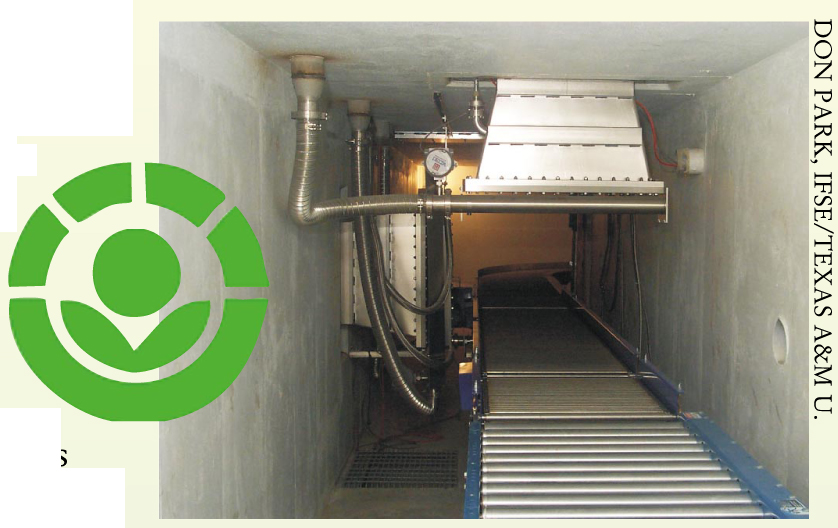
For food irradiation studies, beams of electrons sweep through food samples on a conveyor belt. From the horn on the left, electrons from a third accelerator hit a tantalum target, creating an x-ray source. The radura symbol (inset) lets shoppers know that food has been irradiated.
Don Park, IFSE/TEXAS A&M U.

More about the authors
Toni Feder, tfeder@aip.org