Flattened clouds of ultracold atoms display a topological phase transition
DOI: 10.1063/1.2349715
Reducing a system’s dimensions from three to two need not impoverish its physics. In fact, some of the richest, most intriguing physical phenomena show up in flat, thin layers. The fractional quantum Hall effect and high-temperature superconductivity are essentially two-dimensional—as is the topological phase transition known as Berezinskii-Kosterlitz-Thouless.
Like the onset of ferromagnetism and superfluidity, the BKT transition doesn’t involve the release or capture of latent heat, but it differs from those more familiar transitions in one distinctive respect: When a system makes the BKT transition, its symmetry is preserved, not broken. What changes is the topology of the system’s coherence.
Vadim Berezinskii identified the unusual transition in an analysis that appeared first in Russian in 1970. 1 Soon after, and unaware of Berezinskii’s paper, J. Michael Kosterlitz and David Thouless derived the same result. 2
Being quite generic, the transition was expected to occur in a host of low-temperature 2D systems. In 1978, Isadore Rudnick and, independently, David Bishop and John Reppy found the predicted transition in films of superfluid helium-4. (The online version of this story links to the original Physics Today report from August 1978, page 17 .)
Now, Zoran Hadzibabic, Peter Krüger, Marc Cheneau, Baptiste Battelier, and Jean Dalibard at the École Normale Supérieure in Paris have observed the BKT transition in flattened clouds of ultracold rubidium atoms. 3 Their experiment not only confirms BKT theory in a new system, but also reveals for the first time the transition’s microscopic instigators: local topological defects or vortices.
Holed stockings
Two-dimensional systems can have perfect crystalline order, but only at absolute zero. As soon as any thermal energy becomes available to a 2D lattice, long-wavelength fluctuations emerge to break up the order.
Orientational symmetry is more robust. Despite thermal fluctuations, particles in a 2D lattice, even when not equally spaced, can line up coherently. As the temperature rises, the length over which orientation remains coherent drops. But, as Berezinskii, Kosterlitz, and Thouless discovered, something else happens too.
At finite temperatures, pairs of oppositely oriented defects—vortices—spontaneously form. When the temperature is low, the vortex pairs are tightly bound and sparsely distributed; the system’s coherence falls off with distance algebraically—that is, with a power-law dependence.
But as the temperature rises, the vortex pairs not only proliferate but also widen. When a wide pair sits amid tight pairs, its vortex and antivortex are effectively independent of each other. Collectively, the unbound vortices and antivortices change the character, or topology, of the coherence. Now, the coherence falls off with a steeper, exponential dependence.
The unbound vortices and antivortices also undermine the system’s integrity like holes in a swatch of stocking silk. In a finite system or a stocking, the more independent vortices or holes that form, the weaker the system or fabric becomes—until it loses its coherence or falls apart.
But in the infinite system of BKT theory, the change is abrupt: Below the critical temperature, coherence is algebraic; above, it’s exponential.
It takes two
A Bose–Einstein condensate, like other ordered collectives, loses its characteristic coherence if squashed flat. But a 2D condensate can adopt a kind of quasi-long-range order and keep its superfluidity. Even before anyone had made a BEC, Berezinskii, Kosterlitz, and Thouless anticipated that a 2D condensate would undergo their transition.
Observing a BKT transition in a BEC has been a goal of the cold-atom community for years. How to reach that goal wasn’t clear at first. Broadly speaking, experimenters determine a BEC’s properties by measuring density variations after releasing the condensate from a trap. Unfortunately, density variations don’t provide easy access to the system’s coherence. Phase fluctuations work better. A previous experiment suggested how to exploit them.
In 2004, the Paris group created a BEC and divided it into 30 parallel slices with an optical lattice. Releasing the 30 slices from the trap produced unexpected interference patterns—unexpected because the slices were independent of each other. 4
The Paris researchers realized they could probe the structural coherence of a 2D BEC by trapping two of them at the same temperature and releasing them simultaneously. The resultant fringes, which arise principally from variations in phase rather than density would embody the coherence. Repeating the experiment at different temperatures, they hoped, would reveal the BKT transition.
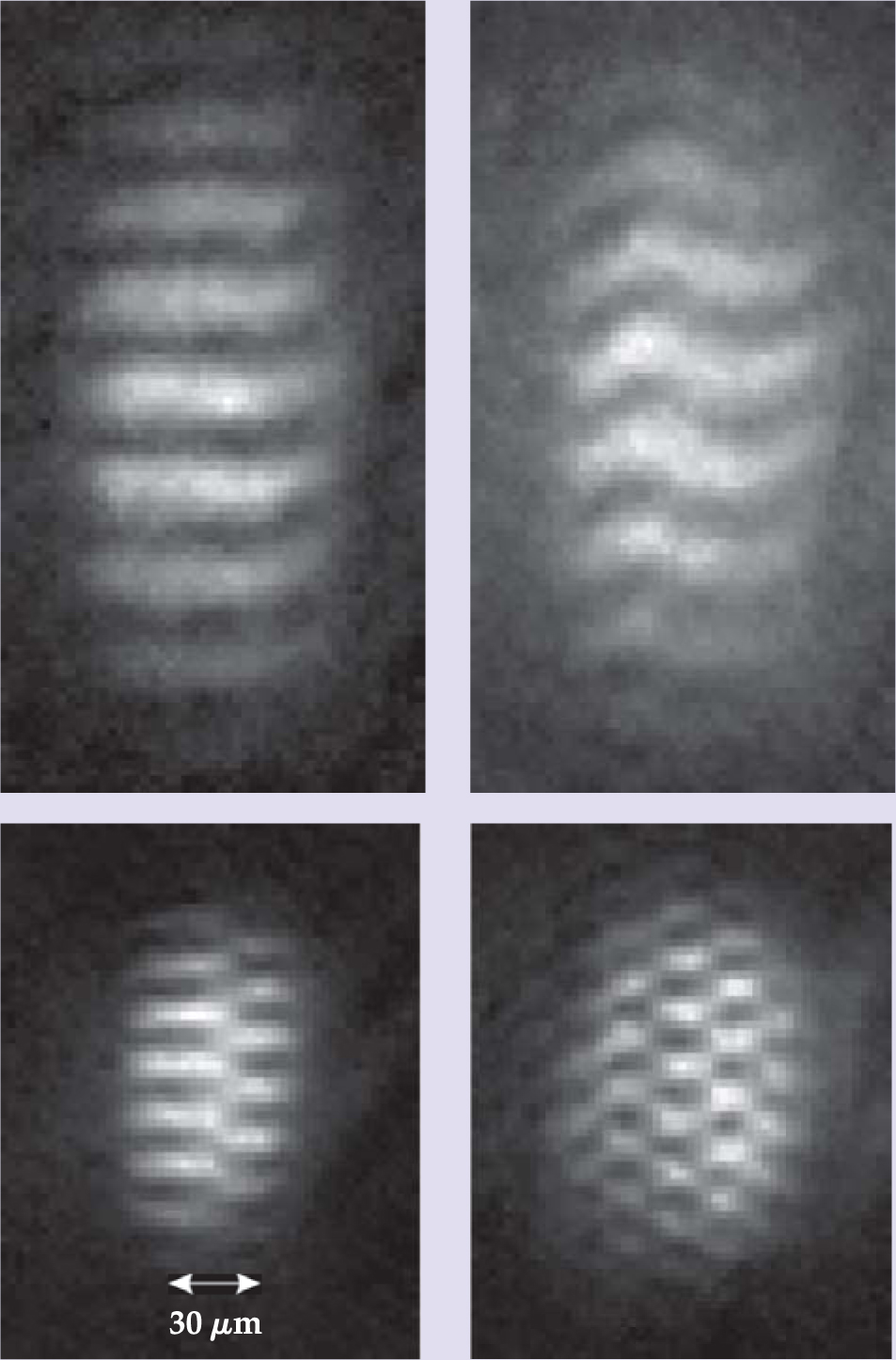
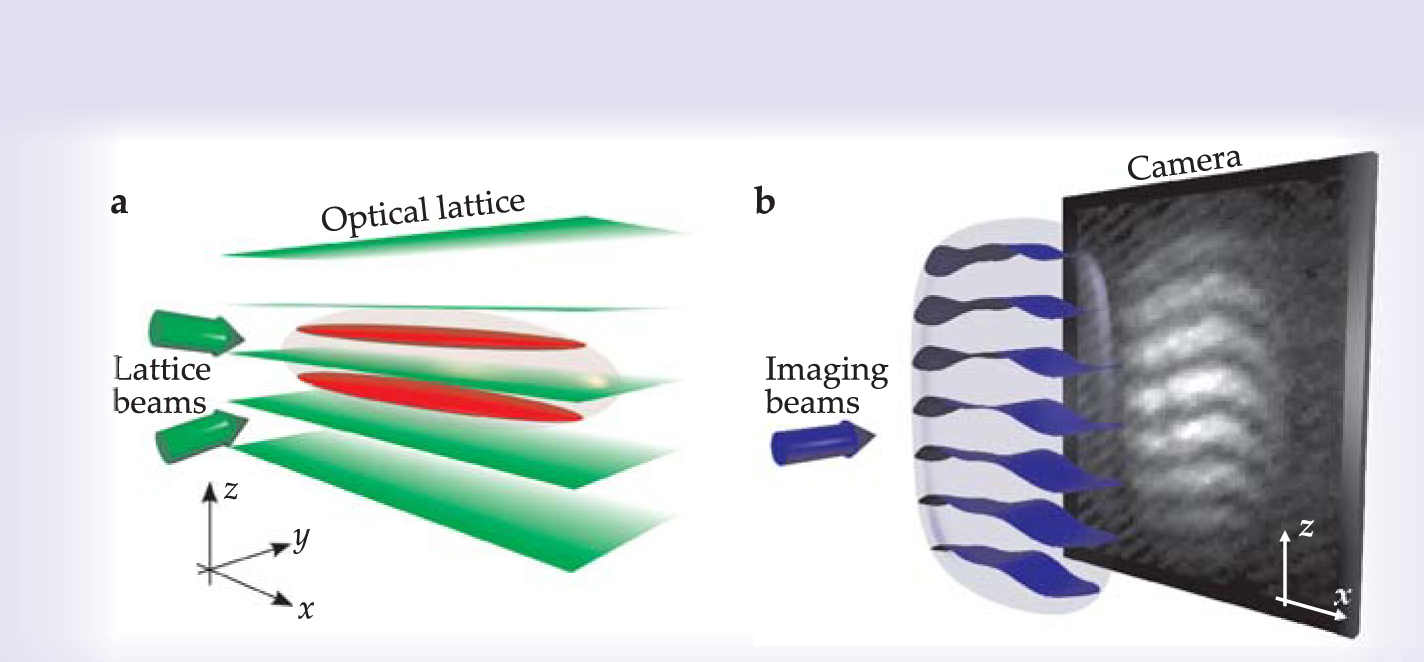
Figure 1 outlines the experimental setup and figure 2 illustrates the kind of data obtained. When released, the two clouds of 87Ru atoms expand most rapidly in the direction of their tightest confinement, the z-direction. After 20 milliseconds, a pulse of laser light tuned to the atoms’ 5 S → 5 P transition is shot through the cloud in the y-direction. Atoms absorb the light and cast shadows in the xz-plane. A CCD camera records the patterns.

Figure 2. fringe shape reveals both the scale of the coherence in the two-dimensional condensate and the presence of vortices. (a) At low temperatures (about 200 nK), the fringes are straight, indicating long-range coherence. (b) At higher temperatures (about 300 nK), the coherence scale shortens and the fringes become wavy. (c) The presence of a single unbound vortex creates a dislocation in the fringe pattern. (d) When the temperature increases, more vortices form, creating more dislocations.
(Adapted from ref. 3.)


Figure 1. Probing the thermodynamic state of a two-dimensional gas entails (a) first trapping two independent clouds (red) by means of an optical lattice (green). Each cloud contains about 105 atoms of rubidium-87 and measures roughly 120 × 10 × 0.2 µm3. When the trap is turned off (b), the clouds expand mostly in the vertical (z) direction and interfere to form a set of wavy maxima (blue) more or less parallel to the xy-plane. Illuminating the clouds with resonant laser light in the y-direction creates a shadow image in the xz-plane.
(Adapted from ref. 3.)

The patterns’ most prominent features are the fringes, which arise from the beating of the two matter waves of the released condensates. The fringe spacing D is given by ht/md, where h is Planck’s constant, t the time after release, m the mass of 87Rb, and d the separation between the two traps. To quantify the patterns, the Paris group fitted the brightness distribution with a function F(x,z) that consists of a Gaussian envelope G(x,z) and a cosine term:
Here, c(x) characterizes local coherence, while the phase term φ(x) characterizes long-range coherence.
Although the function fits the data well, it doesn’t provide a direct, theory-testing route to the underlying physics. While the Paris researchers were trying to figure out how to analyze their data, a providential preprint arrived from theorists Anatoli Polkovnikov of Boston University, Ehud Altman of the Weizmann Institute of Science in Rehovot, Israel, and Eugene Demler of Harvard University.
Inspired by the Paris group’s 2004 paper, Polkovnikov, Altman, and Demler had tackled and just solved the analysis problem 5 : How does the coherence of a 2D (and 1D) BEC manifest itself in a two-cloud interference experiment?
Their starting point was the first-order correlation function g 1(r,r′) of the two interfering condensates. Integrating g 1(r,r′) through the xy-plane between the limits ±Lx and ±Ly yields how quickly the fringe brightness falls off with distance in the x-direction. In a perfectly correlated system, the fringe brightness would persist indefinitely. But in an imperfectly correlated system, integrating over longer and longer distances would gradually wash out the signal. And the higher the temperature, the faster the falloff.
Because the fringes are imaged in the xz-plane, fluctuations in the y-direction average out, but the fluctuations can still affect the integrated brightness in the x-direction. The condensate is longer in the x-direction than in the y-direction, however. And toward the horizontal ends of the condensate, r varies strongly with x and weakly with y. Choosing the integration of g 1(r,r′) to satisfy Lx ≫ Ly therefore reduces the integral’s unmeasurable y-dependence.
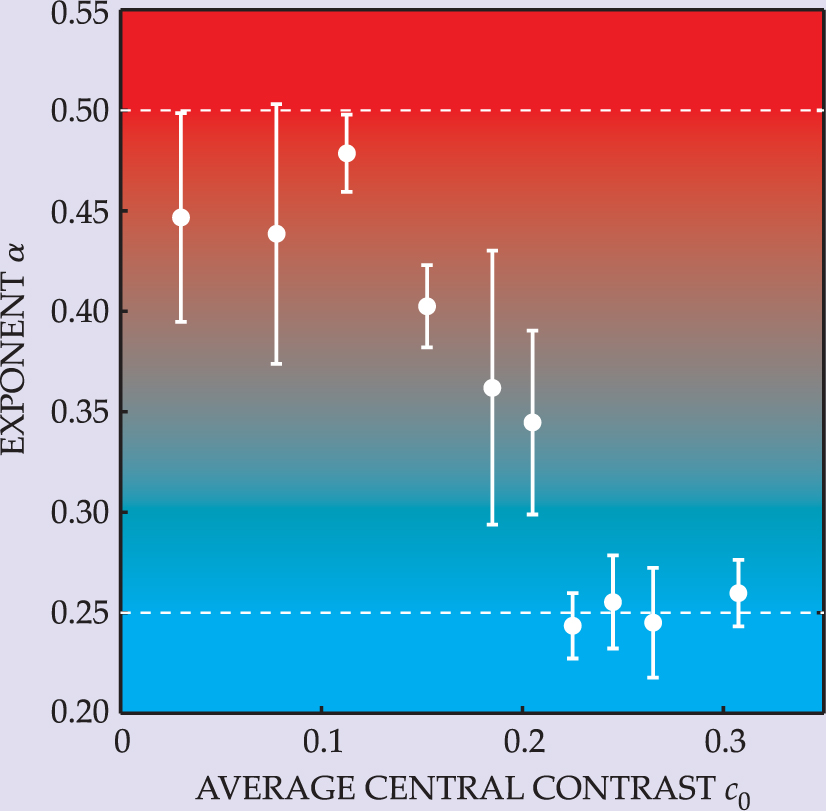
When Polkovnikov, Altman, and Demler did the calculation, they found the fringe brightness falls off at a rate proportional to L x −α . The remarkably simple expression applies on both sides of the BKT transition. Just below the transition, α = 0.25; above it, α = 0.50.
The expression’s derivation presumes a uniform system, but at the edge of the trap, thermal excitations reduce the local contrast c(x). When the Paris team applied the theory to their data, they restricted the measurement of fringe brightness to the region around the fringe center where the local contrast c(x) never falls below half its central value c 0.
The team found that integrated fringe brightness does indeed fall off as L x −α . And, as figure 3 shows, the exponent derived from the data changes with temperature (or with its surrogate c 0), as predicted by Polkovnikov, Altman, and Demler’s application of BKT theory.

Figure 3. The Berezinskii-Kosterlitz-Thouless transition is abrupt in an infinite system, but gradual in a finite system. In the Paris experiment, the transition shows up as an increase in an exponent α that characterizes the coherence. Here, the ordinate is the central contrast c 0, which decreases smoothly and predictably as the temperature rises.
(Adapted from ref. 3.)

Vortices and high-T c
Near the BKT transition, a 2D system teems with both tightly and weakly bound pairs of vortices. The vortices appear in an interference pattern as abrupt steps because a particle, swept once around a vortex, ends up with its phase rotated by 2π.
The Paris experiment can’t resolve tight vortex pairs, but, as panels c and d of figure 2 show, a few presumably unbound vortices manifest the telltale steps. For the first time, the vortices at the heart of BKT theory are evident.
One of the attractions of working with cold-atom condensates is the ability to control their interactions. The Paris group foresees a host of further experiments. Perhaps the most intriguing is creating an analog of a high-T c superconductor. The atoms would have to be fermions, not the bosonic 87Rb atoms. By adjusting the temperature and an applied magnetic field, the fermions could be brought through a superconducting transition. And by adjusting the distance between two condensates, one can investigate the extent to which high-T c superconductivity really is two-dimensional.
References
1. V. L. Berezinskii, Zh. Eksp. Teor. Fiz. 59, 907 (1970).
2. J. M. Kosterlitz, D. J. Thouless, J. Phys. C 5, L124 (1972) https://doi.org/10.1088/0022-3719/5/11/002 .
3. Z. Hadzibabic, P. Krüger, M. Cheneau, B. Battelier, J. Dalibard, Nature 441, 1118 (2006) https://doi.org/10.1038/nature04851 .
4. Z. Hadzibabic, S. Stock, B. Battelier, V. Bretin, J. Dalibard, Phys. Rev. Lett. 93, 180403 (2004) https://doi.org/10.1103/PhysRevLett.93.180403 .
5. A. Polkovnikov, E. Altman, E. Demler, Proc. Natl. Acad. Sci. USA 103, 6125 (2006) https://doi.org/10.1073/pnas.0510276103 .