Europe Wrestles With ITER Site Bid
DOI: 10.1063/1.1634525

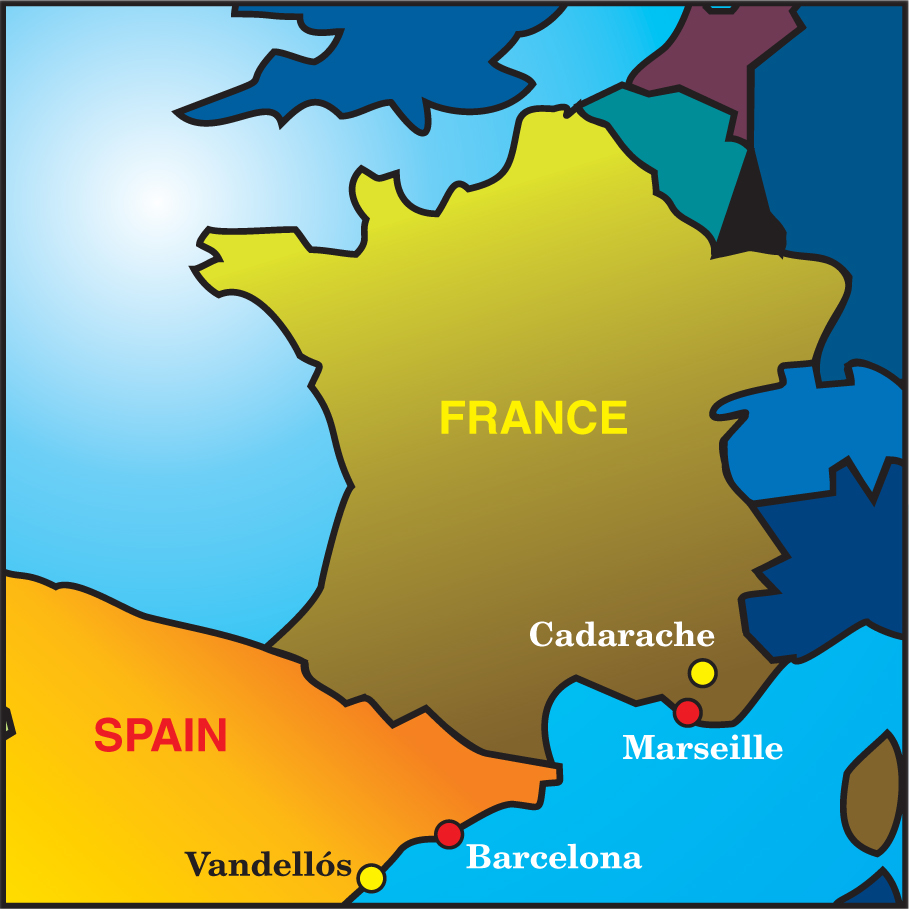
Cadarache or Vandellós? The European Union is in a quandary over whether to put forward the French or Spanish site to host ITER, a $5 billion magnetic fusion experiment intended to prove the feasibility of fusion energy. The decision is set for 27 November, with the final site selection, between the victorious European bid and bids from Canada and Japan, to follow within a couple of months.
In September, a European panel of experts pronounced the site bids of both France and Spain “outstanding,” and said that either of them was “likely to win the international site selection.” The panel, chaired by UK chief science adviser David King, evaluated the two sites in terms of technical and scientific properties, cost, local political and financial commitment, and other factors. The King report notes that France has the advantage of existing technical facilities and highly skilled people, while building ITER in Spain could cut costs; preliminary estimates of the savings are all over the map, from ¢34 million to ¢274 million ($40 million–$319 million). But the report’s conclusions do not point the way to an easy decision.
Not surprisingly, scientists and politicians are rooting for their own country to host the project. “Just have a cup of coffee in Madrid and Paris, and you’ll know that building ITER will be much cheaper in Spain than in France,” says Carlos Alejaldre, director of the fusion lab at CIEMAT, Spain’s national center for energy research. “But that’s not the main issue. We are convinced we have a very good technical site.” Spain’s bid, he adds, “challenges the natural order in Europe. But here it is seen as a chance to have a large international project. There is a dynamism. The whole country feels this is right.”
Arguing that France should host ITER, Jean Jacquinot, who heads that country’s fusion research program, says, “the most important consideration for me is that fusion development proceed along the safest and fastest route.” The Tore Supra experiment in Cadarache and the Joint European Torus in the UK—of which he is a former director—“were constructed on time and budget with the huge help of first-class nuclear fusion centers nearby,” says Jacquinot. “Fusion could pay a very dear price if this lesson [is] forgotten.” A counter example is Germany’s Wendelstein 7-X stellarator, which lacks local scientific and technical support and is suffering costly delays. Some people point to the demise of the Superconducting Super Collider in Texas a decade ago as a warning against building a major project on a greenfield.
The bottleneck is dangerous, says Robert Aymar, former ITER chief who in January will become director general of the CERN particle physics lab near Geneva. “If the different European parties take too much time to decide, you will find that the other partners say, Why accept a European site when they can’t make a decision?”
Behind the scenes of what comes down to a political decision, there is talk of which site would garner the strongest European support to actually go ahead with the project, and what sort of tradeoff the two countries might arrange. For example, Spain might let France take the ITER lead in exchange for a neutron source, a highspeed train line, or something else.
If no solution is found before 27 November, then the 15 EU research ministers may end up selecting the site by vote. In addition to the EU, ITER members are Japan, Russia, Canada, and, as of earlier this year, the US, China, and South Korea. Construction on the project is scheduled to begin in 2005, and if all goes well operations could begin in 2013.
In related news, at press time word on Canada’s participation was expected imminently. Late last year, the Canadian delegation announced that it would revamp its offer to host ITER in Clarington, Ontario. Now the government is considering whether it wants to pony up 20% of the construction costs plus a share of the remaining 80%, as expected of the host country, and indeed how much it wants to contribute to ITER, whether or not it hosts the project.
And on 25 September, the National Academy of Sciences’ National Research Council released a report reaffirming its support for the US rejoining ITER (see Physics Today March 2003, page 23 ). Achieving a burning plasma is so important, the report says, that if ITER falls through, the US should pursue a new international project. The report stresses that, to afford ITER, the US domestic fusion budget needs to grow. It also says the community should follow the examples from astronomy and high-energy physics and set research priorities.

Before a final site for ITER can be chosen, the European Union must decide whether to put forth Cadarache, France, or Vandellós, Spain, as its candidate.

More about the authors
Toni Feder, tfeder@aip.org