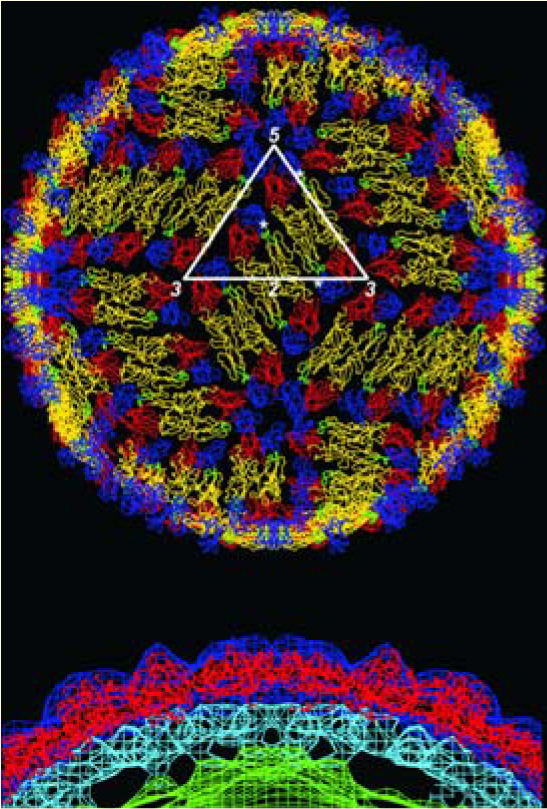
Dengue virus structure solved
DOI: 10.1063/1.4796708
Dengue virus structure solved in two steps. In its nastiest form, mosquito-borne Dengue fever leads to hemorrhaging, coma, and death. Purdue University’s Richard Kuhn and his colleagues from Purdue and Caltech first used cryoelectron microscopy to derive the virus’s rough, 24-Å-resolution shape (for more on cryoEM, see March 1999, page 21 ). To get higher resolution, they assumed that the Dengue virus shares the same molecular building blocks as its relative, tick-borne encephalitis virus. The structure of these building blocks—glycoprotein dimers—had already been solved to atomic resolution, so the problem became how to arrange the glycoproteins to reproduce the cryoEM-derived Dengue structure. By using sophisticated image analysis, Kuhn and company verified the shared building block assumption and solved the structure of Dengue virus to a resolution of about 3Å (see figure). Armed with the structure, they also came up with a set of molecular reconfigurations that the virus executes when it infects its victim. Both the structure and the proposed mechanism could help create a vaccine for Dengue fever, which afflicts tens of millions of people worldwide every year. (R. J. Kuhnet al., Cell, 108 , 717, 2002 http://dx.doi.org/10.1016/S0092-8674(02)00660-8 .)