Dark-matter searches
DOI: 10.1063/PT.3.2513

In July the US Department of Energy and NSF gave the green light to three dark-matter experiments. LZ and SuperCDMS will look for weakly interacting massive particles (WIMPs), and the upgraded Axion Dark Matter Experiment, ADMX-Gen2, will seek a putative dark-matter particle to solve a mystery in the strong force. Funding amounts are being finalized and are subject to congressional appropriations.
More mass—seven metric tons of liquid xenon—and fewer false signals will make the LZ experiment about 300 times as sensitive to traversing WIMPs as its predecessor, LUX (see Physics Today, February 2013, page 19 ). The WIMP signature in LZ consists of a flash of light from a recoiling xenon nucleus followed by luminescence from drifting electrons. LZ is to be built in the Sanford Underground Research Facility for an estimated $55 million, with help from partners Portugal, Russia, and the UK, and from private sources and the host state of South Dakota.
SuperCDMS aims to determine the recoil energy imparted by WIMP collisions with supercooled solid-state germanium and silicon by looking for the phonons and the charge each event generates in the crystal detectors. The experiment is set to both grow 10-fold in size and move from the Soudan Mine in Minnesota to SNOLAB in Sudbury, Ontario, Canada, a deeper site that offers better shielding from cosmic rays. Estimated cost is $32 million, with $3 million expected from Canada and the rest from the US.
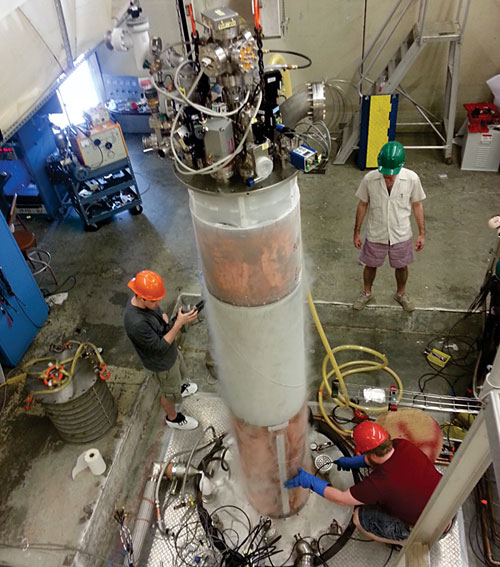
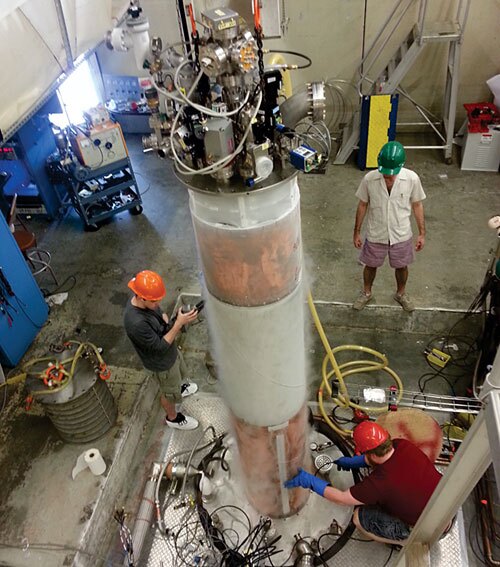
A roughly $1 million dilution refrigeration system will cool ADMX-Gen2 to a few hundred millikelvin, which will reduce thermal noise and thereby increase the sensitivity of the University of Washington–based hunt for axions. The experiment, shown in the photo, involves tuning a radio receiver to detect axions in a magnetic field as they convert to microwave photons.

DMITRY LYAPUSTIN
More about the authors
Toni Feder, tfeder@aip.org