Cosmic tau neutrinos uncovered
DOI: 10.1063/pt.ugmx.qkfo

It took two years for researchers using the vast IceCube Neutrino Observatory to uncover a population of the chargeless, featherweight particles that originated beyond the solar system. They would need a decade more, it turns out, to confirm that those energetic particles come in all three neutrino flavors. To pair with its previous measurements of cosmic muon and electron neutrinos, the IceCube collaboration now reports identifying seven candidate tau neutrinos, the most elusive variety of neutrino because its partner lepton decays so rapidly.

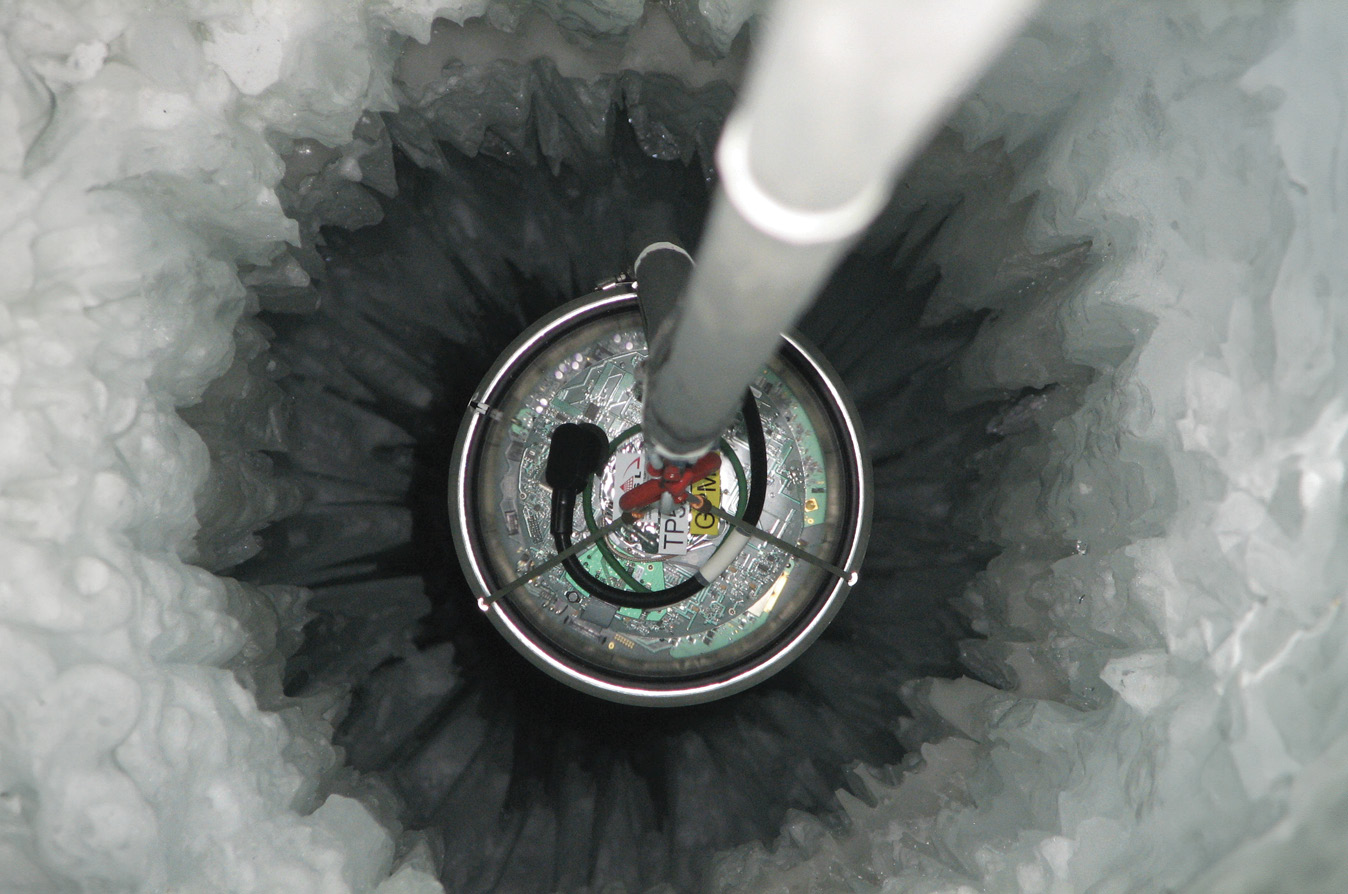
Light sensors for the IceCube Neutrino Observatory are lowered into the Antarctic ice. (Image by Mark Krasberg, IceCube/NSF.)

The candidates were plucked from nearly 10 years of data acquired from the IceCube detector, whose more than 5000 light sensors are attached to cables that are frozen within an Antarctic ice sheet. Whether produced in a laboratory or in a galaxy billions of light-years away, neutrinos are constantly oscillating between flavors until they interact with other matter. When such an interaction occurs, including in the dark icy depths monitored by IceCube, a charged muon, electron, or tau lepton is released. That particle, and the cascade of particles it yields from further collisions, briefly exceeds the speed of light in ice and emits a measurable blue glow as it slows down.
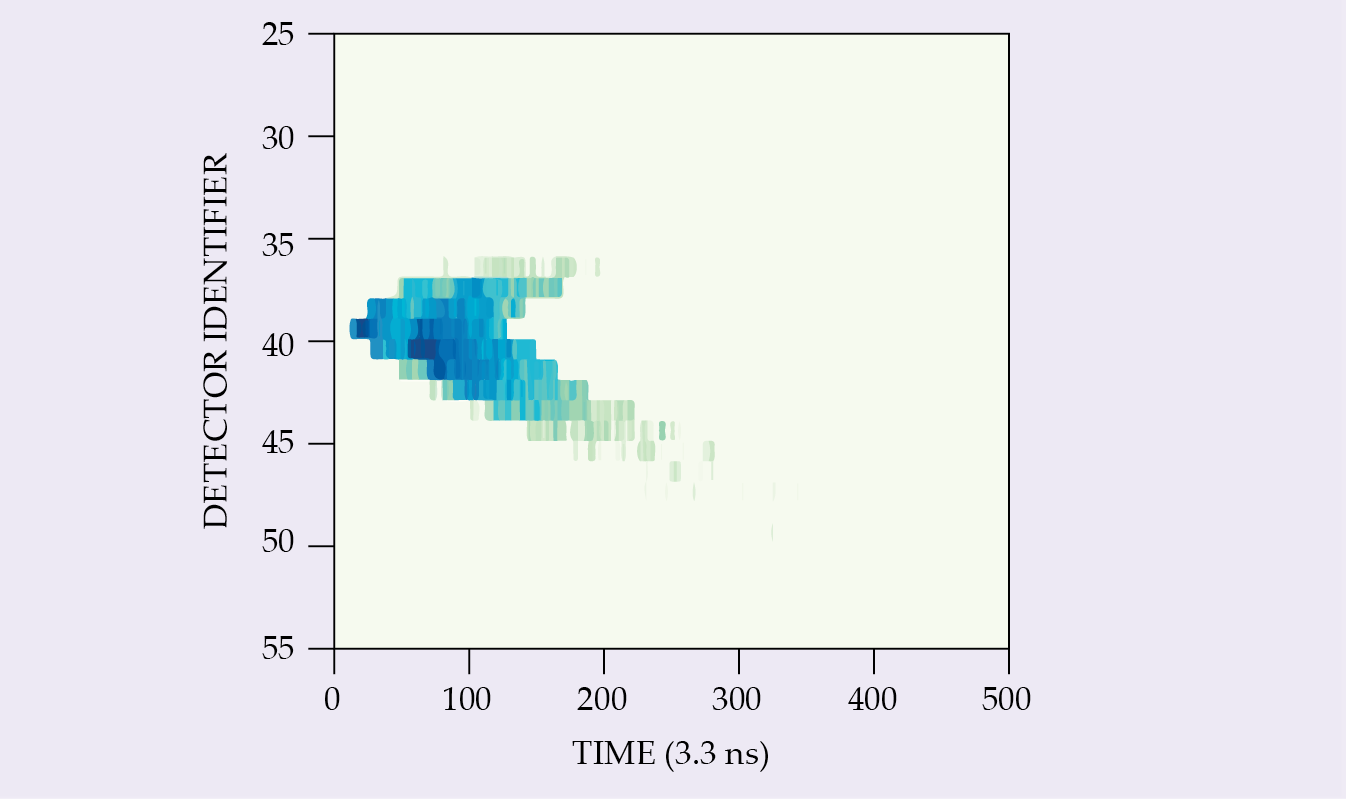
A tau neutrino announces its arrival at IceCube via a so-called double bang: a flash of light triggered by the neutrino’s impact, followed by another from the decay of the tau lepton. But the lepton’s lifetime is so short that the dual flashes are hard to spot. To do the job, IceCube researchers turned to convolutional neural networks, AI models with applications that include identifying objects in images. One model was trained to differentiate between single and double flashes; the others distinguish tau signals from those of muon neutrinos and of cosmic rays.

This candidate tau neutrino was detected at IceCube in 2019. The darker the blue, the brighter the light sensed by the detectors; the numbers on the vertical axis correspond with depth. The two regions of dark blue are presumably caused by the neutrino interaction and then the decay of the tau lepton. (Image adapted from the IceCube collaboration.)

Seven of IceCube’s high-energy particle events aced the tau-ness test of all the neural networks, a number that reflects the rareness of cosmic neutrino detections and the fact that the analysis focused on only a small section of the vast detector. Still, the results establish that there is at least some flux of cosmic tau neutrinos. And they are consistent with theoretical predictions that muon, electron, and tau neutrinos should appear in roughly equal numbers from distant sources because of the particles’ continuous oscillation en route.
The tau neutrino detections also provide verification that the speedy neutrinos that IceCube has been reporting since 2013 as sourced from beyond the solar system are indeed produced far from home. (The cosmic sources may include blazars, active galactic nuclei, and other violent objects.) Although particle interactions in Earth’s atmosphere can produce energetic electron and muon neutrinos, they don’t have time to oscillate into tau neutrinos before reaching the IceCube site. (IceCube collaboration, Phys. Rev. Lett., 132, 151001, 2024 .)
More about the authors
Andrew Grant, agrant@aip.org