One day Hamed Tarawneh came across a notice about an upcoming workshop on SESAME, the multinational synchrotron light source being built in Jordan. He was 22 years old and had recently finished his bachelor’s degree in electrical engineering at Mutah University in Karak, Jordan. At the time, he was an intern at a power plant company.
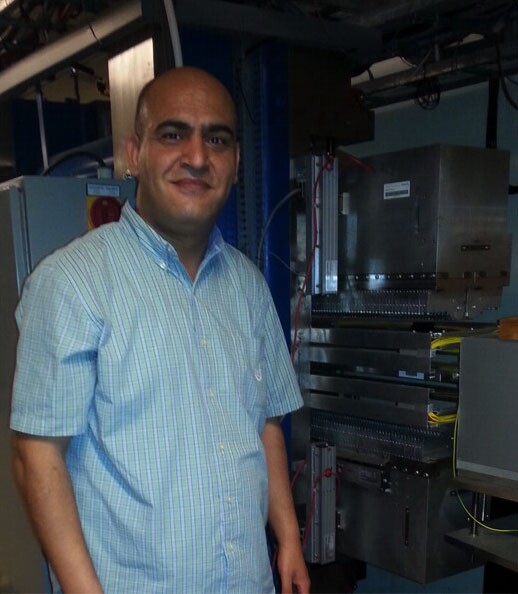
Hamed Tarawneh. CREDIT: Andreas Thiel
Tarawneh attended the workshop, and ended up being selected for a training program in synchrotron and accelerator physics. He went to Sweden’s MAX-lab, a national facility hosted by Lund University, and stayed on to do his PhD there. He then returned to Jordan, where for five years he worked on SESAME. That stint was followed by a couple of years at the Advanced Light Source at Lawrence Berkeley National Laboratory before he rejoined MAX-lab in 2014. There, he is in charge of insertion devices for MAX IV, the world’s first fourth-generation light source, which is on target to start the commissioning phase late this summer and open for users in June 2016.
In a phone call last month, Tarawneh told Physics Today‘s Toni Feder about his career path.
PT: How did you hear about SESAME?
TARAWNEH: At the time, I was looking into opportunities to study in Europe or the US. I was looking for fellowships. I was a member of IEE [the UK’s Institution of Electrical Engineers, now part of the Institution of Engineering and Technology]. I heard about SESAME from one of the proceedings.
The idea of SESAME is based on the CERN model. The Middle East is a troubled region, so this project was thought of as, “let’s get rid of the politics, let’s do the science. A tool to bridge the gap between people.” On a personal level the idea of SESAME was fascinating for me. I liked the idea very much.
I attended a two-week workshop in Jordan that was organized by Herman Winick from Stanford and Gustav Voss from Hamburg. I think there were 40 people from potential member states for SESAME. The idea was to select a few candidates to join the training program in European and American labs. I was among the ones who were selected.
PT: And the training program set you on the path to becoming an accelerator physicist?
TARAWNEH: Yes. In 2001 I went to MAX-lab in Sweden. After I finished my training, after five months, there was a chance to join the lab for PhD studies in accelerator physics with Mikael Eriksson. I worked on the first conceptual design for the accelerator lattice—when I say lattice, I mean how to arrange the different magnetic elements to produce a low-emittance synchrotron light source. It was a theoretical study on the design for MAX IV. We even did the first prototype of the MAX IV bending magnets.
PT: Were the calculations for implementing multibend achromats?
TARAWNEH: Yes. The principle is that we use many bending magnets within one arc to bring down the beam dispersion. The idea is to deliver low emittance. This will be translated into high brightness. MAX IV is the first fourth-generation light source. Many labs around the world are now copying the idea. [See the story in Physics Today, June 2015, page 21.]
PT: You finished your PhD in 2006. What did you do next?
TARAWNEH: I went back to Jordan and spent maybe five years at SESAME. I worked on the design for the magnet system, for the storage ring, and on beam dynamics. But at that time there were problems with funding. There were a lot of delays, so I decided I needed to look into my own career.
I moved to Berkeley to work on the Advanced Light Source. Before I finished the three-year research scientist position, this position at MAX IV opened, and I thought this was the place to be. So, I went from Jordan to Sweden to Jordan to the US and back to Sweden.
When MAX IV got funding in 2009 I was not here. But for me, career-wise, it was the main driver to move to Lund. This is the place to be.
PT: As an aside, how are things at SESAME now?
TARAWNEH: Two years ago they got funds from the European Union to build the magnet system through CERN, and they also get money from member states to build other parts. They have started producing prototypes for the vacuum system, the magnet system. Installation may start next year, and it will probably be delivering light in two years’, three years’ time.
PT: What is your role at MAX IV?
TARAWNEH: I take care of the physics part of insertion devices. I am concerned with the magnetic design and commissioning.
PT: What are the biggest challenges?
TARAWNEH: We are working on 14 beam lines. That means 14 insertion devices, 14 projects running at the same time—following up on the physics, making sure we are not missing anything. At the end of the day you need things that will fit your machine and deliver the expected performance. Also, for me, preparing the commissioning plan. We start commissioning the ring in August of this year, and commissioning the first insertion devices in spring next year. That’s a lot of work.
I am also, of course, looking into future options. What kind of technology for future devices? Superconducting magnets? Permanent magnets? In vacuum? Out of vacuum? It’s a huge parameter space.
PT: Do you like living in Sweden?
TARAWNEH: Yes. Life is not only about career. My two kids are in international schools here. My wife has learned Swedish and is looking for a job. It’s tiny things here and there, a combination, that make life more relaxed here in Lund.
PT: Where do you see yourself in five years?
TARAWNEH: I will be at MAX IV. I have a lot to do here. I expect exciting times and challenges.