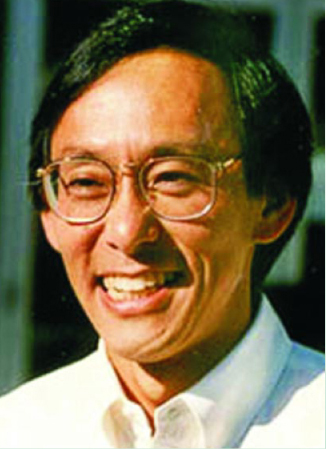
Chu Named Berkeley Lab Director
DOI: 10.1063/1.1801864

“My father wanted me to be an architect. He said the competition in physics was too strong,” recalls Steven Chu, who, of course, went on to win a Nobel Prize in Physics. On 1 August, Chu took the helm of the Department of Energy’s Lawrence Berkeley National Laboratory, succeeding Charles Shank, who served for 15 years.
Despite stepping down, Shank says he will work with Chu on the immediate task facing LBNL: preparing a bid for the University of California to retain the management contract for the lab. UC has run LBNL since the lab’s creation in 1931. But largely because of security breaches at DOE’s weapons labs in Los Alamos and Livermore, it’s anticipated that DOE will, for the first time, open the LBNL management contract for bids. At a press conference announcing Chu’s appointment, UC President Robert Dynes said, “We will go into this potential competition with all resources ablazing.” Although “nothing in this world is bullet proof,” he added, the prestige and visibility that UC gains from Chu’s being a Nobel laureate “puts us in a very strong position.”
Coming to LBNL is a homecoming of sorts for Chu. He did graduate and postdoctoral research at UC Berkeley. He then spent nine years at Bell Labs—overlapping with both Dynes and Shank—before joining Stanford University’s physics department, where he had been since 1987.
Among the subfields represented at LBNL are computing, nanoscience, biophysics, Earth sciences, and cosmology. The lab has a workforce of about 4000, and its annual budget is $521 million.
Chu says he was attracted to the LBNL top job because “it’s a great lab. And it has a lot of pieces that I have a personal scientific interest in. I hope I can make a difference in really getting these pieces to work closely together. Opportunities like this don’t come along all that often.” He shared the 1997 Nobel Prize with Claude Cohen-Tannoudji and William Phillips for cooling and trapping atoms with lasers. These days, Chu’s research is mainly in biophysics.

Chu
LBNL

More about the authors
Toni Feder, tfeder@aip.org