Bonanza for Selected Science in Ireland
DOI: 10.1063/1.1480773

“Everything is benefiting. Institutions are benefiting. Morale is benefiting. And we are confident that the economy will benefit,” says Ireland’s Minister for Science, Technology and Commerce Noel Treacy, referring to Science Foundation Ireland, a new funding agency that by 2006 will dish out 635 million euros (about $560 million) for information and communications technology and biotechnology. The SFI money is the largest single chunk from a €2.5 billion program, Ireland’s biggest-ever investment in research and education.
Attracting world-class scientists to Ireland and building up niche areas of science to be internationally competitive are key goals of SFI. The overarching aim, however, is to transform the economic success that made SFI possible—the Celtic tiger has been growing at nearly 10% a year—into long-term economic robustness. “We have a fantastically strong and happy group of blue-chip multinationals,” says Edward Walsh, chairman of the Irish Council for Science, Technology and Innovation and a member of SFI’s advisory board. “But for the most part, they are not doing research. It’s manufacturing. That’s unstable if you look 10 to 20 years ahead. Intellectual infrastructure is now the target.”
Even with its emphasis on the economy, SFI is a boon to fundamental research. “We will fund the science that underpins biotechnology and information and communications technology,” says agency Director General William Harris, himself a recruit from the US, where, in the early 1990s, he headed NSF’s physical sciences directorate. “We are trying to borrow good ideas from NSF. The openness, competition, things like that,” says Harris. “But we are smaller and we want to be more flexible than NSF can be, and faster in terms of decision making.”
Research payoffs
“SFI represents an interesting challenge,” says John Pethica, who, as one of the 11 scientists awarded up to €6.5 million each over five years in the first batch of SFI grants, is moving his work in nanomechanics and tribology from Oxford University to Trinity College Dublin. “The structure of research facilities [in Ireland] has until now been fairly primitive. This is a tremendous opportunity to really shape things. We are not tied by traditional rules.”
“It’s support of a type we have never had before,” adds SFI awardee Michael Coey, a physicist at Trinity who specializes in spin electronics. “For the past 20 years, I’ve supported my research on outside money, mostly from the European Union, and it was mainly applied. SFI changes the climate. It gives more room for basic research.” Still, he adds, “don’t bet on that lasting. At the end of five years, we have to show we have done something significant.”
“We want people to make the connection between the research they propose and the payoff for biotechnology and ICT,” says Alastair Glass, who oversees information and communications technology for SFI. The hope is that the new research money will catalyze companies to set down R&D roots, stimulating the economy and creating jobs. Says Treacy, “For the past century, we’ve been exporting our best and brightest to foreign shores. We feel we should be able to absorb our own people.”
Seven of the eleven initial awards went to researchers in physics or a related field, mostly nanoscience. About half of the awardees were already in Ireland, and the rest are moving from the US or UK.
The next SFI competition will again aim to attract top-notch scientists from abroad. But in February SFI decided to flesh out its programs, and the new round of awards adds funding for researchers in Ireland, as well as for visitors, conferences, workshops, and interdisciplinary centers.
Strains of success
While information and communications technology and biotechnology are the clear winners in Ireland’s spending spree, money for research has risen across all fields, including the humanities. Non-SFI science funding for new projects, for example, doubled to €6 million this year. “SFI is building two narrow spikes of excellence on a foundation,” says Walsh. The expansion of SFI programs, adds Brian Harvey, vice president of research at University College Cork, “has dispelled the initial disquiet that SFI was very narrow and that they were focused on bringing in outside talent rather than funding researchers here.” Still, fields such as astrophysics and zoology fall outside SFI’s range, Harvey says, “and we need to be vigilant about supporting excellent researchers even if they are not in mainstream areas—to offer tenure and retain them.”
Not surprisingly, the sudden influx of money puts a strain on universities, which not only have to cope with jealousies arising from the focus on two niche fields, but also have to find space and money for new people. With an additional €605 million from the government for bricks and mortar, the biggest challenge for universities is to offer permanent positions and pay internationally competitive salaries to newcomers.
“We are putting down metrics to measure our progress,” says SFI’s Glass. “One is the people we attract. Another is the number of postgraduate students here. We want the rest of the world to say, Wow! What’s happening in Ireland?”

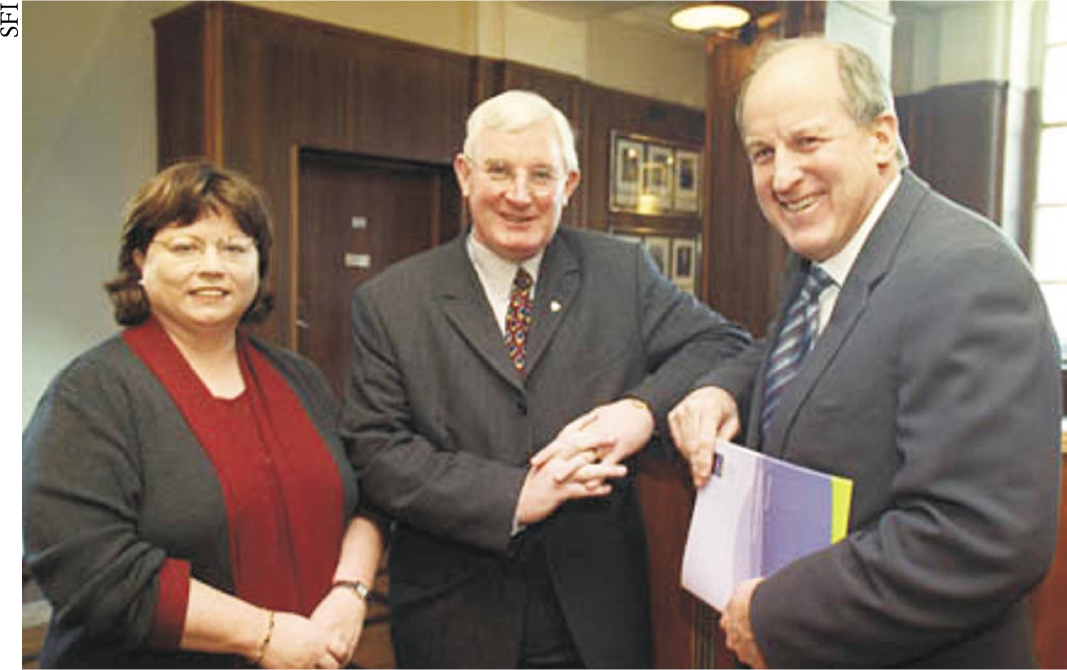
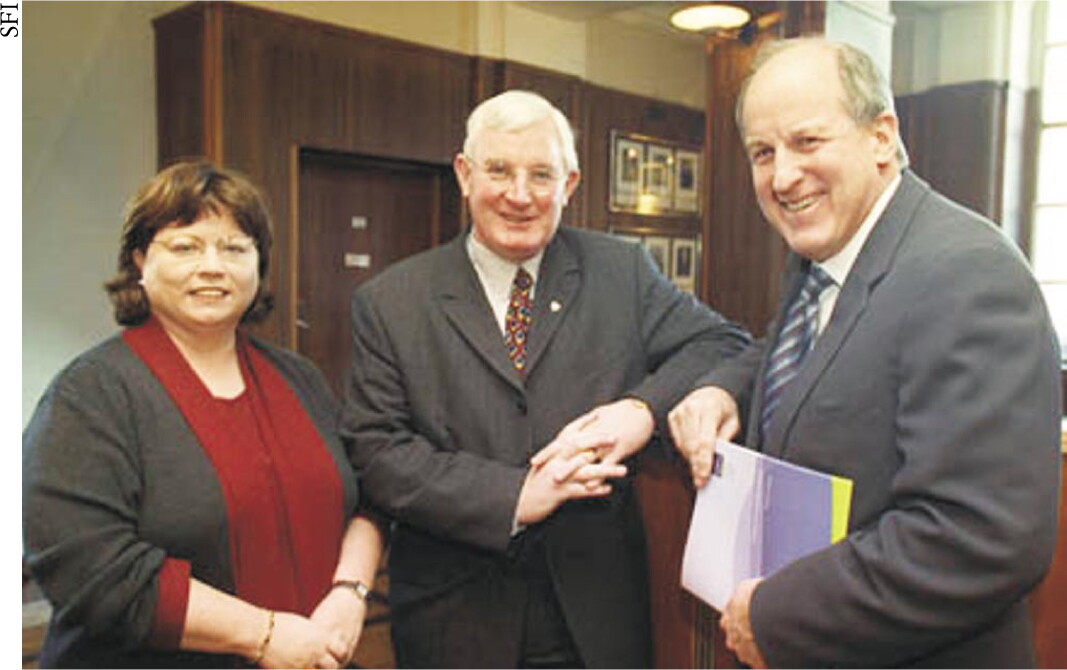
“I’ve never seen politicians that I’ve enjoyed working with more,” says Science Foundation Ireland’s Director General William Harris (right), shown here with Ireland’s Minister for Enterprise, Trade and Employment Mary Harney and Minister for Science, Technology and Commerce Noel Treacy.
More about the authors
Toni Feder, tfeder@aip.org