Baseball rubbing mud does, in fact, make balls grippier
DOI: 10.1063/pt.uvay.aulk


(Image by HeungSoon/Pixabay)

Before the first pitch of any US professional baseball game, each team’s equipment manager applies mud to balls so that they’re less slick and easier to grip. To keep competition fair, every team, for decades, has used one brand: Lena Blackburne Baseball Rubbing Mud. Despite efforts to develop other treatments, none offer the same consistency without damaging the baseballs or making them too difficult to hit. (See “The physics of baseball’s sticky situation ,” Physics Today online, 8 July 2021.)
Douglas Jerolmack (University of Pennsylvania) first got interested in the mud in 2019, when a sports reporter emailed him requesting some scientific analyses. He and his group did a few simple tests over two weeks. “Then we put it on a shelf,” says Jerolmack, “until Shravan [Pradeep] came along and reignited the project because of his capabilities and his interest.”
Pradeep, a postdoc who joined the group in 2021, has a background in the study of flow behaviors of dense suspensions. After imaging the mudded baseballs and designing an experimental apparatus to analyze them, Pradeep, Jerolmack, and colleagues found that the mud’s specific composition and flow properties give it the ideal characteristics for increasing the friction of a baseball’s surface.
X-ray spectroscopy and x-ray diffraction revealed that the mud is composed of roughly equal parts clay and a silt–sand mixture. That composition is, by and large, similar to natural muds. But the baseball mud has a weird, unnaturally sharp upper limit in grain size: Almost no grains are larger than 169 µm, which could explain why the rubbing mud feels so smooth to the touch. The flow tests show how the mud coats the ball’s surface. Rubbing applies shear stresses that deform the mud so that its viscosity decreases, making it flow like a liquid. Once dry, it forms a metastable solid that’s easy to grip.

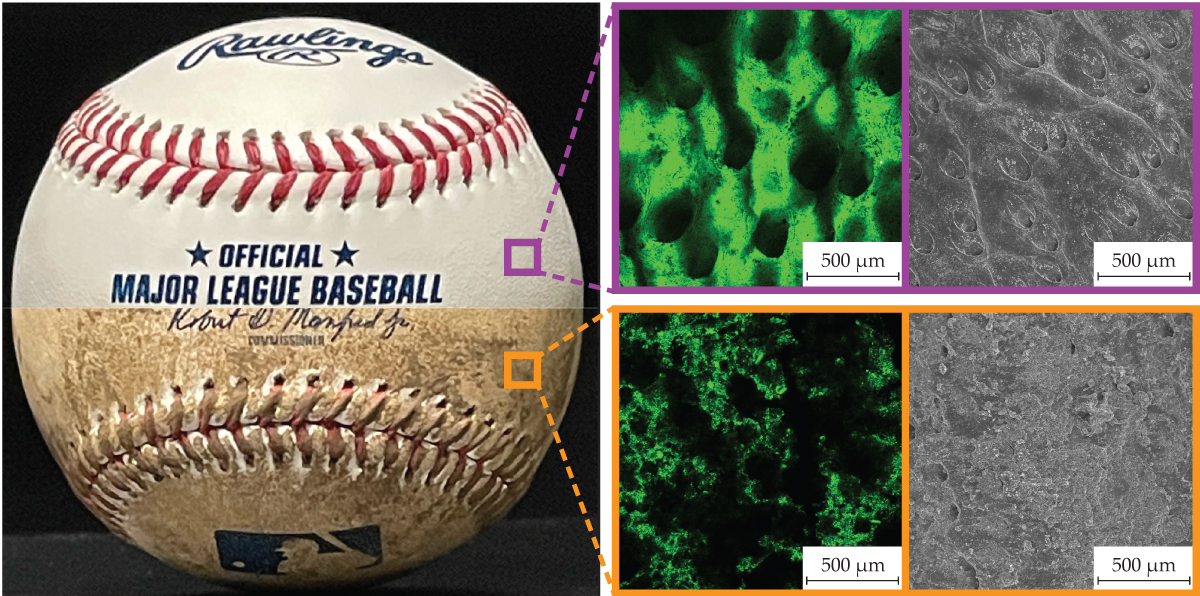
A baseball’s surface, when rubbed with a unique mud, is easy for players to grip. The mud’s mixture of clay, silt, and sand results in a more uniform microscale surface that’s free of holes and with enough adhesion to increase the surface’s friction. (Image adapted from S. Pradeep et al., Proc. Natl. Acad. Sci. USA 121, e2413514121, 2024.)

The changed surface is apparent in microscale images—the researchers took the ones shown here with confocal laser scanning microscopy (green) and scanning electron microscopy (gray). A clean baseball’s surface is pockmarked with holes hundreds of micrometers long and wide and dozens of micrometers deep. When the mud is applied, the holes are filled uniformly with adhesive clay aggregates and silt, while sand particles stick to the ball and create a surface with higher friction.
The mud is collected from a riverbank in New Jersey, but the exact location is a closely guarded secret, as is the processing and screening that’s done before the mud is sold. From the analyses done so far, the researchers speculate that the Lena Blackburne company processes the raw material to remove the largest grains and adjusts the water content for maximum shear-thinning behavior. But the researchers won’t be making their own mud anytime soon. “We know how the mud works, but we don’t know why,” says Jerolmack. “Earth makes complicated materials, and it would be nontrivial to mix together all the right compounds in just the right proportions.” (S. Pradeep et al., Proc. Natl. Acad. Sci. USA 121, e2413514121, 2024 .)
This article was originally published online on 15 November 2024.
More about the authors
Alex Lopatka, alopatka@aip.org