All-male physics faculties don’t prove hiring bias
DOI: 10.1063/PT.3.2113

More than a third of all US college and university physics departments have no women on their faculty. Does that mean those departments are biased against women? No. Do departments that do have women on their faculty provide a better atmosphere for women? Not necessarily.
After hearing one too many times that physics departments with no female professors are unfriendly to women, Rachel Ivie and Susan White of the Statistical Research Center at the American Institute of Physics decided to test the assumption of hiring biases by crunching the numbers.
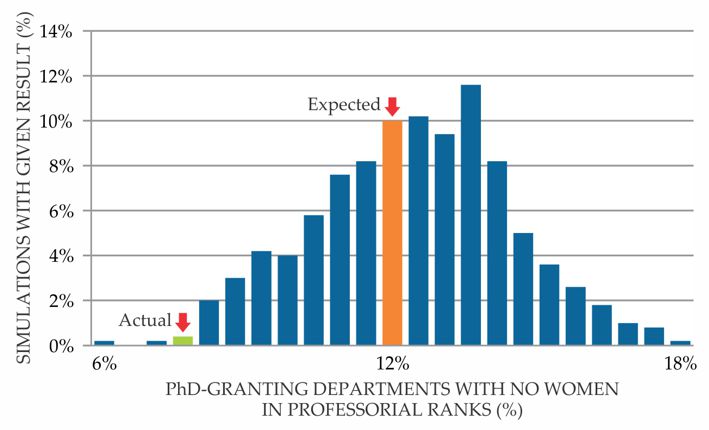
Using a binomial distribution, they simulated distributions of female faculty in physics departments. They considered department sizes representative of both bachelor’s-only and PhD-granting departments. The simulations use the actual proportion of women physics faculty members (13%) and explore statistical distributions across departments for higher representations, up to 50%. (The report, Number of Women in Physics Departments: A Simulation Analysis, can be downloaded from http://www.aip.org/statistics/trends/facultytrends.html .)
From the statistics, it should be no surprise that if you don’t have a lot of women in the pool and you have a lot of small departments, you will have a lot of all-male departments. In fact, for bachelor’s-only departments, the simulations match reality—47% of those departments are all-male. But significantly more PhD-granting departments have females than if faculty members were randomly distributed: In reality, 8% of departments have no women, whereas the simulation average is 12% (see figure). Says White, “Statistics can’t prove anything, but this does suggest to me that departments are trying to diversify.”

ADAPTED FROM AIP REPORT

Based purely on numbers, across all US physics departments there appears to be no systemic bias against hiring women, the study’s authors say. That doesn’t mean there aren’t biases in individual departments, notes Ivie. “Just because you have women doesn’t mean they are treated fairly. And just because a department is all male doesn’t mean they refuse to hire women or they treat them unfairly.” The discussion has long been focused on representation of women—for which physics still lags other science and engineering fields. But, says Ivie, “We now know that we need to start looking at things that are more difficult to measure than representation.” This fall, she says, the Statistical Research Center will start a survey to ask physics faculty about their experiences. (For results and interpretation related to gender equity from a broader global survey, see the article “Women in physics: A tale of limits” by Rachel Ivie and Casey Tesfaye, Physics Today, February 2012, page 47 .)
More about the authors
Toni Feder, tfeder@aip.org