A shaken lattice of ultracold atoms can simulate extreme quantum chaos

To understand the quantum chaos of many-body systems, researchers in recent years have turned to the Sachdev-Ye-Kitaev (SYK) model. Named after theorists Subir Sachdev, Jinwu Ye, and Alexei Kitaev, the model can be used to study diverse research areas, such as how information is destroyed inside a black hole and the behavior of high-temperature superconductors just above the superconducting transition. But realizing it with a practical experimental setup is challenging. Charles Creffield (Complutense University of Madrid), Nathan Goldman (Université Libre de Bruxelles and Collège de France), and colleagues have now offered one solution to that problem: They demonstrate that key characteristics of the SYK model can be simulated by shaking ultracold atoms in a 1D optical lattice. 1 Although the work was conducted using computer simulations, the researchers say it can be realized experimentally using existing cold-atom technologies.
Proposed in the early 1990s and refined in 2015, the SYK model has captured the attention of researchers because of how it describes collective behavior between particles that interact with all the other particles in the system with random coupling strengths. The interactions result in an excitation spectrum that is extremely dense at low energies and can be solved directly. Those characteristics make the SYK model an attractive tool for studying extreme many-body quantum chaos systems that exhibit fast rates of information scrambling via rapidly decaying correlations between particles.

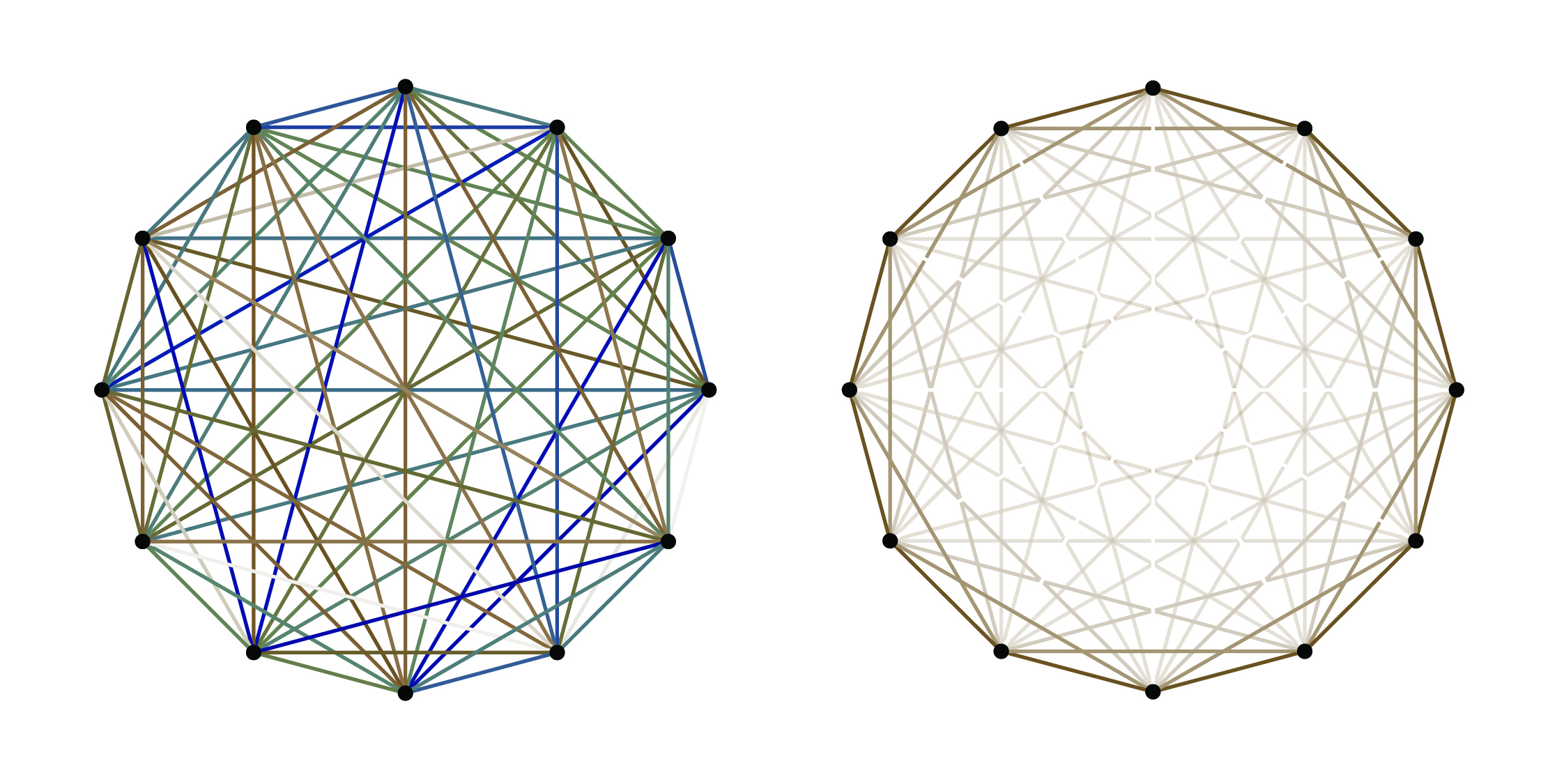
In the Sachdev-Ye-Kitaev (SYK) model of extreme many-body quantum-chaos (left), each particle couples randomly to all the others. Charles Creffield and colleagues have shown how periodically shaking an optical lattice (right) can generate quasi-random long-range couplings. Although the interactions are weaker (indicated by the lower-opacity lines) for particles that are farther apart, the resulting behavior captures many important features of the SYK model.
(Image adapted from ref. 1 .)

The researchers found they could trigger the same type of collective behavior between particles by shaking ultracold atoms in an optical lattice roughly 1000 times per second. Atoms in an optical lattice can typically hop between adjacent lattice sites and repel each other when on the same site. But shaking the lattice suppresses the hopping of individual atoms, and they instead interact—with nearly random coupling amplitudes—with all the others in the lattice. Through numerical simulations, the team found that periodically shaking the lattice re-created key characteristics of the SYK model, including fast information scrambling. The lattice model, however, could not re-create the truly random interparticle interactions that are in the idealized SYK model, Creffield says. Instead, as illustrated in the figure , the shaking generates quasi-random interactions that are weaker for particles farther apart on the lattice.
Goldman says that in practice, shaking could be created by moving a mirror back and forth to modulate the position of a laser used in creating the lattice. Although such a kinetic approach should work for both fermions and bosons, the researchers focused on bosons—the boson SYK model has been less explored than the fermion model. The boson implementation may be more accessible for future experimental work because the particles are relatively easy to cool down.
Among the next priorities for the team are extending the approach to higher-dimension lattices and investigating the equivalent fermion model. Although lattice-shaking experiments are possible with existing technology, researchers will need to develop methods to extract data from the experiments to validate their accuracy as SYK analogues. Such advances could provide a practical path to better understanding quantum chaos in a variety of astrophysical and condensed-matter contexts.
Reference
1. C. Creffield et al., “Sachdev-Ye-Kitaev physics from the Hubbard model: A Floquet-engineering approach ,” Phys. Rev. Lett. 137, 046302 (2026).