A quasicrystal engulfs obstacles to grow without defects

“Quasicrystals have always fascinated me,” says Ashwin Shahani of the University of Michigan, “because they break the usual rules.” Like regular crystals, quasicrystals have ordered structures, but the structures are nonperiodic. At least two unit cells arranged repeatedly in space without any overlaps or gaps are required to form a quasicrystalline structure. Dan Shechtman’s 1982 discovery of quasicrystals was initially met with disbelief by crystallographers. (For more on the finding, see PT’s 2011 story “Nobel Prize in Chemistry honors the discovery of quasicrystals .”)
One defining feature of quasicrystals is that they have symmetries that regular crystals don’t. The crystallographic restriction theorem states that crystals look the same after being rotated a certain angle. (A rectangle, for example, looks the same when it’s rotated 180°, so it has 360°/180° = 2-fold rotation symmetry.) For regular crystals, the allowed values are 2-, 3-, 4-, or 6-fold rotation symmetries. But quasicrystals exist with 5-fold and 10-fold rotation symmetries, which allow them to grow into different structures than crystals.
As crystals grow, disruptions in their lattices interrupt the periodic order of the structures. Such material defects can be responsible for grain boundaries and twinning, in which two or more crystals symmetrically share lattice points. Some evidence suggests that growing quasicrystals are immune to such disruptions. In 2021, a team including Shahani and Michigan colleague Sharon Glotzer found that even after two growing quasicrystals collided with each other and became misoriented, they rearranged their structures to form a single perfect quasicrystal. 1
Shahani’s and Glotzer’s research groups—which include Kelly Wang, now a data scientist at Rhombus Power; Domagoj Fijan, a research investigator at Michigan; and Insung Han, now a professor at Kyungpook National University in Daegu, South Korea—have recently demonstrated similar phenomena for a single quasicrystal with 10-fold symmetry that formed in a disruption-laden environment. It initially grows around noncrystalline obstacles in a molten alloy, deforms, and then re-forms without defects. 2
The defect-free growth is possible because of quasicrystals’ ability to subtly rearrange their structure. The new results are more than just a validation of that ability. That a 10-sided quasicrystal with 10-fold rotation symmetry can self-heal as it grows in nonpristine settings could make some quasicrystals appealing for various applications.
Unexpected pores
To study quasicrystals, researchers typically grow them in a lab. It’s a challenging task, mostly because thermodynamically stable forms are possible in only a handful of alloys. One of the most common ones to study is the aluminum-cobalt-nickel alloy Al79Co6Ni15.
The internal structures of the opaque samples of Al79Co6Ni15 can be observed nondestructively only with high-energy x rays produced at synchrotrons. After a sample has solidified, some basic features of quasicrystalline growth can be recovered, but detailed observations of real-time growth are impossible once the quasicrystal has formed. X-ray radiography measures some of the dynamics of quasicrystals as they grow in a liquid, but the method provides only 2D observations with limited precision.
Figure 1.

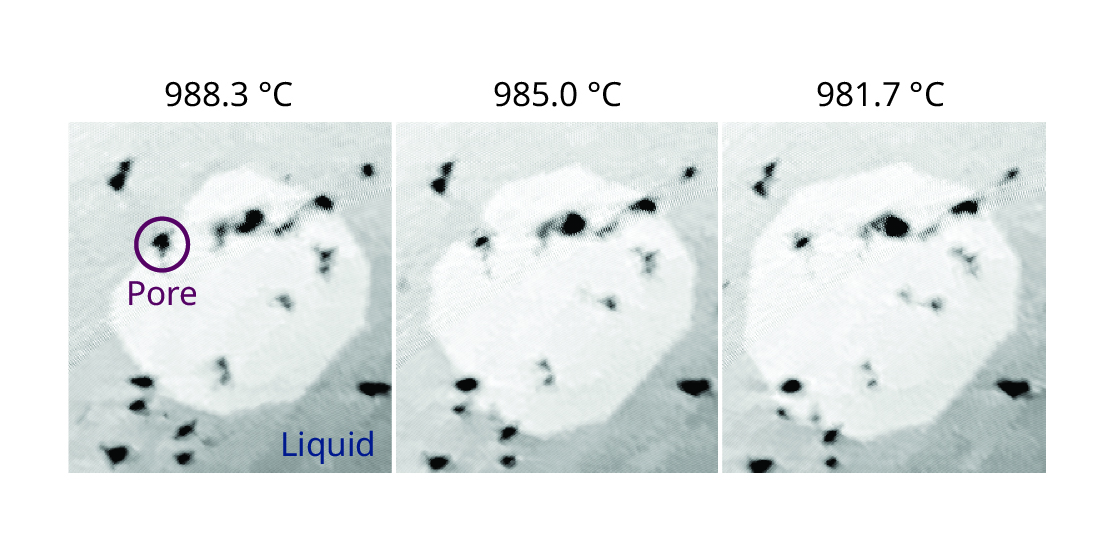
A quasicrystal grows defect-free. As a 150-µm-wide, 10-sided quasicrystal (white) cools and solidifies from an aluminum-cobalt-nickel liquid alloy over a few minutes, it encounters shrinkage pores (black specks). The obstacles initially distort the shape of the quasicrystal. But because of its ability to rearrange its lattice points while preserving the ordered structure, the quasicrystal forms without defects.
(Images courtesy of Insung Han and Ashwin Shahani.)

In the 2010s, developments in beamline optics, high-speed detectors, and reconstruction algorithms provided quasicrystal researchers with a new capability: real-time 3D x-ray tomography. The technique involves rotating a sample and collecting numerous 2D images over a short period of time. The images are then processed together to create a 3D reconstruction. Using the technology in 2019, Han, Shahani, and colleagues published 3D observations of quasicrystals’ growth. 3
For the most recent study, the goal was to better observe the growth of quasicrystals from a liquid alloy. Initial observations, however, showed something unexpected: air pockets in the molten liquid. During solidification, as the viscous liquid-metal alloy reduced in volume, voids, also called shrinkage pores, formed. The emergence of the pores provided the researchers with an opportunity to study what happens when a growing quasicrystal encounters such obstacles.
Figure 1 shows three snapshots, taken at the Advanced Photon Source at Argonne National Laboratory in Lemont, Illinois, of a quasicrystal as it solidifies from the liquid Al79Co6Ni15 alloy. As the growth front at the solid–liquid interface encounters a shrinkage pore, the crystal face initially distorts. But within a few minutes, the quasicrystal engulfs the defect and returns to its pristine, 10-sided morphology.
When a quasicrystal’s growth front encounters a defect—whether that’s a grain boundary, a pore, or some other obstacle—the entire structure becomes strained. The strain to a crystal’s structure often leads to irreparable defects. But for a quasicrystal, the strain can be relieved through complex rearrangements of the material’s particles. The rearrangements, known as phasons, are unique to quasicrystals and arise from their 5-fold, 10-fold, and other unusual symmetries. The phasons enable the quasicrystals observed by the research team to adjust to and engulf the defect yet still preserve the quasicrystals’ long-range positional order and structure.
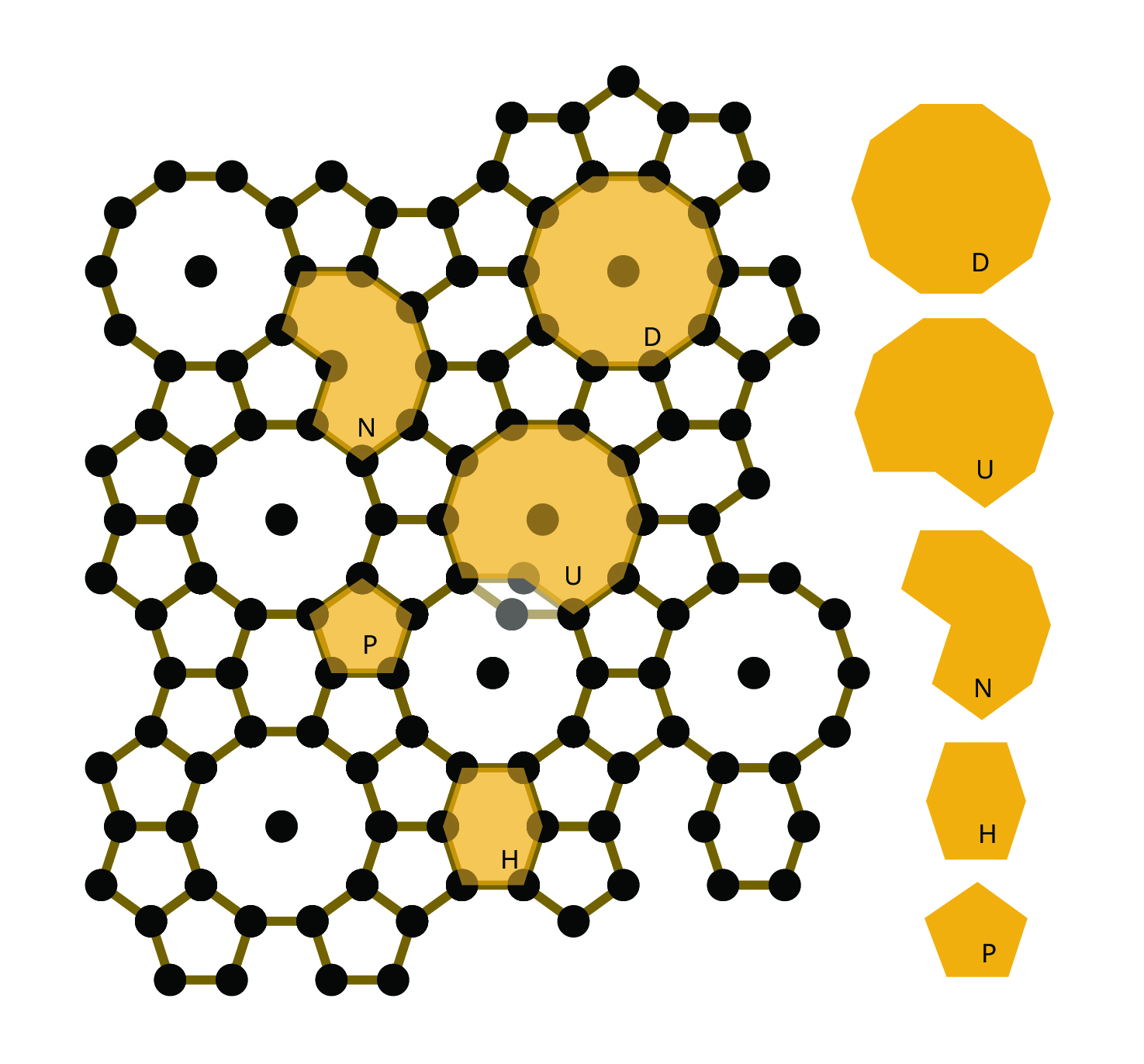
The thorny mathematics behind phasons describes quasicrystals as 3D nonperiodic projections that arise from higher-dimensional periodic lattices. 4 A phason displacement of a lattice point is illustrated in a simplified way in figure 2 .
Return to order
To better understand the phason repair mechanism, Wang and Fijan conducted molecular dynamics simulations of quasicrystal growth. When studying crystals, glasses, and many other systems, researchers often use box models with periodic boundaries: If a particle moves out of the simulation box on one side, for example, it comes back on the other side.
For the new research, the simulations modeled the growth of both a quasicrystal and a common body-centered cubic crystal around a shrinkage pore. To suppress artifacts from periodic boundary conditions, a liquid-like phase was added to the edges of the simulation box and prevented unwanted boundary interactions with the quasicrystal.
Figure 2.

Quasicrystals have a nonperiodic ordered structure—in this 2D case, it’s made with five tiling shapes—that fills a space without gaps. If the gray lattice point is displaced downward from its original position, the labeled U tile becomes a D tile, and the D tile below it becomes a U tile. That switch, known as a phason flip, preserves the ordered structure. Phason flips relax the strain that’s induced when the growth front of a quasicrystal collides with an obstacle and allow the quasicrystal to grow without defects.
(Illustration courtesy of Domagoj Fijan.)

The simulations included about 5 million particles—other crystal simulations typically have on the order of thousands of particles. On top of that challenge, the researchers had to run several hundred simulations on a supercomputer to understand the statistics of the dynamic system. “I think that’s why people generally don’t do this sort of simulation,” says Wang. “It’s not that it’s impossible. I think there’s just easier things to do with your time.”
The simulations quantified a series of parameters that describe the degree of order in the material structure. In the quasicrystal case, the calculated order parameters initially decreased after the growth front collided with and engulfed the pore. Then they increased over time and returned to their precollision values. The increase is consistent with quasicrystals’ capability of structural rearrangement. Once the common crystal encountered the pore, however, the order parameters decreased and never recovered.
Beyond validating theoretical models, the new simulation and experimental results suggest that quasicrystals could be incorporated into materials to make them tolerant of defects. The durability and low friction of quasicrystals have made them possible candidates for nonstick coatings and other surface treatments. Because of their unique structural properties and their capacity for growing defect-free, quasicrystals may have other potential applications too. Some research has examined their use as reinforcements in metal composites and polymer materials. 5
References
1. I. Han et al., “Formation of a single quasicrystal upon collision of multiple grains ,” Nat. Commun. 12, 5790 (2021).
2. K. L. Wang et al., “Defect-free growth of decagonal quasicrystals around obstacles ,” Phys. Rev. Lett. 135, 166203 (2025).
3. I. Han et al., “A side-by-side comparison of the solidification dynamics of quasicrystalline and approximant phases in the Al–Co–Ni system ,” Acta Cryst. A 75, 281 (2019).
4. C. Janot, Quasicrystals: A Primer, 2nd ed., Oxford U. Press (2012).
5. W. Wolf et al., “Recent developments on fabrication of Al‐matrix composites reinforced with quasicrystals: From metastable to conventional processing ,” J. Mater. Res. 36, 281 (2021).