A FAIR deal: Member countries break impasse on stalled antiproton and ion research center
DOI: 10.1063/PT.3.2975

The nine partner nations in the Facility for Antiproton and Ion Research (FAIR) agreed at a 29 September council meeting to go forward with the project, at a cost approaching €1.7 billion (nearly $2 billion). “The mood is good,” says scientific managing director Boris Sharkov. “The period of turbulence is over.” Construction on FAIR in Darmstadt, Germany, is expected to restart next year. Data taking is scheduled to begin in 2022, and the facility is set to be completed by 2025.

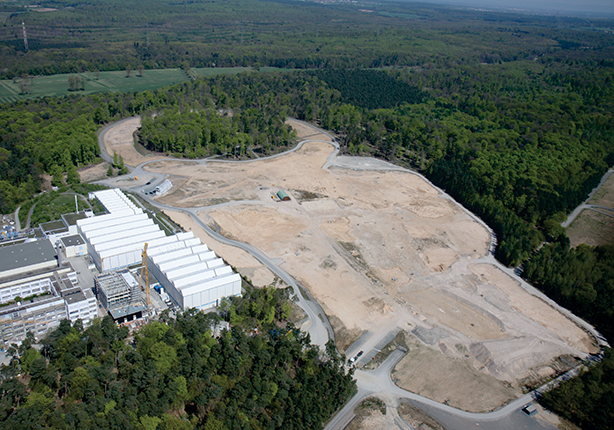
Construction will soon resume on the Facility for Antiproton and Ion Research in Darmstadt, Germany. The buildings on the left are the existing GSI Helmholtz Centre for Heavy Ion Research and the cleared area outlines the future FAIR grounds. The heart of FAIR, a ring 1100 m in circumference, will be at the back circle; the site will also have 4-km-long high-energy beam transport lines, additional storage rings, and experimental setups. Not visible are 1350 posts extending down 60 m that will support the buildings.
TILL MIDDELHAUVE, FAIR

A multi-purpose, multi-ring accelerator center, FAIR will produce heavy ions, exotic nuclei, and antiprotons. It builds on the GSI Helmholtz Centre for Heavy Ion Research, whose accelerator will be upgraded and used as an injector for FAIR. (For more on the GSI, see the story on page 12 .) The new facility will produce a wider range of ions at higher energies than the GSI, with intensities up to four orders of magnitude higher. The antiprotons will be a new feature and, with beam energies up to 15 GeV, will be “absolutely unique worldwide,” says Sharkov. The scientific program is split into four groups, or “pillars,” that examine wide-ranging extremes of fundamental matter: NUSTAR (nuclear structure, astrophysics, and reactions), APPA (atomic, plasma physics, and applications), CBM (compressed baryonic matter), and PANDA (antiproton annihilation in Darmstadt).
As host, Germany is the largest shareholder, paying 70% of the construction costs; the next largest contributor is Russia, with 18%. The other partners are India, Sweden, Finland, Poland, Romania, Slovenia, and France; the UK is an associate partner.
The project has been in the works for more than a decade. In 2010, the member countries signed on to the so-called Modularized Start Version (MSV), a pared-down version of the original FAIR vision. At the time, the start date for experiments was 2018 and the cost was estimated at about €1 billion (project accounting is done in 2005 euros; today, that’s roughly €1.3 billion).
But by late last year, it was clear that the project was significantly behind schedule and over budget. Germany’s Federal Ministry of Education and Research called for a review and the project came to a halt. Chaired by CERN director general Rolf Heuer, the review, released in February, recommended that the management structures of FAIR and the GSI merge; that process has begun, but for now the two are still formally separate entities.
The Heuer review also ranked FAIR’s four science pillars, putting NUSTAR and APPA at the top, CBM next, and PANDA at the bottom. Despite “unique capabilities,” the delay of the FAIR facility means “a substantial part of the [PANDA] discovery potential … for new resonances and exotic states, will have been lost,” according to the review. That is, other facilities around the world will beat PANDA to results. “It’s unlucky that the cost of PANDA is close to the cost overrun,” Frank Maas of the GSI and the University of Mainz noted in early September.
PANDA-monium
Not surprisingly, PANDA scientists defend their experimental program and say it will still be relevant despite the delayed startup. Planned experiments at CERN and in the US, Japan, and China partially overlap with PANDA, says the pillar’s deputy spokesman, Diego Bettoni of Italy’s National Institute for Nuclear Physics (INFN). “But only PANDA will be able to carry out a precise, systematic study of the full spectrum of new particles. And it is unique in covering all three branches of hadron physics—spectroscopy, structure, and dynamics—in a single experiment.” PANDA offers a further advantage, he says: “The particle of interest is formed directly as a result of antiproton–proton annihilation, without accompanying particles.”
Because FAIR is an international project, with legally binding agreements among its partners, no one expected PANDA to be axed outright. Rather, scientists speculated that it would be put on ice without a clear timetable for going ahead. “A nonfixed schedule would be a slow death,” says Maas. “It would be worse than just ending it.” The worry was that funding would slow down and researchers would switch to other projects. Indeed, after the Heuer review came out, the INFN ceased awarding grants to PANDA-related research, and the German research ministry said it would not renew such grants for 2016.
Myriad factors contributed to FAIR’s cost overruns. Among them were an increase in the facility’s planning costs and in demands on fire and radiation safety in civil construction, which were tightened in the aftermath of the 2011 Fukushima nuclear disaster. Scientists also feared that pushing FAIR into a schedule that coincides with a planned upgrade to the Large Hadron Collider at CERN could overstretch budgets.
But some member countries have a strong interest in antiproton research. For example, more than a third of Russian participants in FAIR are involved in the PANDA collaboration, Sharkov says. “There was bottom-up pressure” to go forward with all four pillars. Pressure also came from around the world in the form of more than 70 letters from scientists—both FAIR participants and competitors—who wrote to the German research ministry in favor of keeping the full FAIR science program.
In the months leading up to the council meeting in late September—arranged specifically to resolve the impasse—many FAIR scientists were pessimistic about PANDA’s destiny. But ahead of the meeting there were “hard discussions,” says Sharkov. The countries signed on to a facility with four science pillars, he notes. “Any descoping would jeopardize the project.” Russia and others could consider reducing their contributions.
FAIR moves forward
The pressure and hard talks paid off. “The council confirmed the full MSV,” says Sharkov, “with all four research pillars to be realized. The council confirms this as the goal of the whole project.”
The council capped FAIR construction at just under €1.3 billion (in 2005 euros, or roughly €1.7 billion now). The members agreed to pay for the €250 million increase roughly according to their shares in the project. They will cover €160 million of that by the middle of next year and are committed to paying the remaining €90 million by 2019. “With this staged approach, it is possible to start construction without any further delay,” says Beatrix Vierkorn-Rudolph, an official in Germany’s research ministry. Going forward without having the full amount secured is recognized as a compromise on the part of the ministry. That compromise is what allows the science program to stay intact.
The ministry will also resume funding PANDA-related research. “This is a second nice outcome,” says Maas. “The universities rely on this for PhD students and postdocs. With that money frozen, you could kill the groups in half a year.” It was also surprising, he says, that there was so much fuss over an amount of money that is relatively small compared with the project’s total cost. “They found a good and reasonable compromise.”
Even so, Vierkorn-Rudolph cautions that the Heuer findings should not be ignored: “The PANDA community should not go forward as if nothing has happened. The ministry urges them to rethink what they would like to build, so that they still have the possibility in 2025 to do research which is unique and only possible at FAIR.”
More about the authors
Toni Feder, tfeder@aip.org