Putting a return to the Moon in perspective
DOI: 10.1063/pt.ypkw.dfwz
The article “Back to the Moon … to stay? ” by Michael J. Neufeld in the December 2023 issue of Physics Today (page 40) presents a great deal of information many people outside the science and technology communities should be aware of.

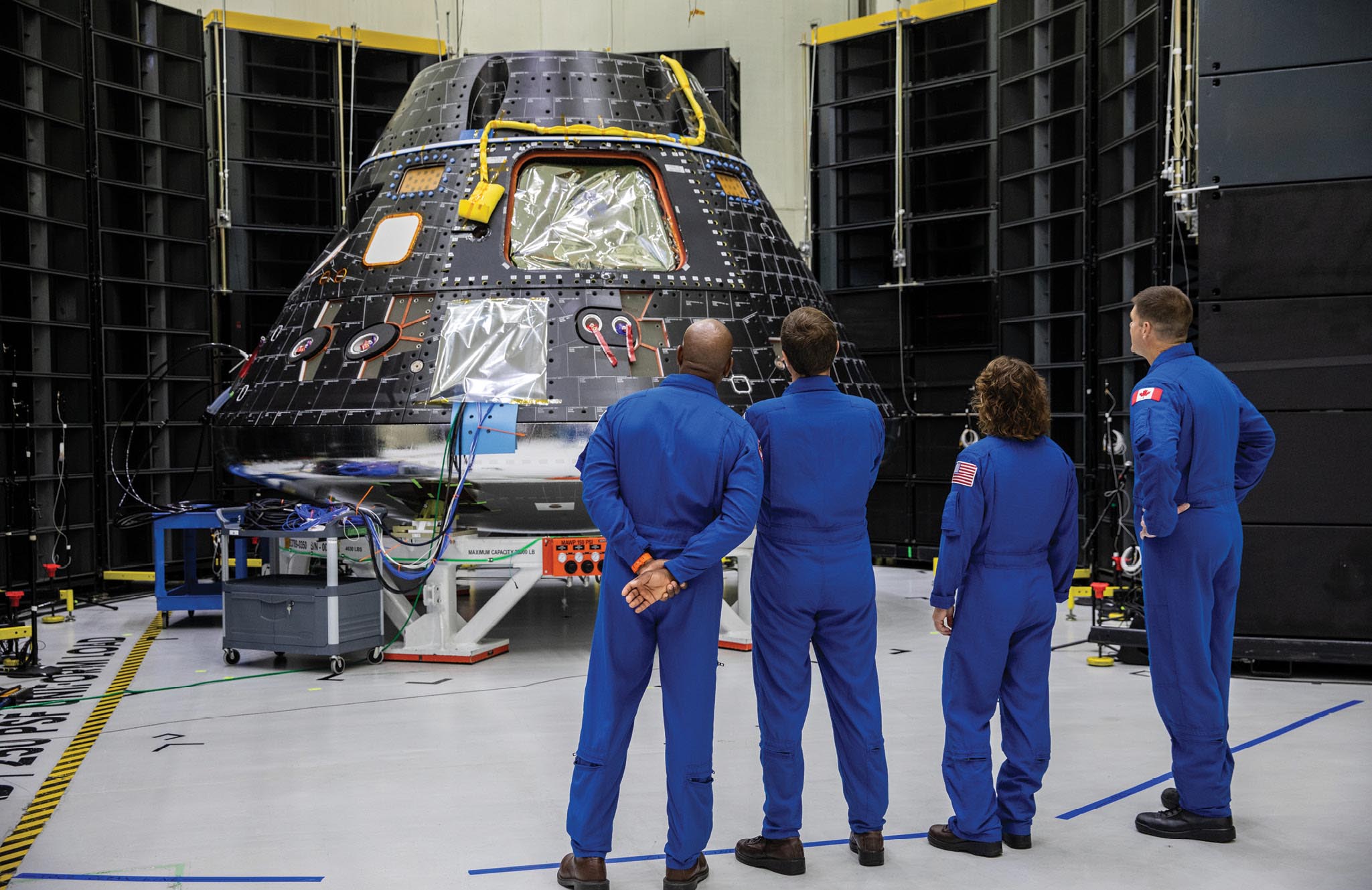
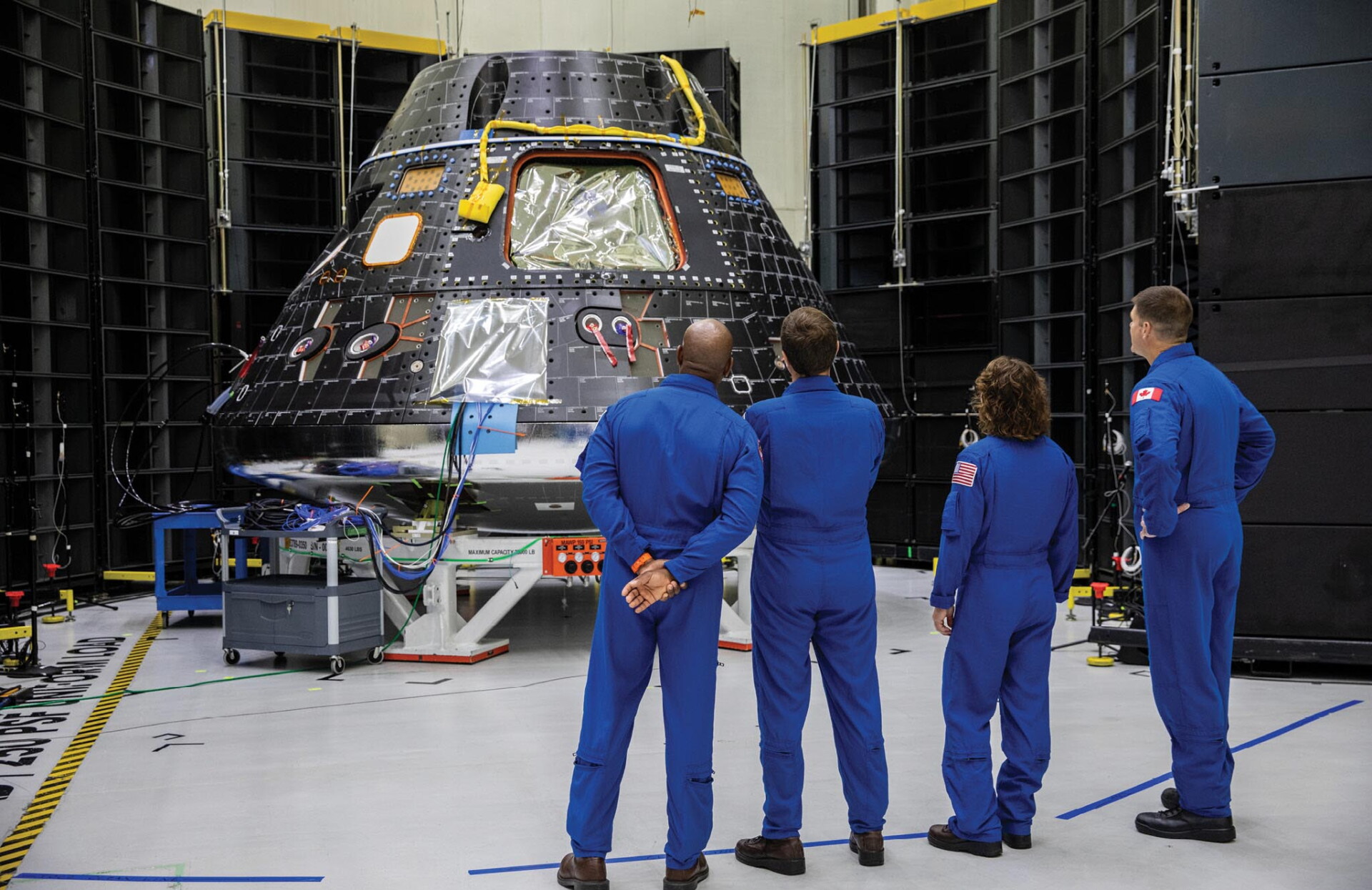
The crew of Artemis 2 at NASA’s Kennedy Space Center. The mission aims to take humans to the Moon for the first time in decades. (Courtesy of NASA/Kim Shiflett.)
Neufeld writes, “Public enthusiasm for sending astronauts to the Moon has remained weak—only 12% of respondents in a recent poll chose it as one of the ‘top priorities’ for NASA (monitoring asteroid threats got 60% and Earth’s climate 50%).” In my experience in doing public outreach about space exploration, I have found few people who can answer correctly when asked what the distance from Earth to the Moon is or how many people have spent time on our natural satellite. Those types of questions should be included in any poll on support for lunar exploration.
Included in Neufeld’s article is a histogram of NASA funding from 1958 through 2020 as a percentage of the federal budget. Note, though, that roughly every 10 days the US spends on national defense the equivalent of the NASA budget for the entire year. 1
Neufeld mentions those who have pushed for the use of robotic spacecraft because of the decreased costs and danger involved. But Steven Squyres, principal investigator for the science payload on the Mars rovers Spirit and Opportunity, commented in 2005, “What we have done with these rovers a really good pair of field geologists could have done in a long weekend.” 2
As Neufeld points out, there are challenges, such as the effects of harsh radiation and low gravity, that need to be overcome for humans to adapt to space. But solving challenges is what science and engineering is about. Neufeld concludes by writing, “We are going back to the Moon to stay, at least for a while—and maybe for the long term.” I look forward to gazing up at the Moon and knowing the names of the people who are living and working there.
References
1. USAspending.gov, “Spending explorer,” https://usaspending.gov/explorer .
2. S. Squyres, Roving Mars: Spirit, Opportunity, and the Exploration of the Red Planet, https://www.c-span.org/video/?188724-1/roving-mars-spirit-opportunity-exploration-red-planet (11 August 2005).
More about the authors
Frank Lock, (lockphys@gmail.com), Gainesville, Georgia.